Roanoke College seniors present at ASM conference

021

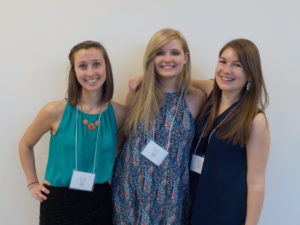
Pictured above from left to right: Sara Farthing, Kirsten Norman, Savannah Scott

The American Society for Microbiology (ASM) regional conferences are more intimate gatherings than the national conference where students and professors present their research projects and learn about others. Roanoke College students Savannah Scott, ’17, and Kirsten Norman, ’17, were two of the students who went to an ASM Virginia conference in November. Their research project was titled, “Development of Novel mcrA and pmoA qPCR Primers and Probe Targeting Methanogens and Methanotrophs in Cattle Farm Samples as a Method of Microbial Source Tracking”. They worked with Dr. Crozier to complete their research.


Both Savannah and Kirsten began the project over the summer.

Kirsten: “In the beginning of the summer we focused on researching more about methanogens and methanotrophs. Once we determined the genes we wanted to target, mcrA and pmoA, we moved on to the next step of primer and probe creation through the program Sequencher. Producing primers and probe allowed us to quantitatively analyze the amount of methanogens and methanotrophs in samples we acquired at the horse farm. What we hope to apply our research to in the future is microbial source tracking which allows one to track where contamination is coming from in bodies of water.”

Savannah really enjoyed working with Dr. Crozier to complete their project.

“My research adviser did a wonderful job in training me the first semester I started research. Then he took a hands-off approach once I figured out the direction of my project. This encouraged me to plan ahead, to learn how to think critically and to learn how to troubleshoot. If I was really stuck, however, he was always there to offer help and guidance.”

Both Savannah and Kirsten had a rewarding experience at the ASM conference

Savannah: “It was really exciting to be able to meet and talk to graduate students about their projects and how they got to where they are. I made many connections with graduate professors and got some insight into possibilities for future work in my field! Many of them offered great advice. Additionally, it was so fun to be in a room with people with the same interests!”

Kirsten: “It pushed me out of my comfort zone, but in a good way because it helped me gain confidence in presenting my research to people that have a lot of knowledge about the subject I am researching. It was inspiring to see what a wide range of people attending the conference including everything from undergraduate research students to graduate students in the progress of completing their Ph.D. Ultimately attending a conference such as this gives one a look into what life after undergraduate studies could look like.”

When asked about why they started and completed their research project, both Savannah and Kirsten saw it as a great experience for after graduation, but quickly grew to love the topic.

Savannah: “Shortly after beginning work in the lab, I realized a passion for microbiology. I continued my research fueled by ambition to find answers and natural curiosity about the subject itself and the techniques involved in microbiology research. I was encouraged by answers that lead to more questions, and the stubborn desire to know why. When the opportunity to present in a conference revealed itself, I was eager to present my findings to experts and professionals within the field I am working because of the insight they would be able to provide. I also knew it would be great experience for graduate school and my future career as a microbiologist.”

Kirsten: “I have a strong desire to pursue research post-graduation and that is what got me interested in performing research in the first place. Another reason as to why I have continued to participate in research is because of the interesting microorganisms we get to study in Crozier’s lab and just how well our lab works together in research.”

Summer Research Abroad: Stephanie Shields

img_7980

Stephanie Shields, ’17, is Psychology major and German minor with a concentration in Neuroscience. Over the summer she was able to travel abroad to Hamburg, Germany through an internship program called the German Academic Exchange Service Research Internship in Science and Engineering. She worked with Ph.D. student Signe Luisa Schneider to complete her project on electroencephalography (EEG), learning, and memory.

“She’s using electrophysiological and behavioral methods to examine differences in EEG patterns and memory between elderly subjects and a young comparison group. She’s also using a brain-computer interface to attempt to train elderly participants to alter their brain activity in the hopes of increasing the activity in certain frequency bands, which have been found to be associated with subsequent memory in prior studies. I helped to set up for, run, and clean up after EEG sessions. I also helped Signe preprocess EEG data, and after gaining more experience with the MATLAB computing environment and reading literature related to the methodology and research questions, I helped with data processing and analysis. I also conducted a literature search, which will hopefully help Signe as she completes the project and writes up the results for publication.”

Stephanie’s favorite moment was when she suggested an idea that would improve the quality of the data.

“I sat down with Signe to talk to her about our preprocessing script and was able to suggest an idea to her that improved the quality of data we ended up with after preprocessing it to remove artifacts. That step is essential in obtaining valid results, so being able to work with my supervisor on that problem and make a meaningful contribution to its solution was both exciting and rewarding.”

For anyone considering doing research, Stephanie recommends giving it a shot.

“Even if you think something may be a long shot and even if you’re worried that you don’t have all the skills or abilities you’ll need, go for it and see what happens. Do your best, and take every experience you have as an opportunity to learn and grow.”

Internship at Patuxent Environmental and Aquatic Research Lab

sam-waby

Samantha Waby performing a natural spawn

Samantha Waby is a senior majoring in Environmental Studies who interned at Patuxent Environmental and Aquatic Research Lab (PEARL) in Saint Leonard, Maryland in the summer of 2016. She worked in their oyster hatchery to complete her research and to learn certain processes in oyster hatcheries such as cleaning the tanks and spawning new oyster larvae. Sam’s research project was titled “A comparison of developmental and economical differences between two oyster larvae diets”.

“Many hatcheries feed their larvae with concentrated algae that comes in a bottle and is stored in a refrigerator. This mitigates the cost and unpredictability that comes with culturing microalgae in a lab, but there has been little research done on the performance of this concentrate in regards to what oyster larvae eat in the wild: live microalgae. There were two components to my project. The first compared the differences the two diets had on certain aspects of larval development (quantified by size and metamorphoses potential on day fourteen of life), and the second part of my project compared the difference in cost between feeding live versus concentrated algae”.

Samantha’s favorite moment while completing her research was finding organisms that made it through PEARL’s filtration system.

“There are many researchers at PEARL, all with expertise in different fields of aquatic ecology and/or fields that relate, so we would take these mystery critters to different labs and try to find someone who could identify them. We found things like nudibranches and fish lice!”

To anyone thinking about doing research, Samantha says:

“Do it! Creating and executing your own research project gives you experience in a field you are interested in, which is really fun and is going to look great when you are applying for jobs”.

Pilgrimage Conference at William & Mary

14607975_1228460897210819_1987473134_n

Pictured above (from left to right): Matthew Johnson ’19, Olivia Contakes ’18, Rebecca Thomson ’19, Sidney Rhyne ‘1(9

On September 30th, a group of students from the Camino de Santiago May term travelled to the College of William and Mary to present at the 2016 Annual Symposium for Pilgrimage Studies. The presentation was focused on the connections the students made while walking the Camino de Santiago, an ancient and modernized pilgrimage route from St. Jean Pied de Port in France to Santiago de Compostela in Spain. The group consisted of Olivia Contakes, Kendall (Sidney) Rhyne, Rebecca Thompson, Matthew Johnson, and their professor Dr. Talbot. Olivia and Sidney were able to talk about their experience walking the Camino and their presentation at William and Mary.
Sidney noted the May term was a very different way of learning.

“We were walking a pilgrimage and stopping at churches, and other important places to learn about along our journey. We learned about history, architecture and Spanish culture along the way.”

Sidney’s presentation at William and Mary focused on the graffiti along the Camino. Olivia focused on her experience making friends with other pilgrims on the trail.
Both Olivia and Sidney enjoyed their time presenting what they learned abroad.

Olivia: “The narrow focus of Pilgrimage at the conference ensured that my classmates and I were surrounded with like-minded scholars who could learn from our talks, as well as we could learn from their presentations. After our panel spoke, the audience eagerly participated in the open-floor question period. We were then able to speak to our collective experience as a group. During the reception, my peers and I spoke with a group of students from Christopher Newport University who had walked the Camino with their professor. We spent about 45 minutes gleefully comparing our perspectives of the Way”.
Sidney: “It was nice to sit in on other people’s sessions and hear what they had to talk about, and most of the people there were experts in the field of pilgrimage. I thought it was pretty cool that we were some of the youngest presenters at this symposium”.

Olivia and Sidney encourage any student to take advantage of the research opportunities at Roanoke

Olivia: “Volunteering to work with Dr. Talbot and to speak at the conference has been so fulfilling. I’d encourage anyone with even a slight passion for a topic they’re studying to take any opportunity for research with RC”.
Sidney: “It is a great experience and you learn a lot in the process.”

2016 Summer Research Showcase: Joely Watson and Skyler Paderick

fb_img_1473198670062

Joely Watson, a junior majoring in Chemistry with a concentration in Neuroscience, worked with Dr. Steven Hughes to complete their summer research project. Their project was tilted “CuInS2/CuInZnS2 film leaching of ions and nanocrystals into the environment”.

“I worked on quantifying the leaching of ions and nanocrystals into solution from CuInZnS2 nanocrystal films. This helped to simulate how industrial solar panels and other nanocrystal-based items are able to affect the surrounding environment- mainly based on differing water environments.”

Joely’s favorite part of doing research was working with her advisor and her lab partners.
To anyone thinking about doing research, Joely says:

“This is a great opportunity to further your major and gain “real-world” experience in the research field. It also doubles as an opportunity to have a steady full-time job over the summer”.


20160905_162124

Skyler Paderick, ’19, is also a chemistry major who worked with Dr. Hughes over the summer. His project is tilted “AgGaS2 Semi-Conductor Nanoparticles: An Exploration of Defects and Doping”. Skyler and Dr. Hughes worked on the synthesis of Silver Gallium Sulfide nanocrystals. They focused on tuning and optimizing fluorescence in the blue-green wavelength range of the visible spectrum using a zinc shell heterostructure by altering various parameters.

“I love the moments where the answer hits me. I get an idea I want to try. Those moments are the greatest. Things just starting coming together”.

Skyler says there’s no better opportunity on campus than research.

2016 Summer Scholar Introduction: Jacob Barfield and Caitlin Donahue

14037740_1179306372126272_1312071882_o

Pictured above: Jacob Barfield and Caitlin Donahue

The Summer Scholars program is one of the many ways students can become involved in research on campus. Each year, students apply for a summer scholarship to work with a faculty advisor to complete their own research project. Research projects come from a variety of topics and disciplines from social sciences to fine arts. This year, thirteen students were chosen as 2016 Summer Scholars. Jacob Barfield and Caitlin Donahue are two of the students selected.

Jacob is a rising senior majoring in Chemistry and Physics. His project is tilted “Modeling the effects of opioids on respiratory neural networks”. He will be working with Dr. Daniel Robb to complete his research.

“I decided to pursue this project because I wanted to do computational physics research and Dr. Robb was one of the only professors doing computational physics research. Out of the projects that he was working on this one sounded the most interesting to me, because for a while now I have had an interest in the brain and how a bunch of neurons which are just types of cells can manage to do the things that they do”.

One of the biggest challenges Jacob had to overcome was learning a new programming language.

“One of the other problems that we faced was getting data from our experimental collaborators that is hard to analyze. The problem that we are currently facing is that the model that we have been using  does not have the pieces that it needs to be able to match up with the behavior of some of the opioids that we now have data for”.

Caitlin is also a rising senior majoring in biochemistry. She will be working with Dr. Timothy Johann and Dr. Richard Keithley on her project, “Development of a Glutamate biosensor”.

“This project is a continuation of a research project that I started working on my sophomore year.  I became involved with research because I was interested in pursuing biochemistry research as a career path.  I have participated in research since my freshman year and was encouraged by my research advisors to apply to the summer scholars program.”

Caitlin believes her biggest challenge will be troubleshooting protocols when things don’t work as expected.

2016 Summer Scholars Introduction: Rebecca Hudon and Taylor Briese

13662505_1155434887846754_736637392_o

Pictured above top to bottom: Rebecca Hudon, Taylor Briese

The Summer Scholars program is one of the many ways students can become involved in research on campus. Each year, students apply for a summer scholarship to work with a faculty advisor to complete their own research project. Research projects come from a variety of topics and disciplines from social sciences to fine arts. This year, thirteen students were chosen as 2016 Summer Scholars. Rebecca Hudon and Taylor Briese are two of the students selected.

Rebecca is a rising senior majoring in biology. Her research project is titled “Generating a star (steroidogenic acute regulatory protein) mutant zebrafish to study human steroid deficiencies”. She will be working with her faculty advisor Dr. Chris Lassiter to use the genome-editing tool CRISPR/Cas9 to generate a mutant zebrafish line to study human steroid deficiencies.

“I started on this project for a few different reasons. The first reason I picked this project is because it focuses heavily on genetics, which is the field of study I intend on pursuing after I graduate from Roanoke. The second reason is that this project gives me the opportunity to use CRISPR/Cas9, which is a relatively new technique in the field of biology research. Lastly, I liked that the project relates my lab work to the medical field and has potential real world applications”.

Rebecca applied to be a Summer Scholar because of the positive things she heard from past Summer Scholars. Her advisor also encouraged her to apply.

“The biggest challenge that I face with this project is troubleshooting. When you work with a technique that is still relatively new in the sciences, there are so many things that could potentially go wrong. I constantly have to rework steps in order to get my desired outcomes. This can be exhausting, but when it finally works, it is incredibly rewarding”.

Taylor is also a rising senior majoring in history and Spanish with a minor in education. Her project is titled “From Roanoke to East Lansing: Charlie Thornhill and Football’s “Underground Railroad”. The project focuses on Charlie Thornhill, a football player who graduated from Lucy Addison High School and attended Michigan State University. Charlie and the MSU football team faced off against Notre Dame in 1966, ending in a tie.

Taylor’s project focuses on asking questions such as: What was Charlie’s life like in Roanoke? What was segregated football during the early 1960’s like in Roanoke? How did the communities of Lucy Addison and the Roanoke Valley shape him into the person he was both on and off of the football field? Taylor will be working with Dr. Wallace Fuentes to complete her project.

“I started this project last fall during my historical methods class. I fell in love with the project and telling Thornhill’s story as I continued to work on it. Dr. Wallace Fuentes let us choose whatever topic we wanted to do for our methods paper. She wanted us to learn methods through a subject that we love, for me that was Michigan State University football. I started to research the 1965-1966 national championship football teams at Michigan State and I happen to find that there was a player from Roanoke on the team named Charlie Thornhill. Well, from there I threw myself into the project and by the end of the semester I was extremely proud of what I had accomplished but I didn’t want it to be over. I mean, how many times do you feel almost sad about turning in a paper not because of the lack of quality in it but because you have done your best and don’t want it to be over? Fortunately, at the beginning of last semester, Dr. Wallace Fuentes approached me about ways to continue my work on the project because we both thought that there was a great story to be told here. The connections to the Roanoke community and using this project to do some outreach in the local community really intrigued us. So we decided applying for Summer Scholars would allow us to hopefully take this project to the level we wanted to. So far, I am really happy about the progress we have made and I am excited for the future.”

Taylor’s biggest challenge will be dealing with race and segregation that surrounds the project.

“I am relying on a lot of community involvement which can make it a project hard if people are less interested than you are.”

2016 Summer Scholars Introduction: Brieanah Gouveia and Daniel Osborne

13621646_1151234994933410_404442460_o

The Summer Scholars program is one of the many ways students can become involved in research on campus. Each year, students apply for a summer scholarship to work with a faculty advisor to complete their own research project. Research projects come from a variety of topics and disciplines from fine arts to chemistry. This year, thirteen students were chosen as 2016 Summer Scholars. Two of them are Brieanah Gouveia and Daniel Osborne.

Brieanah is a rising senior majoring in Art History with concentrations in Legal Studies and Classics and Ancient Mediterranean World. Her project is tilted “Slaves, Foreigners, Barbarians: Class and Ethnicity in Athenian Law and Life” in which she will examine the legal system of ancient Athens and what drove some classes and people to have certain privileges.   Her faculty mentor is Dr. Jason Hawke.

“I will be investigating how Greek custom and perceptions of other classes and foreign ethnicities influenced the development of these distinct status groups within Athens. In addition to law, Greek literature, theater, and pottery will be looked at to determine how Athenian citizens created a collective identity for themselves through political, social, and economic interactions with foreigners.”

Brieannah decided to apply to be a summer scholar because she knew it would provide her the opportunity to gain more research experience and become more involved in the research community on campus.

“Two main occurrences inspired me to pursue this project. The first concerns the Eurocentric construction of history that has dominated academia. Much attention has been given to interpreting the lives of the elite and most “Aryan” figures in the ancient world – sometimes this is forgivingly due to the lack of material remains concerning lower and slave classes. However, only recently has significant attention been given to fleshing out the complexity of social classes and range of different ethnicities that made up classical antiquity.

The second influence is the current US presidential campaign season. Much of the rhetoric that has been voiced concerning who Americans are and what America stands for made me think about citizenship and status throughout history. Debates over xenophobia and proto-racism in ancient Greece emerged as themes that I wanted to pursue.”

Brieanah believes her greatest challenge will be completing the project by the end of the summer.

“I imagine my time management, self-discipline, and speed reading skills will improve immensely by the summer’s end!”

Daniel is also a rising senior who is majoring in History. His project is tilted “A Creative Collection from Brushwood, U.S.A.” in which Daniel will create a collection of pieces set in American Frontier around the twentieth century.   His faculty mentor is Dr. Anita Turpin.

“Set in a fictional frontier town, my creative pieces include short stories, songs, letters, and vignettes, and incorporate characters, such as African American and Mexican cowboys, women in the frontier, and so-called ‘ordinary’ townsfolk, whose narratives have hitherto lacked coverage in popular depictions of the era.”

Daniel decided to peruse this project because of his interest American West and the cliché depictions of it used in modern media.

“Films, books, music, and stories of the American West enthrall both domestic and foreign audiences with their exciting portrayals of saloon gunfights, dusty twilight showdowns on empty streets, and law-evading desperadoes riding off into the sunset. Unfortunately, conventional depictions of the American West have too often trained their focus upon characters who are white male gunslingers and bronco-busters. In presenting such characters, mainstream depictions have overlooked the true diversity of the frontier in terms of race, gender, and occupation. My project aims to advance a historically conscientious view of the American West while preserving the period’s unique, compelling ethos.”

He decided to apply to be a Summer Scholar because he realized he could use his interest in folklore and history with the writing and research skills found in Roanoke College classes.

“My main challenge so far has been maintaining an active creative flow. When I reach a creative hurdle or find myself feeling frustrated, I pause, step away from the writing, and let my thoughts settle elsewhere for a while. Creating a town is hard work – lots of names to remember, faces to paint, places to describe, voices to color, and, perhaps most intimidating of all, wily time frames and tangled dates to bear in mind.”

2016 Summer Scholars Introduction: Joseph (Cody) Statler and Shannon Barter

13509680_1141191519271091_652424780_o

pictured above left to right: Joseph (Cody) Statler and Shannon Barter

The Summer Scholars program is one of the many ways students can become involved in research on campus. Each year, students apply for a summer scholarship to work with a faculty advisor to complete their own research project. Research projects come from a variety of topics and disciplines from fine arts to chemistry. This year, thirteen students were chosen as 2016 Summer Scholars. Two of them are Joseph (Cody) Statler and Shannon Barter.

Cody is a rising senior who was a Health and Human Performance major but will be switching to an Art major. His project is titled “Transforming Text to Image: Illustrating a Children’s Story,” in which he will create artwork for a picture book. Cody decided to apply for the program because he felt it would give him the time and resources to complete his project without any distractions.

“I decided to pursue this project because I am interested in pursuing illustration after I graduate from Roanoke. This project was something I was already interested in doing, but due to the time commitment required and the complexity of creating enough illustrations to accompany this story I did not think it would be possible for me to ever complete.”

“The challenges I face while completing this project are creating illustrations that successfully tell the narrative of this story while simultaneously feeling life-like and captivating the interest of the audience, both parents and their children.”

Shannon is also a rising senior majoring in Biology. Her project is titled “The Socioeconomic Barriers that Limit the Use of Intrauterine Devices and other Long Acting Reversible Devices.” For research, Shannon will be investigating the socioeconomic barriers to the utilization of intrauterine devices and other long-acting reversible contraceptives.

“We are trying to understand why IUDs are not used very frequently in the United States, despite their remarkable effectiveness. Many forms of birth control require the user to use them frequently and correctly, which leaves a large window for human error and drastically reduces their effectiveness. The IUD avoids that issue by being inserted into the uterus for 3 to 10 years (depending on the brand), but women who would be excellent candidates for the IUD still chose to remain with the more inferior forms of birth control, such as the pill or condoms. We will be focusing on three sociological theories that we believe will help uncover some of the mystery surrounding low IUD utilization rates.”

Shannon became interested in the project after being involved in the school organization Students for Equality. She applied for the Summer Scholars program because she saw the opportunity to branch out of biology and into the social sciences for more information about educating women and their bodies.

“The hardest part of this project is finding the appropriate resources. The information is out there, but it has never been composed in a comprehensive way. The scientific and social perspectives are published in very separate and distinct ways, which makes it difficult for a woman looking for IUD answers to make sense of the information. Additionally, we see a lot of biased opinion surrounding the IUD. Women tell the horror stories and not the facts surrounding the situations. Although challenging, this project definitely fills a need that exists in both the scientific and sociological disciplines, which is both satisfying and reassuring.”

Roanoke College Students Present at American Chemistry Society

13052602_1098448183545425_1323413120_o

Six Roanoke College students traveled to San Diego, CA to present at the American Chemistry Society in March. Two of those students were Thane Jones and Morgan Claybrook. Thane is a junior majoring in Chemistry who worked with Dr. Hollis for their research project. Morgan is a junior majoring in Biology and Chemistry who worked with Dr. Sarisky.

Thane’s research project was titled “Synthesis and Diels-Alder Reactivity of 1-(furanmethoxy)nonafluorobiphenyl and 4,4′-bis(furanmethoxy)octafluorobiphenyl”, in which he focused on Thermal Self-Heating Polymers. Morgan’s project focuses on cloning the gene DesIV from a specific type of soil bacteria, Streptomyces griseus.

Both Thane and Morgan enjoyed working with their professors while completing their research project.

Thane: “Dr. Hollis and I have been working one and one for the entire project, and I had daily meetings with him over the summer. Working closely with him really helped me to get into the mindset of a researcher. It taught me the types of questions I should be asking and the steps I should take to complete my goals.”
Morgan: “I’ve really enjoyed working for a professor while conducting research as I’ve been able to work independently but I also have someone with a great deal of knowledge on my topic whose advice I can seek out whenever necessary.”

Thane’s favorite part of the conference was during the beginning.

“Chemical supply companies all set up displays and examples of their products. I got to walk around and see the cutting-edge instrumentation, glassware, and apparatuses that are currently used in the field. We also got free T-shirts and such from the representatives.”

Morgan enjoyed seeing and hearing other’s research projects.

“I felt like I was getting to experience what the science community outside of what I get to be a part of at Roanoke College is really like.”

Both Thane and Morgan highly recommended doing research.

Thane: “Research gives you experience that goes beyond the typical course work and labs that you take during the year. Personally, my research has trained me to be a better chemist, and I am extremely grateful for the opportunity to perform research here at Roanoke College.”
Morgan: “It is a very intellectually rewarding process that helps you to learn valuable skills, like troubleshooting and critically evaluating problems, that will be beneficial for a future career.”