by Bethany Olsen, Roanoke College PR Writer for the Office of Student/Faculty Research
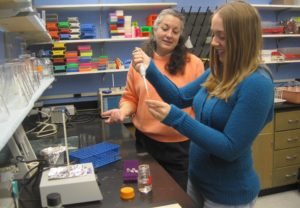 One of the benefits of attending a smaller school like Roanoke College is the opportunity to work closely with a faculty member on research. In working on research with Dr. Marilee Ramesh over her four years, senior Sydney Webb has created a strong relationship that has provided immeasurable experience, knowledge, and support.
Ramesh and Webb have worked together since Webb was a freshman through the Undergraduate Research Assistant Program (URAP), a 4-year research experience unique to Roanoke College. Webb attributes much of her impressive resume to her involvement in URAP. “URAP has allowed me to build my research lab experience,” she said.
Being active in URAP has allowed Webb to accumulate a vast number of lab hours over the years, experience that is very attractive to graduate schools. These hours have given Webb a lot of experience: “I’ve been able to work in the lab since freshman year, where as in many bigger schools you can’t start working in the lab until your junior year.” she said. “URAP has allowed me to manage my own research projects and actually apply techniques that I have only learned about in science classes.”
Ramesh and Webb have developed a strong relationship. “When I write letters of recommendation I am able to go into more detail about the student because I really know how they work and have multiple examples to give of things they have done. The letters become more in-depth because I know them so well,” Ramesh said.
Webb also worked with Ramesh over the summer between freshman and sophomore years through Roanoke College’s Summer Scholars Program, in which Webb was paid to work with Ramesh full-time over the summer. She also received a free tuition credit and free housing. At the end of the eight weeks of research, Webb had accumulated close to two hundred hours of lab time. It was during this summer that Webb was able to start the research program that she continues to work on to this day.
Ramesh has not only helped Webb make connections beyond Roanoke. “Part of my job working with students is to help them find other experiences working outside of our campus. It is important for them to get some experience elsewhere,” Ramesh said. Ramesh encouraged Webb to spend the following summer at Texas A&M as part of an NSF-funded Research Experiences for Undergraduates (REU) program.
“The program gives undergrad students a chance to work on research in a lab with graduate students,” she said, “URAP was instrumental in getting me into the REU program.” She worked in the Cellular and Molecular Medicine Department at Texas A&M, where got the “big lab” experience. “In bigger schools you may only be able to meet with a professor if you have a question once a week, if that, while at a smaller school like Roanoke you can work one-on-one with a professor almost every day of the week,” she said.
Webb is currently applying to graduate schools in hopes of studying Cancer Biology. “It’s great to see students improving over the years and to see them mature. It’s my job to help them take advantage of as many opportunities as possible along the way,” said Ramesh. At Roanoke, the connections will last well beyond graduation.