Three Roanoke College students share their experience about their work on a research collaborative

12369988_1015386725184905_1748686324_o

Pictured above: Anna Denisch (top), Rebecca Conter (left) and Emma Clarke (right)

The MARCUS conference (Mid-Atlantic Regional Conference for Undergraduate Scholarship), is an annual conference where students can present their research to other students, professors, and the public. In 2015, the conference was held at Randolph College on October 10th. The conference is multidisciplinary where students can share a topic using knowledge and methods from a variety of fields.

Anna Denisch, ’16, Rebecca Conter, ’17, and Emma Clarke, ’18, another group of students from Dr. Poli and Dr. Stoneman’s Dragon Research Collaborative, attended the MARCUS conference in October 2015. Anna Denisch worked under the education department and spent her time researching dragon lore and writing a children’s book that explains the myths. Rebecca Conter worked with the Virginia Museum of Natural History studying Paleobotany to later develop activity pages to help children learn about Paleobotany. Emma Clarke spent her time on the project studying Lepidodendron fossils and dragon myths.

Rebecca really enjoyed working with Dr. Poli and the “Dragon research team”.

“It’s a very rewarding experience. Dr. Poli and “Team Dragon” (as we call the Collaborative), push me to expand my knowledge and grow independently. The whole team serves as a support system for one-another. Every week, we bounce ideas back-and-forth, looking for ways to overcome obstacles and expand our horizons”

Anna’s favorite moment doing research was when the research group travelled to Beckley, West Virginia

“We went to the quarry where the fossils that are essentially the backbone of the whole project are found. These tree fossils show bark that looks a lot like how dragon scales are portrayed in art about dragons. It was a lot of fun to go with the group and be able to dig around the site looking for the fossils. The best part: we got to keep whatever we found. I now have dragons in my room, it’s pretty amazing.”

All three students encourage getting involved in research:

Emma: Research is a great resume builder as well as a way to get to know more people on campus.

Anna: I would say go for it! But I would also encourage caution and slowness. When you start a research project, it is so easy to come up with a million ideas of all the different things you want to do. I’m telling you now, you can’t. Yes it’s a good idea to have ideas, but with time constraints you really need to pick one or two solid ideas (that hopefully overlap) and just run with those. You may think you have all the free time in the world when a semester and research start, but trust me, by midterms you’re going to be glad that you’ve only got one or two projects to work on for your research.

Rebecca: Don’t be afraid to step out of your comfort zone. Talk to your professors. Explore your options. You have no idea how good it gets until you dive-in!

Two Roanoke College biology students present at the MARCUS conference

12369699_1013558642034380_385712974_o

Pictured above: Benjamin Schwartz (left) and Sarah Petrosky (right)

The MARCUS conference (Mid-Atlantic Regional Conference for Undergraduate Scholarship) is an annual conference where students can present their research to other students, professors, and the public. In 2015, the conference was held at Randolph College on October 10th. The conference is multidisciplinary where students can share a topic using knowledge and methods from a variety of fields.

Benjamin Schwartz, ‘16, and Sarah Petrosky, ‘17, are two students involved in Dr. Poli’s Dragon Research Collaborative, a multidisciplinary research team focused on explaining some of the myths and traditions around dragons. Both students travelled to the MARCUS conference in October to present their research. Ben’s research investigated medicinal properties in “dragon plants” while Sarah’s research focused on the plant species Lycopodium digitalus and why the plant species is extremely flammable.

Both Ben and Sarah really enjoyed working with Dr. Poli on their research projects.

Ben Schwartz: “Working one on one with a professor is an extremely worthwhile experience. Through research, Dr. Poli has become more than just a supervisor to me. She provides me with just enough insight into my research protocol and technique that I am driven in the right direction, but also so that I am forced to critically think on my own and feel comfortable executing the experiment independently. Moreover, she is also a wealth of knowledge for my future ambitions. Harvesting a relationship like this with a professor is invaluable, and I will always hold close to me everything she has taught me.”

Sarah Petrosky: “I really enjoy working with Dr. Poli. For the most part, I work on my own while giving her frequent updates as to how my research is coming along. In my lab, it is a very independent process. I do not have scheduled time in a lab, just goals that I am required to meet on a weekly basis.”

Ben’s favorite part about working on his project was presenting at the conference.

“Some of the Dragon Research Collaborative traveled together to represent the team and spread the word about our interdisciplinary approach toward research. I enjoyed sharing my studies with people outside of Roanoke College and also learning about research that other schools provide.”

The toughest part about Sarah’s research project was managing the development of the plants.

“The plants I work with cannot be grown in a greenhouse. This means that the stages of development that I look at occur only once a year. The incredibly time-sensitive nature of my project, then, places a lot of pressure on me during the weeks of late August through early November, since I have to catch the plants at each stage in their development when it happens, or I would be unable to complete my protocol.”

Both Ben and Sarah recommend getting involved in research and offer their advice to anyone considering it.

Ben: “Whether you need experience for graduate school or employment after college, or if you’re just truly passionate about a subject and want to learn more, then you must get involved. It’s a win-win, you cannot go wrong.”

Sarah: “There are two big suggestions I have. The first one is, when you get involved in research, make sure your other schoolwork is manageable. This is more for your own health more than anything. Different professors run their labs different ways, but it is still a time commitment, and if you have overloaded on courses, it could get very overwhelming very quickly. The second one is, work with a professor that you like and that has a project that is of interest to you.”

Roanoke College senior presents at the MARCUS conference

DSCN1605


The MARCUS conference (Mid-Atlantic Regional Conference for Undergraduate Scholarship), is an annual conference where students can present their research to other students, professors, and the public. In 2015, the conference was held at Randolph College on October 10th. The conference is multidisciplinary where students can share a topic using knowledge and methods from a variety of fields.
Andrew Dittmar, a senior at Roanoke College, was one of the students who participated in the conference. Andrew was involved with the History department for his research project. The project was titled: “”Discovering Liberty: Defining Individualist Anarchism in Liberty, 1881-1908″. It focused on a periodical titled “Liberty”, which covered a radical political philosophy known as individualist anarchism. Andrew’s goal was to investigate the political philosophy and how it managed to become a part of the magazine.
Andrew first came across his research topic while searching for a topic for his Historical Methods course.

“I was struggling to come up with a topic, as my primary historical interests lie in the ancient world and in turn-of-the-20th-century Russia. I was doing a simple Google search trying to somehow unite one of my areas of interest with our course era, and I stumbled across the first page of the first issue of Liberty in 1881. What struck me was a particular page feature a full length eulogy in poem form honoring Sophia Perovskaya, a Russian revolutionary who had, earlier in 1881, been involved in the assassination of Tsar Alexander II, and had been executed for it. The poem continually referred to her action as having been heroic and necessary; I was intrigued, and kept reading. What I discovered was a full-fledged political ideology taking form in the pages of a newspaper”.

One of the things Andrew enjoyed at the conference was how the panel sessions worked.

“I was a part of a five-person student panel, and each of us had researched dramatically different things. My fellow panelists talked about: neurotransmitters in rats; women in French literature; a skeleton used by secret societies at Bennington College; and sound wave patterns. I have no idea why we were all put together, but I learned a lot. It was really cool to see what other students at other schools were researching.”

To anyone considering doing research, Andrew says:

“I know research in a humanities subject area looks very different than research in hard science, but in both instances, research is about uncovering a story, the story behind what, how, and why things are the way they are. Many of these stories have been told, but many are still waiting to be told. So always keep your eye open for a story that you can uncover and tell, because they’re all around you.”

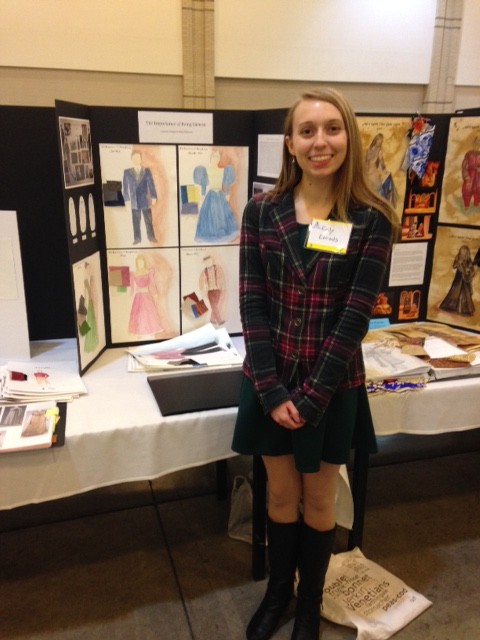
RC Student Conference Presentation: Costume design

SETC 1


The first week of March, Roanoke College senior Emily Edmonds was able to present her research at the Southeastern Theatre Conference in Chattanooga, TN.  Emily did her work under the Fine Arts department. Emily’s research topic focused on costume design in The Importance of Being Earnest, a play by Oscar Wilde. She decided to pursue research with Dr. Ruhland because of her interest in costuming and her desire to pursue it as a career after graduation.

Emily really enjoyed being able to work with a professor while doing her own research.

“Jennie Ruhland is an amazing teacher and I absolutely loved working with her. Her advice throughout the whole process was so meaningful and helpful. I had to revise and edit my project a bit, but even her criticism was constructive and I learned a lot from it. I learned so much more than I ever could have in a class-room so I am really thankful for the experience.”

When asked about the conference Emily says:

“It was different than I expected. My project wasn’t what is traditional of research presentations so it was nerve-racking because I didn’t know what to expect. Plus, I presented my work in a design competition so that added another unique layer to the experience. Honestly though, once I got set-up and everything was prepared, then things went super smoothly. I sadly didn’t place in the competition, but it was great experience and I’m glad that I entered my work and was able to receive feedback from the judges on how I can improve.”

For anyone considering doing research at Roanoke, Emily says:

“Do it!! I think people get intimidated by the thought of presenting research, but it’s such a valuable experience and a great way to learn how to make your research stronger or clearer. If you put a lot of hard work and planning into something, don’t be afraid to put your work out there. Also, don’t let yourself be limited by thinking research can only be done in certain fields. I am a Theatre major who presented a research project about costuming that I worked on and analyzed for a long time so just because your interests aren’t in the sciences, doesn’t mean that should stop you from pursuing research. Definitely get as much one on one time with the faculty here as possible because you will learn so much. Even if it’s just an independent study, it’s still definitely worth doing.”

Roanoke College Senior Presents at Chemistry Conference

Pittcon

This March, Roanoke College senior Colin Blye presented his research at Pittcon, a conference in Pittsburg, PA that covers research on analytical chemistry and applied spectroscopy. Colin’s project involved working with fast-scan cyclic voltammetry (FSCV), a technique used to measure neurotransmission in the brain. Using FSCV, Colin worked on how to address the problems with field inconsistences that FSCV can cause.

Colin worked under Dr. Keithley in the Chemistry Department in order to learn more analytical chemistry and instrumentation. Colin says:

“Working one on one with a professor is a really good learning experience. Doing research you are able to learn so much about a topic that you would not normally get the opportunity to do in a classroom.”

About his experience at the Pittcon conference, Colin says:

“Being able to present my research at Pittcon was a great experience. It was nice to be able to share my hard work with other people who are interested in FSCV. It was cool having people come by and listen to the progress I have contributed to the technique of FSCV and at the same time learn from them as they provided further guidance and ideas to help with my research.”

Colin’s favorite thing about presenting his research was:

“The whole process from finding my topic to then being able to present it at a conference was the confirmation that hard work and the effort you put into something pays off . In this case I was able to show and explain to people my findings that will ultimately help advance and perfect the FSCV technique.”

Dr. Chris Lassiter becomes the new director of the Office of Undergraduate Research

LassiterSpring13Small


In January of 2015, the Office of Undergraduate Research (formerly known as the Office of Student/Faculty Research) received some major changes to its structure. Dr. Chris Lassiter became the new director of the office after Dr. Julie Lyon left the position. Dr. Lassiter obtained his Bachelors of Science degree at Furman University where he majored in Biology. Afterwards he attended Duke University where he obtained his Ph.D. in Genetics and Genomics. Dr. Lassiter joined the Roanoke College faculty as a Visiting Assistant Professor of Biology in 2005. He later became an Associate Professor of Biology in 2012.

Dr. Lassiter explained the many jobs the OUR participates in stating:

“The Office of Undergraduate Research aims to enable and enhance research experiences for all students at Roanoke College. My office defines research as scholarly work and includes the humanities, sciences, and social sciences. During the semester, my office supports the Undergraduate Research Assistant Program (multi-year research projects with faculty) and the Work Study Research Assistant program (allows students to work for faculty mentors for pay). During the summer, we support the Summer Scholars program. Throughout the year, students can apply for funds to present their research at conferences. I also advise the Scholars Floor Living Learning Community in Allegheny Hall.”

Being the new director of the office, Dr. Lassiter talked about a few of the changes he wanted to make to the office, stating:

“One of my first actions was to change the office name from Student/Faculty Research to Undergraduate Research in order to better reflect the emphasis of the office on undergraduate students. As I settle into the role, I’d like to expand the Work Study Research Assistant program that has become successful in the past few years. In addition, I will work to add more funding to assist students to attend conferences.”

For anyone considering undergraduate research, Dr. Lassiter says:

“I strongly believe that a liberal arts education works best when we educate the head, hearts, and hands of students. Engaging in research in your chosen discipline allows for that kind of education. Don’t hesitate to contact me at [email protected] if you are interested in research opportunities on campus. I’ll work with you to make opportunities happen.”

Categories OUR