RC Student Conference Presentation: Costume design

SETC 1


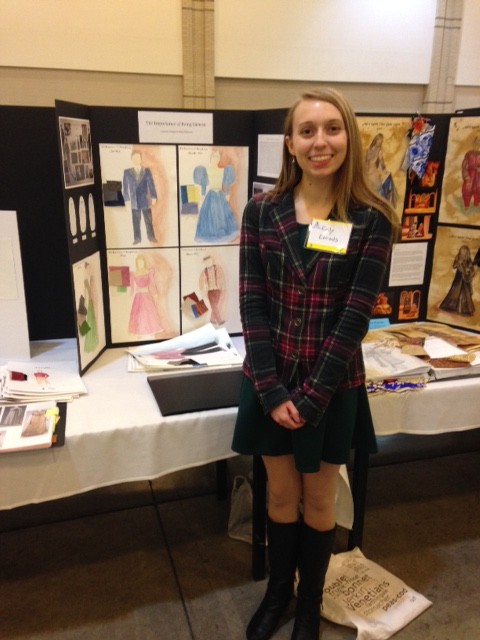
The first week of March, Roanoke College senior Emily Edmonds was able to present her research at the Southeastern Theatre Conference in Chattanooga, TN.  Emily did her work under the Fine Arts department. Emily’s research topic focused on costume design in The Importance of Being Earnest, a play by Oscar Wilde. She decided to pursue research with Dr. Ruhland because of her interest in costuming and her desire to pursue it as a career after graduation.

Emily really enjoyed being able to work with a professor while doing her own research.

“Jennie Ruhland is an amazing teacher and I absolutely loved working with her. Her advice throughout the whole process was so meaningful and helpful. I had to revise and edit my project a bit, but even her criticism was constructive and I learned a lot from it. I learned so much more than I ever could have in a class-room so I am really thankful for the experience.”

When asked about the conference Emily says:

“It was different than I expected. My project wasn’t what is traditional of research presentations so it was nerve-racking because I didn’t know what to expect. Plus, I presented my work in a design competition so that added another unique layer to the experience. Honestly though, once I got set-up and everything was prepared, then things went super smoothly. I sadly didn’t place in the competition, but it was great experience and I’m glad that I entered my work and was able to receive feedback from the judges on how I can improve.”

For anyone considering doing research at Roanoke, Emily says:

“Do it!! I think people get intimidated by the thought of presenting research, but it’s such a valuable experience and a great way to learn how to make your research stronger or clearer. If you put a lot of hard work and planning into something, don’t be afraid to put your work out there. Also, don’t let yourself be limited by thinking research can only be done in certain fields. I am a Theatre major who presented a research project about costuming that I worked on and analyzed for a long time so just because your interests aren’t in the sciences, doesn’t mean that should stop you from pursuing research. Definitely get as much one on one time with the faculty here as possible because you will learn so much. Even if it’s just an independent study, it’s still definitely worth doing.”

Roanoke College Research Assistant Spotlight: Sabrina McAllister

DSC03843

The Work Study Research Assistant program (WSRA) is a large program that contains many students from different parts of the college. Freshmen and seniors, biology and history majors, and everything in between can become a research assistant. Sabrina McAllister, a freshman at Roanoke College, is an example of just one of the many students in the WSRA program. Sabrina works in the Psychology department under Dr. Lindsey Osterman. She began her research last semester.

Sabrina was very excited to do research here at Roanoke.

“I came to Roanoke for all the research opportunities; I wasn’t going to miss out! Doing research with a faculty member is a huge step away from just classroom lectures. It allows you to apply what you learn to the ‘real-world’ and enhances your general experience. Not to mention, it’s a fantastic resume-builder.”

While doing research under Dr. Osterman, Sabrina learned she really enjoyed working one on one with a professor.

“Working directly with a professor is really helpful. They are able to connect you to a whole lot of people in or around their field, which is great when looking for internships, scholarships, and other opportunities. I meet fairly regularly with my professor and we talk a lot casually too; I feel that she is getting to know me as a person rather than just another student in a class.”

For anyone looking into becoming a work study research assistant, Sabrina says:

“Find a professor you click with and ask them about their research, if they have any (most do). Even if they can’t offer you a position, they will likely be able to direct you to someone who can. What you research doesn’t even have to be directly related to your major. It’s really important, though, that you seize the opportunities available to you. Roanoke has lots, so just start looking for them.”

Roanoke College Senior Presents at Chemistry Conference

Pittcon

This March, Roanoke College senior Colin Blye presented his research at Pittcon, a conference in Pittsburg, PA that covers research on analytical chemistry and applied spectroscopy. Colin’s project involved working with fast-scan cyclic voltammetry (FSCV), a technique used to measure neurotransmission in the brain. Using FSCV, Colin worked on how to address the problems with field inconsistences that FSCV can cause.

Colin worked under Dr. Keithley in the Chemistry Department in order to learn more analytical chemistry and instrumentation. Colin says:

“Working one on one with a professor is a really good learning experience. Doing research you are able to learn so much about a topic that you would not normally get the opportunity to do in a classroom.”

About his experience at the Pittcon conference, Colin says:

“Being able to present my research at Pittcon was a great experience. It was nice to be able to share my hard work with other people who are interested in FSCV. It was cool having people come by and listen to the progress I have contributed to the technique of FSCV and at the same time learn from them as they provided further guidance and ideas to help with my research.”

Colin’s favorite thing about presenting his research was:

“The whole process from finding my topic to then being able to present it at a conference was the confirmation that hard work and the effort you put into something pays off . In this case I was able to show and explain to people my findings that will ultimately help advance and perfect the FSCV technique.”

Dr. Chris Lassiter becomes the new director of the Office of Undergraduate Research

LassiterSpring13Small


In January of 2015, the Office of Undergraduate Research (formerly known as the Office of Student/Faculty Research) received some major changes to its structure. Dr. Chris Lassiter became the new director of the office after Dr. Julie Lyon left the position. Dr. Lassiter obtained his Bachelors of Science degree at Furman University where he majored in Biology. Afterwards he attended Duke University where he obtained his Ph.D. in Genetics and Genomics. Dr. Lassiter joined the Roanoke College faculty as a Visiting Assistant Professor of Biology in 2005. He later became an Associate Professor of Biology in 2012.

Dr. Lassiter explained the many jobs the OUR participates in stating:

“The Office of Undergraduate Research aims to enable and enhance research experiences for all students at Roanoke College. My office defines research as scholarly work and includes the humanities, sciences, and social sciences. During the semester, my office supports the Undergraduate Research Assistant Program (multi-year research projects with faculty) and the Work Study Research Assistant program (allows students to work for faculty mentors for pay). During the summer, we support the Summer Scholars program. Throughout the year, students can apply for funds to present their research at conferences. I also advise the Scholars Floor Living Learning Community in Allegheny Hall.”

Being the new director of the office, Dr. Lassiter talked about a few of the changes he wanted to make to the office, stating:

“One of my first actions was to change the office name from Student/Faculty Research to Undergraduate Research in order to better reflect the emphasis of the office on undergraduate students. As I settle into the role, I’d like to expand the Work Study Research Assistant program that has become successful in the past few years. In addition, I will work to add more funding to assist students to attend conferences.”

For anyone considering undergraduate research, Dr. Lassiter says:

“I strongly believe that a liberal arts education works best when we educate the head, hearts, and hands of students. Engaging in research in your chosen discipline allows for that kind of education. Don’t hesitate to contact me at [email protected] if you are interested in research opportunities on campus. I’ll work with you to make opportunities happen.”

Categories OUR