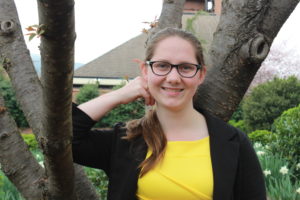
Summer Scholars Spotlight: Madison Snyder

Senior Madison Snyder (Psychology major & sociology minor, December ’24) conducted research over the summer through RC’s Summer Scholars program. Her project titled, Differences in Stress Between Freshmen and Seniors Focusing on Presenting, investigates the differences in stress between college freshmen and seniors while enduring public speaking. Using the Trier Social Stress Test (TSST) model, she has started collecting data from senior participants focusing on a variety of details such as stuttering, eye contact, and the accuracy of the presentation. Applying to Summer Scholars gave Madison great opportunities to further conduct research and allowed for the growth of new and existing skills. During the summer, she gained experience with the Institutional Review Board to approve her study as well as undergoing Social and Behavioral Research CITI training. Additionally, Madison learned how to compose multiple surveys, how to use electrodes, and the Mindware device responsible for collecting heart rate data. Her short-term goals for this research include accurately collecting physiological and self-reporting data; she aims to understand how heart rates differ between baseline, preparation, and presentation segments. Furthermore, she aims to determine whether seniors’ experience with presenting correlates to the amount of stress involved. Her long-term goals are to seek further research and understand stress management options, utilizing the results to consider which options are best for specific groups. Madison would like to thank her advisor, Dr. Kennedy-Metz, Roanoke College psychology professor, for providing guidance throughout the process, and Dr. Carter, Roanoke College psychology professor and Director of Experiential Learning, for hosting the Summer Scholars events, providing research information, and explaining the process.

Congratulations and we look forward to seeing your success in the future!


Summer Scholar Research Highlights

Stephanie Zemba ’21

Major: Sociology

Title:Social Isolation Among Aging Immigrants

Abstract: Health consequences of social isolation are well-documented. Older immigrants are particularly vulnerable to social isolation due to the stresses associated with aging in a foreign country. The projected increase in foreign-born elders makes social isolation an important phenomenon to study. The proposed research will employ semi-structured interviews to explore whether and how social isolation is experienced by immigrant elders in the Roanoke Valley. Investigating social isolation among immigrant elders who live in an area where their ethnic group is underrepresented will provide a greater understanding of the challenges these elders face and potentially help local organizations address their needs.

Something about the scholar: Stephanie is a junior at Roanoke College, majoring in sociology. She was born and raised in Greensburg, Pennsylvania. Through the Research Fellows program and an independent study course, Steph is involved with two ongoing research projects in the Sociology department on interfaith dating and nondrinking students. She is a member of the French and Culture Shock clubs on campus, and her hobbies include creative writing, reading, and painting. Her friends like to joke that if you can’t find Steph in the library, you’ll find her attending office hours. Steph’s future plans include attending graduate school, earning a PhD in sociology, and becoming a college professor.


Nathaniel Willis ’20

Major: History, Political Science

Title: Religion and Politics in the Middle East: A Comparative Study of Christian Communities in Egypt, Lebanon, and Israel

Abstract: The relationship between religion and state is an important component of the political dynamic of the countries of the Middle East and North Africa, and while Islam is the predominate religion in these areas, Christian Minorities play a notable role in the region. These communities include the Coptic Christians of Egypt, Maronite Christians of Lebanon, and the numerous Christian churches in Israel and Palestine. This study is a comparative analysis of how each community directly and indirectly participates in the political and civil service apparatuses of their respective countries.

Something about the scholar: Nathaniel is a senior from Bedford, Virginia and is a History and Political Science double major. His primary interest of study is the intersection of religion with the fields of politics and history, which is an interest likely influenced by his parents, one of whom is a professor of religious studies at Lynchburg College and the other an ordained Presbyterian minister. Nathaniel is involved in Roanoke College athletics, having participated for 3 seasons of Cross Country and 2 seasons of Track and Field. Nathaniel has spent his past three years at Roanoke working as a student assistant (churl) for the History Department, as well as spending a semester in Washington, D.C. working as an intern for the U.S. Department of State.


Summer Scholar Research Highlights

Dylan Sullivan ’20

Major: Chemistry

Title: Development of a Low-Cost Fluorescence Spectrometer

Abstract: The technique of fluorescence spectroscopy utilizes light to determine unknown concentrations of molecules. The actual instrument used, a fluorimeter, costs over $30,000 so most students lack access to learn about and use this technique. In this research, I propose to develop a fully-functional LEGO-based fluorimeter as a cost efficient alternative to a commercial fluorimeter. Specifically, I will determine how various components and engineering designs affect the LEGO fluorimeter’s performance. Afterwards, I will then utilize this instrument to characterize the speed of an enzymatic reaction, with an end goal of developing a laboratory experiment to be used by Roanoke College students.

Something about the scholar: Dylan is from Fredericksburg, Virginia and is currently a senior at Roanoke College. He is majoring in Chemistry and is looking to attend a graduate program for a Ph.D. in Chemistry after his graduation. Dylan is also currently working as a chemistry departmental assistant under Dr. Keithley’s mentorship. When it comes to chemistry courses he has previously taken, he enjoys organic chemistry and quantitative chemistry the most.


Andrew Webb ’20

Major: Applied Computer Science

Title: Creating Interactive Fire Spread in VR

Abstract: The project is focusing on creating a program that can take the United States Forest Service’s Fire Spread data and put it into a Virtual Reality space. From there, the Virtual Reality space will be used to create training programs for US Forest Service Firefighters to better learn how to handle forest fires.

Something about the scholar: Andrew is a Senior Applied Computer Science Student. A New Mexican student, he prefers to consider himself a Roanoker. When he isn’t busy working on VR forests, he likes to explore the local ones.

Summer Scholar Research Highlights

Andrew Droubay ‘20

Major: Computer Science & Mathematics

Title: Pointer Visualization and Education in C++ Through Gamification

Abstract:The syntactic and theoretical use of pointers within computer programming is often a difficult obstacle to intermediate students. Solutions involving visualizations and practice problems have been used before, but a better result may be obtained through gamifying the problem. This project aims to create an enjoyable, educational, and visual game that will reinforce the use of pointers within a computer science curriculum. The game’s effectiveness will be tested on a group of students in CPSC 170 at Roanoke College.

Something about the scholar:  Andrew is a math and computer science major and IT programmer at Roanoke College, where he writes forms and web applications for the college’s website and internal IT use. He has been inducted into Alpha Lambda Delta, the freshman honor society, and Pi Mu Epsilon, the national mathematics honor society, and has been a member of the President’s or Dean’s list each semester at Roanoke. He enjoys computer science as a problem solving challenge yielding tangible results. When he’s not studying, he likes to spend his time fishing, woodworking, or designing, studying, and playing video games.

Mark Maust ‘20

Major:Chemistry

Title:Optimization and Investigation of a novel palladium-catalyzed olefin difunctionalization

Abstract:Organic compounds are molecules are compounds that can be found everywhere in modern life. The creation of organic compounds is often tedious and costly, so exploring opportunities to efficiently synthesize these compounds is of interest. An essential component to the synthesis of organic molecules is the formation of carbon-carbon bonds. Palladium has shown capabilities to form carbon-carbon bonds and thus has been utilized widely in organic synthesis. Specifically, this research investigates the transformation of a carbon-carbon double bond through a novel pathway using palladium to gain a deeper understanding of the reaction so others can utilize it in their investigations.

Something about the scholar: A third year Chemistry major, Mark has an interest for the discovery and excitement that is associated with research. In the summer of 2017, Mark began his research in the Brenzovich lab where he began studying a palladium-catalyzed olefin difunctionalization reaction. During his research time, Mark has successfully created unique compounds that have provided insight into the step-by-step process of how the reaction occurs. The work he performed has been presented at the national American Chemical Society Conference (March 2018) and is currently being prepared for publication. Mark plans to continue his research and take his love for discovery to graduate school to further his education in organic synthesis and hopefully start a career in pharmaceutical research. 

Summer Scholar Research Highlights

Jared Boone ’20

Major: Political Science & French

Title: Power Structures and Political Tradition: An Explanation for the Disparate Healthcare Outcomes Between the United States and France

Abstract: The United States and France have distinctly different healthcare systems and these differences are shown in nearly every measure. It is unique that two western Republics with very similar systems of governance, values, traditions, and global interests have created such different systems and this project seeks to answer the question of why. A three-pronged approach is taken for each country which focuses on the key actors of each system. First, a history of the contemporary health system is treated which outlines the development of the major actors as well as the politics that surrounded this development. Then follows an examination of how these key actors interact when reform efforts are undertaken by the government in order to guard their own respective interest. Finally, specific recent reforms are examined specifically focusing on the political process involving such key actors and how they influenced the ultimate political outcome. Interviews of students, doctors, and academics in each system are used to supplement the research. Through the understanding the political structure of each respective system, this project seeks to understand the disparate result of the two systems.

Something about the scholar: Jared is a rising senior in the Honors program that began to enjoy the study of politics during the presidential primaries of the 2016 election. During this time, he was a bored high school student, but these events sparked his realization that in our modern world, the domain of politics is among the last in which, as a nation, we fight with one another for what we think is right. However divisive this process may be, Jared believes that this constant battle of ideas is important for the health of our local, national, and global society. Regarding his study of French, this is something that he undertook starting his freshman year in high school and never had the heart to let go. So, he made it a second major and now he seeks to one day be able to call himself bilingual in the French language and culture. Further, he seeks to begin to put that skill to use in this project which he is completing for the Roanoke College Honors Program, out of love for the political process seen in different cultures, and to give himself a boost for his upcoming career. In his free time, Jared enjoys music, biking and chess among other things. If he’s not working on his project, taking shots of espresso while hovering over his online chessboard or at choir practice, you can probably find him on one of the beautiful nature trails in Roanoke.

Emma Coogan ‘20

Major: Biology

Title: Testing the Limits of Perception and Cognition of the Odorous House Ant Tapinoma sessile

Abstract: I propose experiments with the well-known odorous house ant (Tapinoma sessile) to determine their color vision abilities, and then, to determine their ability to recognize themselves through the mirror test paradigm often used in studies of animal cognition. My research will build upon and test controversial published work demonstrating self-recognition in a single species of Myrmica ants. If ants exhibit self-recognition, we would better understand the limits of cognitive abilities of insects, compared to vertebrates—so-called higher animals—as very few animal species pass the mirror test.

Something about the scholar: Emma is a rising senior at Roanoke College, majoring in Biology and minoring in Psychology. With a deep passion for ecology as well as comprehending alternative viewpoints, she has studied a variety of resources outside the classroom—such as Joseph Campbell’s Hero of a Thousand Faces and Measuring Behavior: An Introductory Guide by Paul Martin and Patrick Bateson. She has thrown herself into the realms of interning and volunteering in both wildlife rehabilitation and zoological institutes. Having a strong belief in animals’ rights as well as human rights, she hopes to foster human respect for the other lifeforms with which they share the planet so that both groups might be brought closer together.
 

Summer Scholar Research Highlights

Isabel Hildesheim ‘20

Major: Biology

Title: Using Bryophytes for Stronger Quantification of the Effects of Air Pollution in Habitat

Abstract: This project will work to develop a method for using mosses to quantitatively assess air pollution. Moss will be fumigated with SO2 in the lab. The morphology, physiology, and cytology of these mosses will be observed, and polar auxin transport, photosynthesis, and respiration rates will be measured pre and post fumigation. Moss will be placed at three locations within Southwestern Virginia along a pollution gradient. Every three months for a year, the number of moss species present at these sites will be counted and samples of the moss specimens placed in the field will be collected for observation and analysis.

Something about the scholar: Isabel is Biology major who is passionate about conservation. She is an avid hiker and her hobbies include identifying plants and animals, spending time outdoors, reading, and learning about the world around her. She is dedicated to finding ways to improve the environment and educate others about how important the environment is. Her long-term goal is to go to graduate school and eventually get a job as a National Park Ranger performing conservation ecology field research. 


Emma Howard-Woods ‘20

Major: Sociology

Title: Barriers to Healthcare Access: How Socioeconomic Status Affects Perceived Access to Healthcare

Abstract: The goal of this project is to assess different barriers to healthcare access within the Roanoke Valley. This project will begin with the selection of three clinics within the Roanoke Valley, each serving a distinct socioeconomic population. From there, each clinic will receive two sets of questionnaires, one to be distributed to the patients, and one to the healthcare providers that work there. The questionnaires are designed to gauge the extent to which participants from each clinic perceive different barriers to healthcare access. Participants will also have an opportunity to participate in an optional interview.

Something about the scholar:  Emma was raised in Roanoke, Virginia. She graduated from William Byrd High School in 2016. She is now a junior at Roanoke College and is majoring in Sociology with concentrations in Anthropology and Peace and Justice Studies. She is active in the Honors program as well as the Student Peace and Justice Association and Alpha Kappa Delta. After Roanoke, she plans to go to graduate school to study public health, public policy, and law. She hopes to someday have a career in healthcare policy where she can make healthcare more equitable.

2017 Summer Scholars: Abdul-Fatah Soroush

Fatah is one of the 2017 Summer Scholars, a group of students selected to carry out their own research project with a faculty mentor over the summer. A senior majoring in International Relations, Fatah’s research project is titled: “United Nations and Global Governance”. He worked with Dr. Andreea Mihalache-O’Keef to complete his project.

“The focus of my paper is to analyze the role of the United Nations with regards to how it deals with contemporary “security threats” such as ongoing intra-state wars, trans-national terrorism, environmental catastrophes, pandemics, and so on. “Security threats” is in quotes because the nature of these threats, as well as what should be done about them, is interpreted differently by the members of the United Nations and by international experts. The approach of my paper is from a human security standpoint (considering the security of the world’s populations and prioritizing it over the security of nation-states) and it suggests, rather cautiously, that if the United Nations is to have more control over its surroundings (as necessary, given trans-nationalization of these threats), rather than the reverse, its member states need to transfer more loyalty, authority, and legitimacy to it. With this project, I intended to learn how the United Nations could be reformed or made more effective in trying to alleviate human suffering and promoting human prosperity”.

Fatah first became interested in his project during the Washington semester program where he did research on the involvement of Iranian-backed militias fighting in Syria.

“The role of UN Security Council has been virtually irrelevant in Syria, since many resolutions that have tried to reduce the scale of horrors happening in Syria have been vetoed by the veto-holding members of the Security Council (United States, Russia, China, France, and Britain); particularly by either the United States or Russia. The role of regional actors is devastating too. Iran, Saudi Arabia, Turkey, Israel, as well as several non-state actors like ISIS, al-Qaeda, etc. carry out their own agendas and are highly detrimental to the population in Syria. Syria presents a very ugly picture, but is a great example of how a more sovereign United Nations could have been more helpful in reducing the scale of suffering happening there”.

Fatah enjoyed working with Dr. Andreea Mihalache-O’Keef. She encouraged him to present his research at the ISA-South conference in Orlando on October 20th-21st

“I presented my Summer Scholars paper in a panel called “Mobilization,” which was chaired by my Summer Scholars advisor Dr. O’Keef. I also attended four other panels themed “Governance,” “Environment, Health and Human Security,” “Refugees and Migration,” and “Middle East and Central Asia.” The panelists, as well as the audience, in each panel were mostly graduate students and professors, but there were some undergraduates too. It was a great learning experience and I had a chance to talk with some professors and graduate school students about my academic interests, and to get their advice as I prepare for graduate school applications”.

To anyone considering doing research, Fatah suggests to find a research question and pursue it.

“This is what I believe education is all about, to observe the nature, oneself, others, world events, and so on, and see what kinds of questions one comes across to study”.

2017 Summer Scholars: Megan Miller

Megan Miller, a senior majoring in Psychology, was one of the thirteen students selected into the 2017 Summer Scholars program. Over the summer, she was able to work with her faculty advisor, Dr. Chris Buchholz, to complete her research project titled: “Self-driving cars as a test of the potentially harmful effects of empathy on moral decision making”.

“My research project is attempting to understand what individual differences impact the decisions made during a moral dilemma. We hypothesized that empathy levels, your ability to understand the feelings of others, would have a large impact of what types of decisions people would make. Specifically those with higher levels of empathy would lead to consequentialist decisions, such as thinking about the greater good. We used self-driving cars as the moral dilemma in our study, asking participants who they think a self-driving car should save (examples include save your mom vs. three people, save yourself vs. a scientist on the verge of curing diabetes). From completing the project, I hope to learn what factors actually influence the types of decisions people make when faced with a moral dilemma”.

Megan started to think about her project while working with her advisor, Dr. Buchholz, in a research lab during her sophomore year.

“I helped with the other projects in the lab and then Dr. Buchholz and I started doing a literature review of empathy, focusing on the negative effects empathy can have. From there, we came up with the idea to see how empathy impacts moral decision making and decided on self-driving cars, since they are still an extremely new technology. We thought they would provide an interesting moral dilemma, and would potentially provide information for companies that make self-driving cars to help them determine how to program the cars”.

Megan enjoyed working with Dr. Buchholz over the summer.

“The Summer Scholars program has allowed me to work on my project throughout the summer, giving me more time to explore the results and hypothesize the reasons for the unexpected results. Summer Scholars also gave me funding that I was able to use to pay participants for the study”.

Megan is still working on her final research paper, but hopes to complete her project soon.

“I’ve completed most of the data analyses, but I’m still working on completing my final research paper. We did determine that males are more likely to make choices that benefit the greater good (such as saving Nobel Prize winning physicist over a stranger) than females, but overall both males and females tend to save themselves and their mom. We just ran a follow up study looking more into the gender differences, but haven’t analyzed that data yet”.

To anyone considering doing a research project, Megan recommends getting involved.

“If you’re interested, but don’t have a project in mind, talk to a professor in the department you’re interested in doing research in. They might already have a project in mind they need help with that you can take in your own direction, or they can help you brainstorm ideas for your own project”.

2017 Summer Scholars: Sabrina McAllister

Sabrina McAllister, a senior majoring in Psychology, was one of the thirteen students selected into the 2017 Summer Scholars program. Over the summer, she was able to work with her faculty advisor, Dr. David Nichols, to complete her research project titled “Time Perspective as a State-Based Measure”.

“My project is on time perspective (the way a person orients him/herself towards the past, present, or future). I am focusing specifically on the Zimbardo’s Time Perspective Inventory (ZTPI), which is the most popular measure of time perspective in the psychology literature. I am examining its structure to determine ways in which it can be improved and modified to provide more valid and reliable results”.

Sabrina first got into her project through Dr. Nichols.

“My advisor had been previously doing research on time perspective when I started working with him. The first project I took on under his supervision was a literature review that combined sensation-seeking and time perspective, which was how I was introduced to the ZTPI. As I did the reading for my paper, I realized that there seemed to be a lot of uncertainty in the literature regarding Zimbardo’s questionnaire, so I made it my next project to improve on some of that”.

Sabrina decided to apply to be a summer scholar so she could work on her research project without having to worry about getting distracted by classes and campus events. She was able to work closely with her research advisor throughout the summer.

“My research advisor is very helpful. He has given me several bits of advice and taught me new things. I think the best part of working with him is the amount of independence he provides. I can ask direct questions if I’m unsure of something, but most of the time, I’m given an instruction and some resources, and I figure it out myself. It can be more work this way, but it allows me to learn a lot in a very short amount of time, which is thrilling”.

Sabrina has learned quite a bit from working on her project.

“I’ve gained an understanding of statistical concepts that are not included in the standard statistics curriculum, and I’ve gained computer skills that will be useful throughout my life, on the job and off. I am also currently working on writing a final manuscript for my project, and I expect that, as I continue it, I will learn about the nuts and bolts of scientific writing that I haven’t yet come across. It will continue to be lots of intensive work and require ample amounts of time, but it will be worth the effort because, by the end of it, I will have completed two project defenses, presented at a campus poster session, and at a national conference. I also intend to submit the manuscript for publication in the spring, which will be an exciting milestone in both my academic and professional career”.

To anyone considering doing research, Sabrina’s advice is to get started right away.

“Research is time-intensive and long-winded, but it’s very rewarding and beneficial. You’ll get the most out of it if you do it for more than just one or two semesters. I started research in my department during my very first semester, and I wouldn’t have come this far or learned this much if I hadn’t spent this much time with it. If it’s something you’re strongly interested in, contact the people in your department. Even if your first choice of advisor isn’t available, get your foot in the door and do a little bit of something with someone. It’s not a four-year commitment! See what options are available to you, and take advantage of them. Also, don’t be afraid to be original. Most of the research students I’ve talked to came up with their project on their own, pitched the idea to their advisor, and ran with it from there; so you should definitely feel free to explore your own interests”.

2017 Summer Scholars: Lynn Luckenbaugh

The Summer Scholars program allows students serious about research to work one-on-one with a faculty mentor to design and implement a research project during the summer and present their findings in the fall. Each year students are selected from various majors across campus. Lynn Luckenbaugh was one of the thirteen summer scholars selected into the 2017 Summer Scholars program.

A senior majoring in Biochemistry and Math, Lynn’s project is entitled “Investigation of a Putative Hydroxymandelate Synthase in Streptomyces violaceusnige”. She’s been working with Dr. Sarisky to investigate the function of enzymes in Streptomyces violaceusnige and collect more data on metal, pH, and temperature preferences.

“There are two related enzymes, HMS and HPPD.  HMS catalyzes a reaction important in vancomycin synthesis, an antibiotic, and HPPD catalyzes a reaction important in tyrosine catabolism.  I am studying an enzyme from Streptomyces violaceusniger that is thought to be an HMS, but due to the similarity of the enzymes may have HPPD function instead. I chose this project because I wanted to study an enzyme that was useful for something, like antibiotic synthesis, and I thought that the idea of HMS and HPPD being so similar but having different functions was interesting”.

Lynn wanted to do the summer scholar program because she enjoyed doing research over the school year and wanted to do research full time over the summer. In completing the project she hopes to gain more biochemical laboratory techniques.

“I have not yet completed this project. I have successfully produced a sample of this enzyme but I have not yet been able to show activity.  There have been issues trying to get the starting material for this reaction into solution.  Due to the time spent investigating this issue, the batch of enzyme I had produced and purified sat in the freezer for about a month.  This could have caused activity levels to decrease.  I plan to start the fall semester by producing and purifying another batch of enzyme to see if I can detect activity in it”.

As Lynn reflects on her time spent at Roanoke, she says that research has been one of her most valuable experiences.

“While taking a lecture class or a lab allows you to learn material and gain some experience, research allows you to gain independent experience with procedures common in your discipline and it allows you to really master a skill.  It also teaches you problem solving skills, time management, and many other important transferable skills”.