Roanoke College Student Presents at 2017 National Conference of Undergraduate Research

Dantaé Henderson is a senior majoring in Spanish with concentrations in Latin American and Caribbean Studies and Teaching English as a Second Language (TESL). She presented her research project, “Du Bois’s Double consciousness and The Afro-Peruvian Identity in Victoria Santa Cruz, ‘Me Gritaron Negra’”, at the 2017 National Conference of Undergraduate Research (NCUR) at the University of Memphis. Dantaé finished her project while completing her independent study for the Spanish major with Dr. Bañuelos-Montes.

She decided to investigate this topic because of her interest in analyzing literature and connecting literature to different theories.

“Vitoria Santa Cruz’s poem, “Me gritaron negra”, reveals how the paradigms of the dominant groups are formed and how the marginalized groups, in this study the Afro-Peruvians, are forced to deny the racial characteristics and cultural manifestations that make up their cultural identity. The stereotypes that separate the groups by race continue to create racial divisions in which the superior groups impose whiteness as the norm, thus imposing a colonialist idealism that categorizes marginalized groups as inferior. Victoria Santa Cruz’s poem is a reaction to the dominant discourse that poses as a threat to nationalism because such discourses manifest a process of acculturation and denial of the Afro-Peruvian’s identity. How does Victoria Santa Cruz resist this discourse of superiority? To understand this process, I will use W.E. B. Du Bois’ concept of double consciousness. The dominant discourse provides a realistic representation of how Afro-Peruvians are depicted in a traditional manner, which maintains, still, colonial stereotypes. This image impacts the perceptions of the Afro-Peruvian, as the dominant discourse continues to expose the stereotypical image; Du Bois believes that the marginalized individual will identify with that message on the long-term. This is the dialogue of the first part of the poem. The second part of the poem alludes to Du Bois’ attainment of the, “self-consciousness…into a better and truer self.” By applying Du Bois theory, I can argue that Victoria Santa Cruz creates an Afro-Peruvian subject that moves from the margin to the center, the creation of the Afro-Peruvian identity”.

Dantaé enjoyed having chance to work with Dr. Bañuelos-Montes.

“It was a great opportunity to utilize the knowledge and specialties of a specific professor because sometimes in the classroom they are not able to work one on one with a student and do a more profound research”.

Dantaé found the experience of presenting her research at NCUR very exciting.

“I never thought that an idea could turn into me presenting this research and defending in a foreign setting. It gave me experience that will help me in my future studies”.

To anyone thinking about doing research at Roanoke, Dantaé suggests you take the opportunity.

“It is a great way to specifically take on a topic that interests you that may not be to do in your regular classes”.
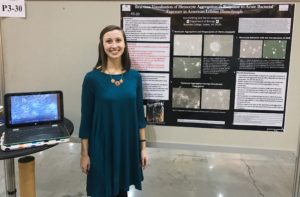
Roanoke College student presents at Society for Integrative and Comparative Biology conference

Sara Farthing, a junior at Roanoke majoring in biology with a minor in chemistry and Spanish, had the opportunity to present her research at the Society for Integrative and Comparative Biology conference in January. Her research project was titled “Real-time Visualization of Hemocyte Aggregation in Response to Acute Bacterial Exposure in American Lobster Hemolymph”. She worked with her research advisor, Dr. Jorgensen, to understand the physiology of invertebrates.

“We mainly used the American Lobster as our model organism. Specifically, I am studying the immune response of the American lobsters. I used microscopy to determine how the hemocytes (essentially blood cells) coagulate and also how they react in the presence of bacteria. Using the microscopes, I was able to visualize the cells in real time using time lapse photography. This means I could see the progression of a process over a certain period of time instead of capturing one image, which could be an isolated event out of the context. I was able to visualize the clotting mechanism of hemocytes (the lobster blood cells) in real time and how this process was affected by the introduction of bacterial cells. My results showed that the clotting mechanism is in fact involved in the immune response of the American lobster”.

Sara really enjoyed presenting her research at the Society for Integrative and Comparative Biology conference.

“I had so many people not only listen to my elevator speech but have one on one conversations with me and discussions in which my experience and knowledge was equally valued. In addition I was even able to make connections with other labs across the country who we will be collaborating in the continuation of my project. I had several graduate students and professors say that my research was far more advanced then what they had seen at the undergraduate level. It is possible I am studying phenomena and asking questions that even professionals haven’t thought to ask yet! This was an inspiring and enriching experience that I will never forget”.

Sara loved working with Dr. Jorgensen to complete their research project.

“He is a wonderful mentor who guides and challenges me throughout my research. He makes himself available so that he can be there when things go wrong or if things go right and I want to push ahead to the next level. I am continuously learning from him not only in areas concerning research but he is a role model for me in how to treat and guide others with an encouraging and kind demeanor. He has also become a friend and support network for me here at college. This will be one of those connections that I cherish and will have for the rest of my life”.

For anyone contemplating doing research at Roanoke, Sara says:

“Absolutely do it! No matter what major, there is always an opportunity for you to get involved in research with a professor. All you have to do is ask and professors will be happy and willing to encourage and nurture your passion for this area of curiosity. More than any club or organization, doing research here at Roanoke has helped me find my niche as well as group of students and faculty that I can always count on”.