Roanoke College Senior Conducts and Presents Research at UC Davis

DSC_0031


Over the summer of 2015, Maya Shende, a senior at Roanoke College, decided to do a Research Experience for Undergraduate (REU) at UC Davis in Davis, California. She worked in Justin Siegel’s lab in the Genome and Biomedical Sciences Center along with eight other undergraduates.

Maya participated in a ten week program that involved time in North Carolina, California, and Washington. During her first week, Maya went to Raleigh, North Carolina to learn about the Rosetta codebase, a molecular biology/chemistry codebase. Most of her time in the program, however, was spent at UC Davis working on her research project.

“My project involved protein-protein and protein-small molecule interfaces. I was looking at the contacts made between two docked proteins or a protein docked with a small molecule, to see if there was a way to quantify the number of contacts in order to further understanding of protein-protein and protein-small molecule interactions. All of this work was done computationally and all of the docking simulations were run using the Rosetta code.”

For the last week of the REU, Maya went to Seattle, Washington, where she and eight other undergraduates presented their research. One of Maya’s favorite parts of the summer was the conference in Seattle.

“RosettaCon was one of the coolest conferences I have ever been to. First, I was essentially surrounded by celebrities in the world of computational molecular biology and computational chemistry. I spent a week having intellectual conversations with some of the forerunners of the field and learning so much every day. Second, presenting my work to such esteemed scholars in the field was a great experience. Not only did I get an opportunity to better my presentation skills, but I also got great feedback about different routes I could take with my research.”

Maya’s advice to anyone interested in research is to start early.

“The more research you do as an undergraduate, the more you learn and more competitive you will be after graduating. Research is also a great way to learn things that you can’t learn in a classroom environment. It is a way to explore topics that are interesting to you, and apply what you learn in your classes to coming up with solutions to real problems!”
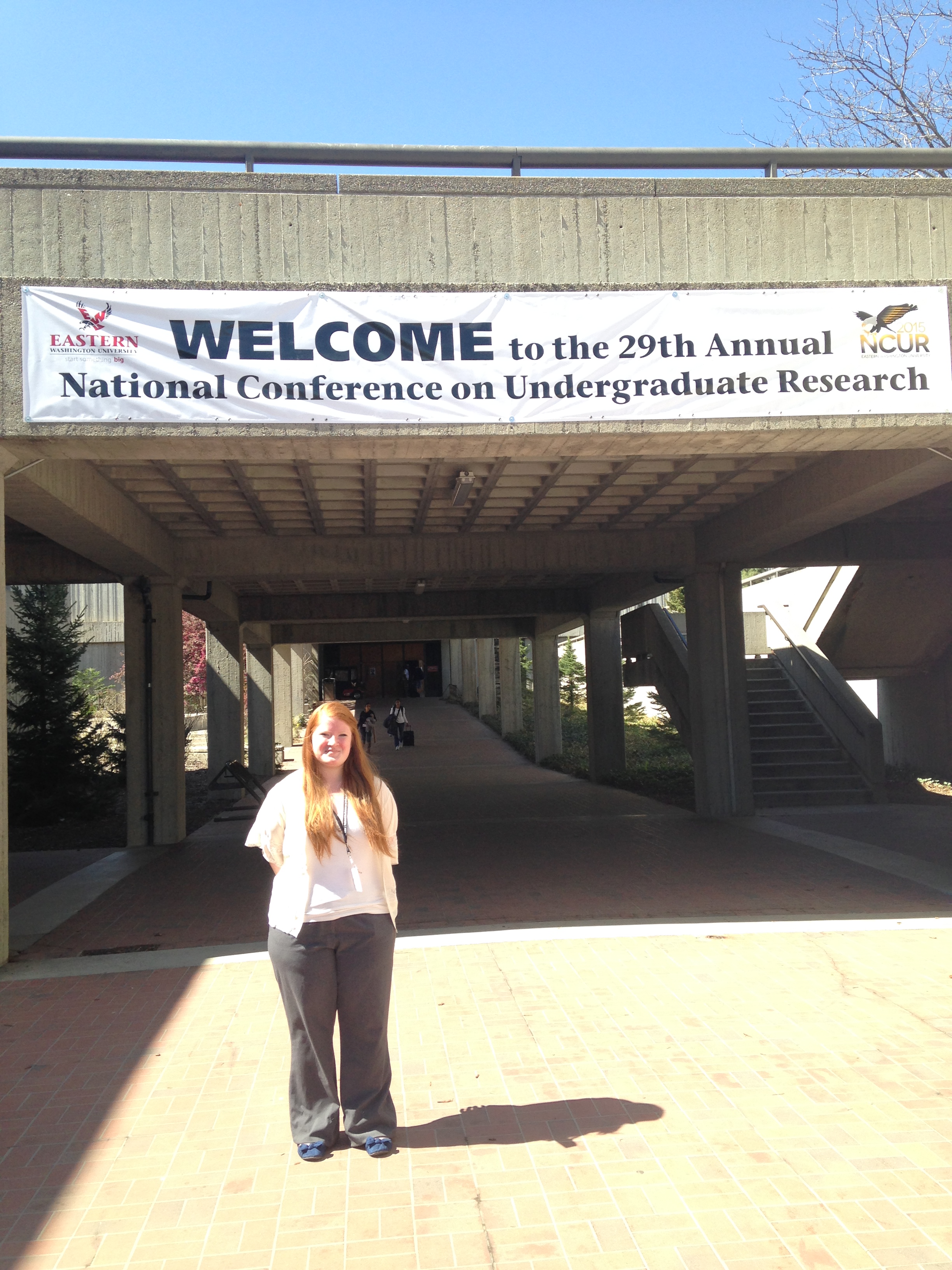
Recent Roanoke College Graduate presents her research in Cheney, Washington

440


In April 2015, Lydia Delamatta, a recent Roanoke College graduate went to the National Conference on Undergraduate Research in Cheney, Washington. Lydia worked with the Public Affairs department on her project titled “Discrimination Stops Here: How Education Affects Gender Political Equality Across Democratic Nations”. Lydia became involved in research after meeting Dr. O’Keef at a professional development panel organized by the Public Affairs Society. The two then worked together on their project.
Lydia enjoyed her time working with Dr. O’Keef:

“Working one on one with a professor is honestly the best way to learn, and when working with Dr. O’Keef, you feel like your research matters. Working one on one, I was able to ask all the questions I needed to as well as develop a professional relationship. Dr. O’Keef, along with all of the Public Affairs professors, truly bend over backwards to help us cultivate our skills and thoughts, and to perfect our projects, and independent study projects help you recognize their dedication.”

When we asked what Lydia’s favorite part of the conference was she had a hard time choosing one but ultimately decided that presentation day was the best:

“Overall, in the span of only a few hours, I had made two professional connections, both because of the work I had put in with Dr. O’Keef in developing this quantitative research project. I was able to represent myself and Roanoke College at this conference, and I would like to think that on that day I honored both.”

To anyone who hasn’t done research or is thinking about it, Lydia says:

“Definitely get involved in the Undergraduate Research program at Roanoke College and Summer Scholars, and get involved with a professor you would like to work with and ask for their mentorship with a research project. If you have a great work ethic and you ask one of your professors about an undergraduate research project they will help you, either by mentoring you, or finding you the best professor for your topic. Seriously they really will.”

Roanoke College Students Travel to Snowbird, Utah for Biology Conference

Pictured above from left to right: Alex Kramer, Ben Walker, Seth Fortmann, and Rebecca Hudon

Roanoke College students Alex Kramer, Ben Walker, Seth Fortmann, and Rebecca Hudon traveled to Snowbird, Utah in mid-July of 2015. They attended the 74th Annual Meeting for the Society for Developmental Biology to present their research. Seth recently graduated from Roanoke College and works at Johns Hopkins University. Three current students, Ben, Alex, and Rebecca, were interviewed about their research experience.

Ben’s research topic was investigating the effects of atrazine on embryonic zebrafish development. He decided to do this research after finishing a similar study on estrogen. Ben won the award for Best Undergraduate Presentation, Honorable Mention and was one of only four undergraduate students to win an award at the conference.

Rebecca’s topic was assessing estrogenic pollution in the Roanoke River using embryonic zebrafish as a bioindicator. She decided on this topic because of her previous experience on the topic during her work in the lab and looks forward to her future endeavors.

Alex’s research topic is about aquatic toxicity of a dental sealant compound. He chose that topic because of its relevance to public health and the large impact it can cause on the industry.

When asked about how it is to work one on one with a professor, Alex said:

“I really enjoy working with Dr. Lassiter because [of] how accessible he is. Whenever I get to a new stage in my research, Dr. Lassiter has always been very helpful in explaining what I need to do next. After we decide what to do next, I am actually running the experiments and am collecting data on my own and at my own pace. Once the data has been finished being collected, we will meet together to analyze and interpret the results together”

Rebecca stated that her favorite part about presenting her research was the feedback she got from other researchers.

“While talking about my research with others I was often given advice about procedures and asked questions that I had not previously considered. These interactions have helped to shape the future of my project.”

Ben’s advice to any students who haven’t gotten involved in research is to find a field that interests you and approach any faculty who performs research that may interest you.

“Being able to use knowledge you learn from the classroom to make an impact, no matter how big, on your specific field is an extremely rewarding process.”

Summer Scholars Introduction: Natalie Wilkson, Phillip Barbolla, and Benjamin Walker

The Summer Scholars program enrolled thirteen students for 2015. Three of them are Natalie Wilkson, Phillip Barbolla, and Benjamin Walker.

 Natalie-Wilkinson

Natalie Wilkson

Natalie Wilkson is a senior at Roanoke College majoring in Math and Computer Science. She is planning on going to graduate school after graduation. She is the current president of Mu Beta Psi, the national honorary musical fraternity, the vice president of RCSCACM, the computer science club, a member of Pi Mu Epsilon, and is in the mathematics honorary society. Natalie has a strong interest in music and computer science and loves when the two combine together.

Natalie’s project is titled: “Optical Music Recognition using Hidden Markov Models”. In her project, Natalie will be using optical music recognition (OMR), a program similar to Optical character recognition (OCR) that converts images of text to actual text documents. OMR has often showed poor performance in comparison to OCR, however, there are algorithms that show promise for OMR. One of those algorithms is HMM which Natalie will use to see if HMM improves the performance of OMR.

phillip barbolla

Phillip Barbolla

Phillip Barbolla is a senior and mathematics major in the Honors program, attending Roanoke College as a Bittle scholar. He is pursuing a psychology minor and neuroscience concentration. Phillip is also active in several clubs and activities such as Habitat for Humanity, Roanoke College Student Chapter of the Mathematical Association of America, and the national mathematics honors society. He has also worked as a calculus teaching assistant and served on the Honors executive board. In his spare time Phillip enjoys hiking, purchasing nerdy apparel from the internet, and getting a little too competitive while watching Jeopardy.

Phillip’s project is titled: “Optimizing Course Offerings with Genetic Algorithms and Particle Swarm Optimization”. Phillip will apply genetic algorithms and particle swarm optimization to the problem of scheduling. By doing so, Phillip hopes to develop a system that can minimize potential conflicts in MCSP department course offerings, adaptable to other departments and institutions.

Ben Walker summer scholar pic

Benjamin Walker

Ben Walker is a senior at Roanoke College majoring in Biology and Chemistry. Native to the Roanoke area, Ben decided to go to Roanoke College as a pre-med student. Ben got involved in research under Dr. Lassiter his freshmen year and continues to do so now. Ben enjoys his research with Dr. Lassiter and believes that doing research will help him with linking academic work and real world applications. On his free time, Ben enjoys playing sports with his friends or tutoring students.

Ben’s project is titled: “Effects of Atrazine on the Development of Craniofacial Cartilage, Skull Sutures, and the Heart in Zebrafish (Danio rerio)”. In his project, Ben will be handling atrazine, an herbicide that has been stated to effect developing organisms. In order to test this hypothesis, Ben will be treating zebrafish embryos with different concentrations of atrazine and examining developmental defects it causes in the zebrafish.