Roanoke College students named one of the five finalists in the Wege Prize competition.

FullSizeRender (2)

Lavender and Lydiah

Lydiah Mpyisi, ’16, and Lavender Micalo, ’18, are both students who were both brought up in Nairobi, Kenya where they witnessed first-hand many issues large cities can have such as overpopulation, insecurity and unemployment. Their experiences there helped motivate them into their current project. Lydiah and Lavender’s project was also inspired from Dr. Okeef and Dr. Bucher’s classes. Their project is titled “Greening Urban Slums and Promoting Community Health through Secondary Healthcare Interventions”.

After starting their project, Lydiah and Lavender attended the 7th Annual Millennial Campus Network Conference at the United Nations Headquarters in New York City in August 2015. At the conference, the two learned about the Wege Prize 2016 Competition, a yearly competition where undergraduate students design and propose a product, service, business/non-profit organization, or other solution to solve a problem that can help us transition from a linear economic model to a circular economic model.

Afterwards, Lydiah and Lavender formed Team KYCE (Kenyan Youths for Circular Economy) with students from three other colleges and entered the Wege Prize 2016 competition. Their plan for the project is to use already existing independent projects and integrate them in way that will create a self-sustaining system that will create employment, improve sanitation and hygiene, enhance the aesthetic value of the urban slums, and improve the overall health of the slum communities.

Team KYCE integrates four projects: The Community Cooker, Peepoo, Community Gardens, and Bio digesters. The Community Cooker uses trash, collected by local youth for income, to power a neighborhood cooking facility. Peepoo is a personal toilet that is used to convert human waste into organic fertilizer. Community gardens are pieces of land gardened by a group of people and are used to produce fruits, vegetables, and/or ornamentals. And lastly, Bio-digesters are structures in which organic matter is digested through anaerobic fermentation with the production of a burnable biogas and a nutrient-rich slurry.

“KYCE will work with the locals to set up waste collection and sorting sites. The waste will be sorted out into categories: biodegradable, recyclable, reusable, and combustible. The biodegradable waste will be used a raw material for a bio-digester that will be set up to generate liquid ethanol and biogas that can be used as a source of electricity to the roadside business owners during night hours to curb insecurity. The recyclable wastes will be sold to recycling companies and converted into useful materials that can be resold. The money obtained from the recycling companies will be used to pay the worker at the waste collection site. Wastes that can be re-used will be donated to orphanages or to other members of the slum communities who may be in need of those items. The combustible waste will be sold to the Community Cooker management crew to be used as a source of fuel for the Community Cooker. The payment from this transaction can be used to fuel the trucks used to transport the wastes to the collection sites. With this approach of waste management, we envision that we will be able to re-duce trash and dumpsites that are found in public places in most urban slums in developing countries. Additionally, we plan to work together with the locals to establish urban and/or community gardens to replace the dump sites. The garden will be used to grow food crops, which will not only provide food but will also provide a source of income to those who will be involved in planting and selling the food. To enhance the growth of food, KYCE will partner with Peepoople to obtain the organic fertilizer that Peepoo makes from human waste. Continued use of Peepoo will help to minimize the use of ‘flying toilets’ and defecating in public places. As a result, there will be improved sanitation in the urban slums.”

KYCE was named one of the five finalists in the Wege Prize competition and students will be travelling to Michigan in May to present their project to a panel of judges for the chance to win.

“Our hope is that our project will be chosen as the best. We are currently working on refining the details of the project and the presentation slides. We are happy that we got this opportunity to represent the good work that Roanoke College students, like us, are doing to impact communities in a positive way.”

WSRA spotlight: Christa Waterwiese

1418325_774145589267292_1227971390_n 3

Christa Waterwiese, a freshman at Roanoke College, is one of the students under the work study research assistant program. In the program, students are hired and paid to work alongside a professor on a research project. There is a variety of research projects spread across all the academic departments on campus.

Christa works in the English department with Dr. Kuchar. The two research Eastern European Literature from the 19th and 20th centuries. Christa researches novels and authors included in Dr. Kuchar’s publications and classes. She also occasionally does some Russian translations.


Christa has always been interested in research.

“It is something I do in my free time anyway, so when there was an opportunity to research a topic I love and gain the experience of working a professor I jumped at the chance!”

Christa loves doing research with a professor.

“Dr. Kuchar has taught me so much about research; the best tools, the best way to conduct it, etc. She has impacted the way I look at things and the way I do work for my classes.”

One of the most challenging aspects of Christa’s research so far was during the process of translating a story.

“Dr. Kuchar was asked to translate a story from Ukrainian into English for a student of one of her associates in the Ukraine. So while Dr. Kuchar dictated a rough translation I typed the English. What made it so fun was the story made absolutely no sense to us and we were really struggling to understand what was going on. We need to take a lot of laugh breaks!”

Christa recommends students get involved in research.

“You get the opportunity to become friends with one of the professors, you learn valuable skills about research you can apply to your classes and your future careers, and it looks great on resumes for any job or graduate school program!”

URAP spotlight: David Miller

image1


The Undergraduate Research Assistants Program (URAP) is a program where students work one on one with a faculty member on a research project together. Students apply their senior year of high school and can work on their research program for four years. David Miller, a sophomore at Roanoke College, is a URAP student that works in the Chemistry department with Dr. Keithley. David decided to get involved in URAP to get a feel for the lab environment and to prepare for any graduate or professional programs. His project is titled “Carbon-Fiber Microelectrodes for use in Fast-Scan Cyclic Voltammetry”. He has been working on the optimization of the process for making disk shaped carbon-fiber microelectrodes.

David has enjoyed working with Dr. Keithley.

“Dr. Keithley is a mentor to me and is always helping me to see things differently and support me as well as pushing me to try things on my own and letting me run with some of my ideas for the project”

One of the most challenging aspects of David’s research has been optimizing the process for the electrodes.

“It requires thought and observation by comparison to ones we have already done and requires a drive to match a certain standard of quality.”

To anyone considering research, David says:

“Even if you are unsure but the door is open take the opportunity as long as you can still get all your course work done. Research is very valuable in its experiences and the bonds it builds with faculty and other students.”

Work Study Research Assistant Spotlight: Kevin Oakey

Kevin


Kevin Oakey is a senior at Roanoke College participating in the work study research assistant program. In the program, students are hired and paid to work alongside a professor on a research project. A variety of research projects are spread across all the academic departments on campus.

Kevin first became interested in the work study program while searching for an on campus job. After looking into the program he decided it would be an excellent activity for a resume and applied for a position. He now works in the Economics department with Dr. Kassens. The two are conducting research for an economic textbook that relates criminal activity to economics.

Kevin has enjoyed working with Dr. Kassens so far.

“Professor Kassens is a fantastic mentor and really helps steer me in the right direction with research methods and materials. I really enjoy learning about two topics that intrigue me.”

Kevin’s advice to anyone considering research is to understand the importance of time management.

“You don’t want research to completely overtake your schoolwork but you do want to be able to set a time to get usable and thorough research.”

Roanoke College student presents research in Portland, OR

FullSizeRender-1

Angela Montalvo, a senior majoring in Biology at Roanoke College, presented her research at the Society for Integrative & Comparative Biology in Portland, Oregon this January. She worked with Dr. Jorgensen in the Biology department for her project. Angela first decided to do research during her freshmen year. She became interested working with crabs and lobsters by watching fellow lab partners work with them on underwater treadmills. She then became inspired to do her own research after seeing a recent alumni’s research on the project.
Angela studies the immune response of the American lobsters to an acute bacterial challenge.

“I inject lobsters with a bioengineered bacteria (it is resistant to two antibiotics and expresses green fluorescent protein) and trace where the bacteria lands in their body. I work to better understand how lobsters respond to a bacterial infection and try to determine which organs are best for clearing the bacteria from their hemolymph (blood).”

Angela really enjoyed working with Dr. Jorgensen.

“He pushed me to better myself in class, in the research lab, and as a person. I appreciated having someone I could bounce ideas off of and problem solve.”

One of Angela’s favorite parts about presenting was the questions she’s been asked about her project.

“My favorite one by far is “So, do you still eat lobster?”… the answer is a simple “yes!”. The questions that some ask generate discussion about things that could be done in the lab that would help us better understand what exactly is going on in the lobster. There is not much written about the immune response, which makes this data difficult to interpret at times. New projects have been started because of conversations held at my poster!”

Angela highly recommends students to get involved in research.

“Find an area that you are interested in and talk to a professor about it; there could be an opening in a lab that does similar research or start your own project as an independent study. Doing research taught me how to think through a difficult problem and learn from my mistakes.”

WSRA spotlight: Jennifer Barthol


IMG_1741

Jennifer Barthol, a sophomore at Roanoke College, is one of the students under the work study research assistant program. In the program, students are hired and paid to work alongside a professor on a research project. A variety of research projects are spread across all the academic departments on campus. Jennifer works under the Health and Human Performance department with Dr. Elizabeth Holbrook. Jennifer first became interested in the project after being contacted by Dr. Holbrook. After discussing some of her interests and goals, Jennifer decided to work on the project.

Jennifer’s research focuses on surveys given to local elementary school students and their parents about healthy eating and physical activity habits as a part of Dr. Holbrook’s Roanoke Valley Community Healthy Living Index annual assessment. Last semester, Jennifer compiled all the data and entered it into a worksheet. Afterwards, she met with Dr. Holbrook to discuss creating a PowerPoint presentation about the data. The PowerPoint was created and presented to community stakeholders across the Roanoke Valley to inform private and non-profit organizations about the health-related needs of the children in our community. After presenting to the community, they discussed writing an abstract for conference presentation. The abstract was submitted to the National Conference on Undergraduate Research and has been accepted.
While conducting her research, Jennifer was thankful to work with Dr. Holbrook.

“She not only pushes me to do my best, but she is an incredible mentor and role model of someone I hope to be like one day. She has taught me many things, and I do not know what I would do if I didn’t have her by my side throughout the research process and my time here at Roanoke College. If it weren’t for her, I would not have had this opportunity to research something so intriguing to me.”

One of Jennifer’s favorite things about conducting research was learning about other research projects.

“I enjoyed learning from other students who are conducting research in my major. I am able to learn what they are doing and then see if I can apply it to my research findings in any way.”

To anyone considering research, Jennifer says:

“Make sure you enjoy what you are researching, find new ways of doing things (whatever it may be), ask questions, and read up on other research projects/articles.”

Roanoke College student presents research at the Experimental Biology conference in Boston

IMG_0802 (1)


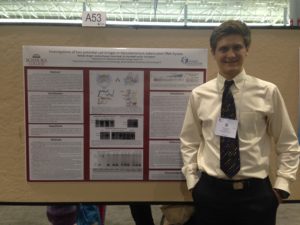
Nicholas Wright, a senior at Roanoke College, presented at the Experimental Biology conference in Boston in March of 2015. Nick’s project focused on understanding the amino acids responsible for binding interactions occurring between two subunits of a protein complex in the bacteria that causes tuberculosis. The project was a collaboration between the Roanoke College Chemistry department and the Department of Integrated Science and Technology at James Madison University. He decided to do research at Roanoke as soon as he found a research project he was interested in.
Nick really appreciated the ability to work with a professor while conducting research.

“Working with my advisor, Dr. Tim Johann, is a great experience. I always feel welcome to talk about an experiment, preparations in lab, techniques, etc. Having worked in labs elsewhere, this is something that is unique and special at Roanoke. In many labs you may rarely see the faculty principle investigator.”

Nick found that presenting can be one of the most challenging components of conducting research.

“You always have to know your audience and remember that the audience does not have the same level of understanding of the project as you do. Communicating science is the most important part of doing research, so it is critical that you prepare for presentations of your work.”

Despite the challenges, Nick still encourages getting involved as soon as possible.

“Research isn’t for everyone, but if you are interested in research and it turns out that you enjoy it, the earlier to start the better. Graduate programs value experience and competency very highly.”

Nick spent the Summer of 2015 doing research at the Scripps Institute, Florida and will be interviewing for graduate programs this spring.

Three Roanoke College students share their experience about their work on a research collaborative

12369988_1015386725184905_1748686324_o

Pictured above: Anna Denisch (top), Rebecca Conter (left) and Emma Clarke (right)

The MARCUS conference (Mid-Atlantic Regional Conference for Undergraduate Scholarship), is an annual conference where students can present their research to other students, professors, and the public. In 2015, the conference was held at Randolph College on October 10th. The conference is multidisciplinary where students can share a topic using knowledge and methods from a variety of fields.

Anna Denisch, ’16, Rebecca Conter, ’17, and Emma Clarke, ’18, another group of students from Dr. Poli and Dr. Stoneman’s Dragon Research Collaborative, attended the MARCUS conference in October 2015. Anna Denisch worked under the education department and spent her time researching dragon lore and writing a children’s book that explains the myths. Rebecca Conter worked with the Virginia Museum of Natural History studying Paleobotany to later develop activity pages to help children learn about Paleobotany. Emma Clarke spent her time on the project studying Lepidodendron fossils and dragon myths.

Rebecca really enjoyed working with Dr. Poli and the “Dragon research team”.

“It’s a very rewarding experience. Dr. Poli and “Team Dragon” (as we call the Collaborative), push me to expand my knowledge and grow independently. The whole team serves as a support system for one-another. Every week, we bounce ideas back-and-forth, looking for ways to overcome obstacles and expand our horizons”

Anna’s favorite moment doing research was when the research group travelled to Beckley, West Virginia

“We went to the quarry where the fossils that are essentially the backbone of the whole project are found. These tree fossils show bark that looks a lot like how dragon scales are portrayed in art about dragons. It was a lot of fun to go with the group and be able to dig around the site looking for the fossils. The best part: we got to keep whatever we found. I now have dragons in my room, it’s pretty amazing.”

All three students encourage getting involved in research:

Emma: Research is a great resume builder as well as a way to get to know more people on campus.

Anna: I would say go for it! But I would also encourage caution and slowness. When you start a research project, it is so easy to come up with a million ideas of all the different things you want to do. I’m telling you now, you can’t. Yes it’s a good idea to have ideas, but with time constraints you really need to pick one or two solid ideas (that hopefully overlap) and just run with those. You may think you have all the free time in the world when a semester and research start, but trust me, by midterms you’re going to be glad that you’ve only got one or two projects to work on for your research.

Rebecca: Don’t be afraid to step out of your comfort zone. Talk to your professors. Explore your options. You have no idea how good it gets until you dive-in!

Two Roanoke College biology students present at the MARCUS conference

12369699_1013558642034380_385712974_o

Pictured above: Benjamin Schwartz (left) and Sarah Petrosky (right)

The MARCUS conference (Mid-Atlantic Regional Conference for Undergraduate Scholarship) is an annual conference where students can present their research to other students, professors, and the public. In 2015, the conference was held at Randolph College on October 10th. The conference is multidisciplinary where students can share a topic using knowledge and methods from a variety of fields.

Benjamin Schwartz, ‘16, and Sarah Petrosky, ‘17, are two students involved in Dr. Poli’s Dragon Research Collaborative, a multidisciplinary research team focused on explaining some of the myths and traditions around dragons. Both students travelled to the MARCUS conference in October to present their research. Ben’s research investigated medicinal properties in “dragon plants” while Sarah’s research focused on the plant species Lycopodium digitalus and why the plant species is extremely flammable.

Both Ben and Sarah really enjoyed working with Dr. Poli on their research projects.

Ben Schwartz: “Working one on one with a professor is an extremely worthwhile experience. Through research, Dr. Poli has become more than just a supervisor to me. She provides me with just enough insight into my research protocol and technique that I am driven in the right direction, but also so that I am forced to critically think on my own and feel comfortable executing the experiment independently. Moreover, she is also a wealth of knowledge for my future ambitions. Harvesting a relationship like this with a professor is invaluable, and I will always hold close to me everything she has taught me.”

Sarah Petrosky: “I really enjoy working with Dr. Poli. For the most part, I work on my own while giving her frequent updates as to how my research is coming along. In my lab, it is a very independent process. I do not have scheduled time in a lab, just goals that I am required to meet on a weekly basis.”

Ben’s favorite part about working on his project was presenting at the conference.

“Some of the Dragon Research Collaborative traveled together to represent the team and spread the word about our interdisciplinary approach toward research. I enjoyed sharing my studies with people outside of Roanoke College and also learning about research that other schools provide.”

The toughest part about Sarah’s research project was managing the development of the plants.

“The plants I work with cannot be grown in a greenhouse. This means that the stages of development that I look at occur only once a year. The incredibly time-sensitive nature of my project, then, places a lot of pressure on me during the weeks of late August through early November, since I have to catch the plants at each stage in their development when it happens, or I would be unable to complete my protocol.”

Both Ben and Sarah recommend getting involved in research and offer their advice to anyone considering it.

Ben: “Whether you need experience for graduate school or employment after college, or if you’re just truly passionate about a subject and want to learn more, then you must get involved. It’s a win-win, you cannot go wrong.”

Sarah: “There are two big suggestions I have. The first one is, when you get involved in research, make sure your other schoolwork is manageable. This is more for your own health more than anything. Different professors run their labs different ways, but it is still a time commitment, and if you have overloaded on courses, it could get very overwhelming very quickly. The second one is, work with a professor that you like and that has a project that is of interest to you.”

Roanoke College senior presents at the MARCUS conference

DSCN1605


The MARCUS conference (Mid-Atlantic Regional Conference for Undergraduate Scholarship), is an annual conference where students can present their research to other students, professors, and the public. In 2015, the conference was held at Randolph College on October 10th. The conference is multidisciplinary where students can share a topic using knowledge and methods from a variety of fields.
Andrew Dittmar, a senior at Roanoke College, was one of the students who participated in the conference. Andrew was involved with the History department for his research project. The project was titled: “”Discovering Liberty: Defining Individualist Anarchism in Liberty, 1881-1908″. It focused on a periodical titled “Liberty”, which covered a radical political philosophy known as individualist anarchism. Andrew’s goal was to investigate the political philosophy and how it managed to become a part of the magazine.
Andrew first came across his research topic while searching for a topic for his Historical Methods course.

“I was struggling to come up with a topic, as my primary historical interests lie in the ancient world and in turn-of-the-20th-century Russia. I was doing a simple Google search trying to somehow unite one of my areas of interest with our course era, and I stumbled across the first page of the first issue of Liberty in 1881. What struck me was a particular page feature a full length eulogy in poem form honoring Sophia Perovskaya, a Russian revolutionary who had, earlier in 1881, been involved in the assassination of Tsar Alexander II, and had been executed for it. The poem continually referred to her action as having been heroic and necessary; I was intrigued, and kept reading. What I discovered was a full-fledged political ideology taking form in the pages of a newspaper”.

One of the things Andrew enjoyed at the conference was how the panel sessions worked.

“I was a part of a five-person student panel, and each of us had researched dramatically different things. My fellow panelists talked about: neurotransmitters in rats; women in French literature; a skeleton used by secret societies at Bennington College; and sound wave patterns. I have no idea why we were all put together, but I learned a lot. It was really cool to see what other students at other schools were researching.”

To anyone considering doing research, Andrew says:

“I know research in a humanities subject area looks very different than research in hard science, but in both instances, research is about uncovering a story, the story behind what, how, and why things are the way they are. Many of these stories have been told, but many are still waiting to be told. So always keep your eye open for a story that you can uncover and tell, because they’re all around you.”