Research Fellows Spotlight: Hallie Manchester

The Research Fellow program is one of the many opportunities presented to incoming students who are interested in getting involved in research. Students work with a faculty mentor in any subject that they are interested in and create a research project. After they finish or complete a substantial part of their research, students present their projects at conferences both on and off campus.

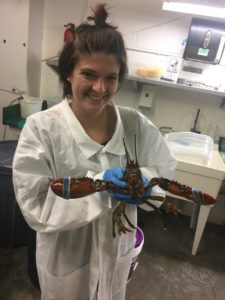
One of the students involved in Research Fellows is Hallie Manchester. Hallie, ’20, joined the program last year and has worked with her research advisor, Dr. Jorgensen, on their project about the American lobster.

“I inject the lobster with Vibrio bacteria containing a gene to glow called GFP. We then study the ratio of bacteria to hemocytes, or lobster blood cells. What we have been finding is a predictable curve of bacterial clearance vs hemocytes present. The hemocytes clump around the bacteria and bring it out of the body as the method of clearance. I will soon start on a project to investigate if the lobsters have an immune memory; if we inject the same bacteria later, will it affect how fast they can clear it from their system? We are also doing qPCR to determine how much live bacteria is in the tissues of the animal when the experiment is over”.

Hallie decided to apply for to the Research Fellows program after taking a science class called biotechnology in high school.

“I knew from then that I at least wanted to try research in college. When I applied to Roanoke, a huge factor to my decision to come here was my acceptance to the fellows. I wanted to work closely with a professor and discover something new. Since entering the fellows I have expanded my ability to do research on paper but also in the lab, not to mention I get paid”.

Hallie has really enjoyed working with her research advisor.

“Dr. Jorgensen has become a big part of my life. He takes us out for lab lunches and helps me network with fellow researchers and people in health professions. During my first freshman semester, I went to dinner with a visiting Virginia Tech Professor and was able to make connections, it was a major highlight! But Doc entrusts me with a lot of responsibilities with experiments and animal husbandry. It’s a really awesome experience to have a professor trust you with their lab and the other students you work with”.

Hallie’s most exciting part of her research so far was doing her first bacterial challenge by herself.

“I had been practicing on old animals and had been doing prep work helping an older peer. Then I got to do a whole experiment by myself. I had to do my own injections, plates, count my own hemocytes, and prep my own animal and reagents. It was crazy to know I was in charge of my own experiment and I could make a discovery”.

Hallie’s biggest goal from undergoing the Research Fellows is to be published in a scientific journal as a coauthor

“As an undergraduate this is a huge project to undertake and to be published would be a giant honor. However, some more realistic goals are to go to national conferences on undergraduate research and make a difference in the lobster fishing industry. Coming from Rhode Island, I have noticed the decline in the fishing industry and my research may make a difference in how we fish for crustaceans, like lobsters.

To anyone considering doing research, Hallie says,

“Being in the fellows has shown me that research is not limited to science. There are awesome projects going on in all the departments! Follow your passion and find out what is going on around campus. Don’t be afraid to approach a professor about their project, you never know if they have a position open. If you have passion, you can figure something out. Also, once you get started, you do a lot of grunt work. Keep working and eventually you will get to do something cool. Just stick it out until you do your part as a newbie. Balancing research, school, sports and social life can seem a bit daunting, but with time management it is possible”.

2017 Summer Scholars: Abdul-Fatah Soroush

Fatah is one of the 2017 Summer Scholars, a group of students selected to carry out their own research project with a faculty mentor over the summer. A senior majoring in International Relations, Fatah’s research project is titled: “United Nations and Global Governance”. He worked with Dr. Andreea Mihalache-O’Keef to complete his project.

“The focus of my paper is to analyze the role of the United Nations with regards to how it deals with contemporary “security threats” such as ongoing intra-state wars, trans-national terrorism, environmental catastrophes, pandemics, and so on. “Security threats” is in quotes because the nature of these threats, as well as what should be done about them, is interpreted differently by the members of the United Nations and by international experts. The approach of my paper is from a human security standpoint (considering the security of the world’s populations and prioritizing it over the security of nation-states) and it suggests, rather cautiously, that if the United Nations is to have more control over its surroundings (as necessary, given trans-nationalization of these threats), rather than the reverse, its member states need to transfer more loyalty, authority, and legitimacy to it. With this project, I intended to learn how the United Nations could be reformed or made more effective in trying to alleviate human suffering and promoting human prosperity”.

Fatah first became interested in his project during the Washington semester program where he did research on the involvement of Iranian-backed militias fighting in Syria.

“The role of UN Security Council has been virtually irrelevant in Syria, since many resolutions that have tried to reduce the scale of horrors happening in Syria have been vetoed by the veto-holding members of the Security Council (United States, Russia, China, France, and Britain); particularly by either the United States or Russia. The role of regional actors is devastating too. Iran, Saudi Arabia, Turkey, Israel, as well as several non-state actors like ISIS, al-Qaeda, etc. carry out their own agendas and are highly detrimental to the population in Syria. Syria presents a very ugly picture, but is a great example of how a more sovereign United Nations could have been more helpful in reducing the scale of suffering happening there”.

Fatah enjoyed working with Dr. Andreea Mihalache-O’Keef. She encouraged him to present his research at the ISA-South conference in Orlando on October 20th-21st

“I presented my Summer Scholars paper in a panel called “Mobilization,” which was chaired by my Summer Scholars advisor Dr. O’Keef. I also attended four other panels themed “Governance,” “Environment, Health and Human Security,” “Refugees and Migration,” and “Middle East and Central Asia.” The panelists, as well as the audience, in each panel were mostly graduate students and professors, but there were some undergraduates too. It was a great learning experience and I had a chance to talk with some professors and graduate school students about my academic interests, and to get their advice as I prepare for graduate school applications”.

To anyone considering doing research, Fatah suggests to find a research question and pursue it.

“This is what I believe education is all about, to observe the nature, oneself, others, world events, and so on, and see what kinds of questions one comes across to study”.

Damian Ream: Summer Intern Experience at Dominion Energy

Over the summer, Damian Ream, ’18, had the opportunity to work with Dominion Energy in Surry, Virginia. Damian was an intern at the Physics department in Dominion Energy’s Surry Nuclear Power Station.

“The purpose of the health physics department is to analyze nuclear samples taken from the plant to ensure nothing harmful is leaving the power plant, and more importantly, to make sure plant workers are working safely and not receiving larger doses of radiation than what is expected or allowable”.

Damian worked under his supervisor Paul Harris, but also was able to work with full time health physics technicians and students from other colleges.

“I learned a lot about how nuclear energy works and what goes into maintaining and running a power plant. I also was able to take a trip to Dominion Energy’s clearing house where they sell their energy and also look for new business endeavors. I obtained valuable insight on the nuclear industry and was able to further learn and shape my goals for the future”.

Damian’s favorite part about working at the nuclear power station was being able to research some of the new technologies that the power plant has available.

“The most interesting part to me was potentially using drones to check certain plant conditions. One condition in particular was checking the structure and integrity of the containment building using thermal imaging to see where repairs may need to be made. Ultimately it was determined that it was a technology not needed at this time, as it would require a licensed drone pilot due to the fact that it would be used by a corporation for business purposes. That licensing process would cost time and money, and then the drone would only be able to be flown by those few individuals who actually got licensed”.

To anyone considering doing research or an internship, Damian’s advice is to apply to any program or project that interests you.

“Even if you feel you may not be qualified, apply anyways. There were a few interns I worked with from different departments who weren’t chosen for the department they applied for, but their internship application was actually forwarded to another department that ended up hiring them as an intern. Apply even if you’re not sure if you’d be interested in it. I think that’s all part of the internship experience. If you find you like it, that’s great! Dominion Energy is one of the many companies that often offer their interns full-time jobs out of college. If you find you don’t like it then that’s still good. You’ve gained some valuable internship experience, and you just decided a career path you’re not interested in rather than trying to pursue it post-graduation and deciding then”.

2017 Summer Scholars: Megan Miller

Megan Miller, a senior majoring in Psychology, was one of the thirteen students selected into the 2017 Summer Scholars program. Over the summer, she was able to work with her faculty advisor, Dr. Chris Buchholz, to complete her research project titled: “Self-driving cars as a test of the potentially harmful effects of empathy on moral decision making”.

“My research project is attempting to understand what individual differences impact the decisions made during a moral dilemma. We hypothesized that empathy levels, your ability to understand the feelings of others, would have a large impact of what types of decisions people would make. Specifically those with higher levels of empathy would lead to consequentialist decisions, such as thinking about the greater good. We used self-driving cars as the moral dilemma in our study, asking participants who they think a self-driving car should save (examples include save your mom vs. three people, save yourself vs. a scientist on the verge of curing diabetes). From completing the project, I hope to learn what factors actually influence the types of decisions people make when faced with a moral dilemma”.

Megan started to think about her project while working with her advisor, Dr. Buchholz, in a research lab during her sophomore year.

“I helped with the other projects in the lab and then Dr. Buchholz and I started doing a literature review of empathy, focusing on the negative effects empathy can have. From there, we came up with the idea to see how empathy impacts moral decision making and decided on self-driving cars, since they are still an extremely new technology. We thought they would provide an interesting moral dilemma, and would potentially provide information for companies that make self-driving cars to help them determine how to program the cars”.

Megan enjoyed working with Dr. Buchholz over the summer.

“The Summer Scholars program has allowed me to work on my project throughout the summer, giving me more time to explore the results and hypothesize the reasons for the unexpected results. Summer Scholars also gave me funding that I was able to use to pay participants for the study”.

Megan is still working on her final research paper, but hopes to complete her project soon.

“I’ve completed most of the data analyses, but I’m still working on completing my final research paper. We did determine that males are more likely to make choices that benefit the greater good (such as saving Nobel Prize winning physicist over a stranger) than females, but overall both males and females tend to save themselves and their mom. We just ran a follow up study looking more into the gender differences, but haven’t analyzed that data yet”.

To anyone considering doing a research project, Megan recommends getting involved.

“If you’re interested, but don’t have a project in mind, talk to a professor in the department you’re interested in doing research in. They might already have a project in mind they need help with that you can take in your own direction, or they can help you brainstorm ideas for your own project”.

2017 Summer Scholars: Sabrina McAllister

Sabrina McAllister, a senior majoring in Psychology, was one of the thirteen students selected into the 2017 Summer Scholars program. Over the summer, she was able to work with her faculty advisor, Dr. David Nichols, to complete her research project titled “Time Perspective as a State-Based Measure”.

“My project is on time perspective (the way a person orients him/herself towards the past, present, or future). I am focusing specifically on the Zimbardo’s Time Perspective Inventory (ZTPI), which is the most popular measure of time perspective in the psychology literature. I am examining its structure to determine ways in which it can be improved and modified to provide more valid and reliable results”.

Sabrina first got into her project through Dr. Nichols.

“My advisor had been previously doing research on time perspective when I started working with him. The first project I took on under his supervision was a literature review that combined sensation-seeking and time perspective, which was how I was introduced to the ZTPI. As I did the reading for my paper, I realized that there seemed to be a lot of uncertainty in the literature regarding Zimbardo’s questionnaire, so I made it my next project to improve on some of that”.

Sabrina decided to apply to be a summer scholar so she could work on her research project without having to worry about getting distracted by classes and campus events. She was able to work closely with her research advisor throughout the summer.

“My research advisor is very helpful. He has given me several bits of advice and taught me new things. I think the best part of working with him is the amount of independence he provides. I can ask direct questions if I’m unsure of something, but most of the time, I’m given an instruction and some resources, and I figure it out myself. It can be more work this way, but it allows me to learn a lot in a very short amount of time, which is thrilling”.

Sabrina has learned quite a bit from working on her project.

“I’ve gained an understanding of statistical concepts that are not included in the standard statistics curriculum, and I’ve gained computer skills that will be useful throughout my life, on the job and off. I am also currently working on writing a final manuscript for my project, and I expect that, as I continue it, I will learn about the nuts and bolts of scientific writing that I haven’t yet come across. It will continue to be lots of intensive work and require ample amounts of time, but it will be worth the effort because, by the end of it, I will have completed two project defenses, presented at a campus poster session, and at a national conference. I also intend to submit the manuscript for publication in the spring, which will be an exciting milestone in both my academic and professional career”.

To anyone considering doing research, Sabrina’s advice is to get started right away.

“Research is time-intensive and long-winded, but it’s very rewarding and beneficial. You’ll get the most out of it if you do it for more than just one or two semesters. I started research in my department during my very first semester, and I wouldn’t have come this far or learned this much if I hadn’t spent this much time with it. If it’s something you’re strongly interested in, contact the people in your department. Even if your first choice of advisor isn’t available, get your foot in the door and do a little bit of something with someone. It’s not a four-year commitment! See what options are available to you, and take advantage of them. Also, don’t be afraid to be original. Most of the research students I’ve talked to came up with their project on their own, pitched the idea to their advisor, and ran with it from there; so you should definitely feel free to explore your own interests”.

2017 Summer Scholars: Lynn Luckenbaugh

The Summer Scholars program allows students serious about research to work one-on-one with a faculty mentor to design and implement a research project during the summer and present their findings in the fall. Each year students are selected from various majors across campus. Lynn Luckenbaugh was one of the thirteen summer scholars selected into the 2017 Summer Scholars program.

A senior majoring in Biochemistry and Math, Lynn’s project is entitled “Investigation of a Putative Hydroxymandelate Synthase in Streptomyces violaceusnige”. She’s been working with Dr. Sarisky to investigate the function of enzymes in Streptomyces violaceusnige and collect more data on metal, pH, and temperature preferences.

“There are two related enzymes, HMS and HPPD.  HMS catalyzes a reaction important in vancomycin synthesis, an antibiotic, and HPPD catalyzes a reaction important in tyrosine catabolism.  I am studying an enzyme from Streptomyces violaceusniger that is thought to be an HMS, but due to the similarity of the enzymes may have HPPD function instead. I chose this project because I wanted to study an enzyme that was useful for something, like antibiotic synthesis, and I thought that the idea of HMS and HPPD being so similar but having different functions was interesting”.

Lynn wanted to do the summer scholar program because she enjoyed doing research over the school year and wanted to do research full time over the summer. In completing the project she hopes to gain more biochemical laboratory techniques.

“I have not yet completed this project. I have successfully produced a sample of this enzyme but I have not yet been able to show activity.  There have been issues trying to get the starting material for this reaction into solution.  Due to the time spent investigating this issue, the batch of enzyme I had produced and purified sat in the freezer for about a month.  This could have caused activity levels to decrease.  I plan to start the fall semester by producing and purifying another batch of enzyme to see if I can detect activity in it”.

As Lynn reflects on her time spent at Roanoke, she says that research has been one of her most valuable experiences.

“While taking a lecture class or a lab allows you to learn material and gain some experience, research allows you to gain independent experience with procedures common in your discipline and it allows you to really master a skill.  It also teaches you problem solving skills, time management, and many other important transferable skills”.

Roanoke College Student Presents at 2017 National Conference of Undergraduate Research

Dantaé Henderson is a senior majoring in Spanish with concentrations in Latin American and Caribbean Studies and Teaching English as a Second Language (TESL). She presented her research project, “Du Bois’s Double consciousness and The Afro-Peruvian Identity in Victoria Santa Cruz, ‘Me Gritaron Negra’”, at the 2017 National Conference of Undergraduate Research (NCUR) at the University of Memphis. Dantaé finished her project while completing her independent study for the Spanish major with Dr. Bañuelos-Montes.

She decided to investigate this topic because of her interest in analyzing literature and connecting literature to different theories.

“Vitoria Santa Cruz’s poem, “Me gritaron negra”, reveals how the paradigms of the dominant groups are formed and how the marginalized groups, in this study the Afro-Peruvians, are forced to deny the racial characteristics and cultural manifestations that make up their cultural identity. The stereotypes that separate the groups by race continue to create racial divisions in which the superior groups impose whiteness as the norm, thus imposing a colonialist idealism that categorizes marginalized groups as inferior. Victoria Santa Cruz’s poem is a reaction to the dominant discourse that poses as a threat to nationalism because such discourses manifest a process of acculturation and denial of the Afro-Peruvian’s identity. How does Victoria Santa Cruz resist this discourse of superiority? To understand this process, I will use W.E. B. Du Bois’ concept of double consciousness. The dominant discourse provides a realistic representation of how Afro-Peruvians are depicted in a traditional manner, which maintains, still, colonial stereotypes. This image impacts the perceptions of the Afro-Peruvian, as the dominant discourse continues to expose the stereotypical image; Du Bois believes that the marginalized individual will identify with that message on the long-term. This is the dialogue of the first part of the poem. The second part of the poem alludes to Du Bois’ attainment of the, “self-consciousness…into a better and truer self.” By applying Du Bois theory, I can argue that Victoria Santa Cruz creates an Afro-Peruvian subject that moves from the margin to the center, the creation of the Afro-Peruvian identity”.

Dantaé enjoyed having chance to work with Dr. Bañuelos-Montes.

“It was a great opportunity to utilize the knowledge and specialties of a specific professor because sometimes in the classroom they are not able to work one on one with a student and do a more profound research”.

Dantaé found the experience of presenting her research at NCUR very exciting.

“I never thought that an idea could turn into me presenting this research and defending in a foreign setting. It gave me experience that will help me in my future studies”.

To anyone thinking about doing research at Roanoke, Dantaé suggests you take the opportunity.

“It is a great way to specifically take on a topic that interests you that may not be to do in your regular classes”.

Roanoke College student presents at Society for Integrative and Comparative Biology conference

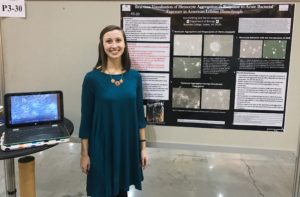
Sara Farthing, a junior at Roanoke majoring in biology with a minor in chemistry and Spanish, had the opportunity to present her research at the Society for Integrative and Comparative Biology conference in January. Her research project was titled “Real-time Visualization of Hemocyte Aggregation in Response to Acute Bacterial Exposure in American Lobster Hemolymph”. She worked with her research advisor, Dr. Jorgensen, to understand the physiology of invertebrates.

“We mainly used the American Lobster as our model organism. Specifically, I am studying the immune response of the American lobsters. I used microscopy to determine how the hemocytes (essentially blood cells) coagulate and also how they react in the presence of bacteria. Using the microscopes, I was able to visualize the cells in real time using time lapse photography. This means I could see the progression of a process over a certain period of time instead of capturing one image, which could be an isolated event out of the context. I was able to visualize the clotting mechanism of hemocytes (the lobster blood cells) in real time and how this process was affected by the introduction of bacterial cells. My results showed that the clotting mechanism is in fact involved in the immune response of the American lobster”.

Sara really enjoyed presenting her research at the Society for Integrative and Comparative Biology conference.

“I had so many people not only listen to my elevator speech but have one on one conversations with me and discussions in which my experience and knowledge was equally valued. In addition I was even able to make connections with other labs across the country who we will be collaborating in the continuation of my project. I had several graduate students and professors say that my research was far more advanced then what they had seen at the undergraduate level. It is possible I am studying phenomena and asking questions that even professionals haven’t thought to ask yet! This was an inspiring and enriching experience that I will never forget”.

Sara loved working with Dr. Jorgensen to complete their research project.

“He is a wonderful mentor who guides and challenges me throughout my research. He makes himself available so that he can be there when things go wrong or if things go right and I want to push ahead to the next level. I am continuously learning from him not only in areas concerning research but he is a role model for me in how to treat and guide others with an encouraging and kind demeanor. He has also become a friend and support network for me here at college. This will be one of those connections that I cherish and will have for the rest of my life”.

For anyone contemplating doing research at Roanoke, Sara says:

“Absolutely do it! No matter what major, there is always an opportunity for you to get involved in research with a professor. All you have to do is ask and professors will be happy and willing to encourage and nurture your passion for this area of curiosity. More than any club or organization, doing research here at Roanoke has helped me find my niche as well as group of students and faculty that I can always count on”.

Roanoke College student presents at Consortium for Computing Sciences in Colleges Southeast conference

Christian Moore, a senior majoring in computer science and math, had the opportunity to present his research project at the Consortium for Computing Sciences in Colleges Southeast conference in November 2016. Christian’s project was titled “Finding the Center of the Universe”. His research advisor was Dr. Anil Shende.

Christian best described his project as imagining a bunch of people in a room walking away from each other.

“If everyone closed their eyes and stood at one point, then started walking away from each other, [then], at some point I ask you to open your eyes.  How many people would you need to look at to find the center where you started? For this problem I designed an algorithm so that we could solve for the center in no more than four observations.  I was able to show mathematically that my algorithm worked”.

Christian found that working with Dr. Shende was very helpful.

“While working, there are many different paths you can take to solve the problem, and sometimes you can find yourself stuck in one way of thinking about your problem.  A huge help that my advisor gave me was reminding me that there are alternate paths to a solution.  This really helped keep me from thinking that there is only one solution”.

Christian enjoyed his time at the conference.

“While I was there, I was part of the student research competition as well as part of the student programming competition. I was able to see the research projects of other students my age from schools around the Southeast.  What I enjoyed most was talking to the various judges and visitors at the conference.  It was amazing to see that the keynote speaker of the conference came by to talk with all the students that were presenting research”.

For anyone thinking about doing research, Christian says:

“Do it. As a younger student I was never really sure whether research or an internship was right for me, so I tried both.  Now after finishing my summer research project, my only wish is that I would have started looking at research sooner.  This summer of research was the driving factor for why I chose to continue on to graduate school after Roanoke”.

Roanoke College student presents “Stat Crew” in Atlanta

David Moreau, a senior majoring in physics and minoring in math, had the opportunity to present his research project at the Joint Mathematics Meeting in Atlanta, Georgia. David’s project was titled “Stat Crew at Roanoke College” where he worked Dr. Roland Minton and a group of students to participate in sports analysis for the various athletic teams at Roanoke.

“It started off in the Fall of 2015 by getting passing statistics to the coaches of the soccer teams. An app was developed by our own Dr. Adam Childers for basketball season to get pinpoint locations of shots so that heat maps could be created, along with player by player statistics for each game. Lastly, this app was tweaked for lacrosse to get shot by shot breakdowns of plays for both teams”.

David became involved in research early in his freshmen year.

“I met Dr. Minton in a scholarship interview during my senior year of high school, where he introduced the idea of Stat Crew to me along with telling me about his golf research. When I decided to come to Roanoke, I emailed Dr. Minton and he kept me informed about the beginning of Stat Crew. At first, I received course credit for the work I was doing. I mostly participated in the data collection process (going to games and actually getting the data and using the app). My input was able to help change the app to become more user-friendly and efficient. This research project, however, is more of a group effort. We would not be here without the effort of the entire Stat Crew, and the countless hours that Dr. Minton and Dr. Childers have invested into making sure the group survives. Through their motivation and dedication to the group, I think all of us in the Stat Crew really wanted to invest our time to make sure we were doing something meaningful for the college”.

David really enjoyed working with Dr. Minton to finish the project.

“Dr. Minton and I have much in common, mostly from our common interest in golf. Getting to know him on such a personal level has been a very rewarding experience. He is definitely one of my role models here at school and makes me excited to continue the work I have done with the Stat Crew.”

At the Joint Mathematics Meeting, David presented on the details of Stat Crew and the group’s goals for the future.

“Presenting my research was quite the experience. I have never been on a stage of such high level of academia before. To be in a room of such experts in the field of Sports Analytics as a sophomore undergraduate student was quite mind numbing. I tried not to think about it too much by the time I got up there. The hotel I was presenting at was quite intimidating, but the support of the MCSP department was unwavering and helped immensely as I was up there on stage”.

David believes getting involved in research was one of the best decisions he made.

“Roanoke has some immense opportunities for people willing to put in the work for them. As a sophomore undergraduate student, I presented at the biggest math meeting in the world. I truly believe that I only would have gotten this opportunity here at Roanoke and no-where else. For that, I am grateful to the staff of the MCSP department for putting their faith in me to do a good job representing the school”.

For anyone thinking about doing research, David says:

“Research at Roanoke will take you places that you never would have expected. Take advantage of any opportunity you can, as the staff here is willing to put as much effort in as you are to help see you succeed”.