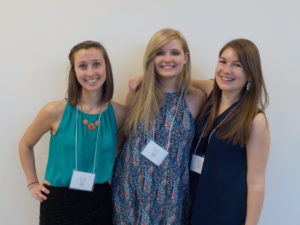
2017 Summer Scholars: Lynn Luckenbaugh

The Summer Scholars program allows students serious about research to work one-on-one with a faculty mentor to design and implement a research project during the summer and present their findings in the fall. Each year students are selected from various majors across campus. Lynn Luckenbaugh was one of the thirteen summer scholars selected into the 2017 Summer Scholars program.

A senior majoring in Biochemistry and Math, Lynn’s project is entitled “Investigation of a Putative Hydroxymandelate Synthase in Streptomyces violaceusnige”. She’s been working with Dr. Sarisky to investigate the function of enzymes in Streptomyces violaceusnige and collect more data on metal, pH, and temperature preferences.

“There are two related enzymes, HMS and HPPD.  HMS catalyzes a reaction important in vancomycin synthesis, an antibiotic, and HPPD catalyzes a reaction important in tyrosine catabolism.  I am studying an enzyme from Streptomyces violaceusniger that is thought to be an HMS, but due to the similarity of the enzymes may have HPPD function instead. I chose this project because I wanted to study an enzyme that was useful for something, like antibiotic synthesis, and I thought that the idea of HMS and HPPD being so similar but having different functions was interesting”.

Lynn wanted to do the summer scholar program because she enjoyed doing research over the school year and wanted to do research full time over the summer. In completing the project she hopes to gain more biochemical laboratory techniques.

“I have not yet completed this project. I have successfully produced a sample of this enzyme but I have not yet been able to show activity.  There have been issues trying to get the starting material for this reaction into solution.  Due to the time spent investigating this issue, the batch of enzyme I had produced and purified sat in the freezer for about a month.  This could have caused activity levels to decrease.  I plan to start the fall semester by producing and purifying another batch of enzyme to see if I can detect activity in it”.

As Lynn reflects on her time spent at Roanoke, she says that research has been one of her most valuable experiences.

“While taking a lecture class or a lab allows you to learn material and gain some experience, research allows you to gain independent experience with procedures common in your discipline and it allows you to really master a skill.  It also teaches you problem solving skills, time management, and many other important transferable skills”.

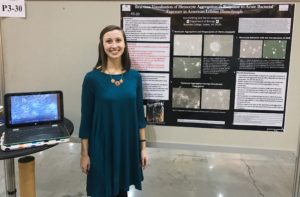
Roanoke College Student Presents at 2017 National Conference of Undergraduate Research

Dantaé Henderson is a senior majoring in Spanish with concentrations in Latin American and Caribbean Studies and Teaching English as a Second Language (TESL). She presented her research project, “Du Bois’s Double consciousness and The Afro-Peruvian Identity in Victoria Santa Cruz, ‘Me Gritaron Negra’”, at the 2017 National Conference of Undergraduate Research (NCUR) at the University of Memphis. Dantaé finished her project while completing her independent study for the Spanish major with Dr. Bañuelos-Montes.

She decided to investigate this topic because of her interest in analyzing literature and connecting literature to different theories.

“Vitoria Santa Cruz’s poem, “Me gritaron negra”, reveals how the paradigms of the dominant groups are formed and how the marginalized groups, in this study the Afro-Peruvians, are forced to deny the racial characteristics and cultural manifestations that make up their cultural identity. The stereotypes that separate the groups by race continue to create racial divisions in which the superior groups impose whiteness as the norm, thus imposing a colonialist idealism that categorizes marginalized groups as inferior. Victoria Santa Cruz’s poem is a reaction to the dominant discourse that poses as a threat to nationalism because such discourses manifest a process of acculturation and denial of the Afro-Peruvian’s identity. How does Victoria Santa Cruz resist this discourse of superiority? To understand this process, I will use W.E. B. Du Bois’ concept of double consciousness. The dominant discourse provides a realistic representation of how Afro-Peruvians are depicted in a traditional manner, which maintains, still, colonial stereotypes. This image impacts the perceptions of the Afro-Peruvian, as the dominant discourse continues to expose the stereotypical image; Du Bois believes that the marginalized individual will identify with that message on the long-term. This is the dialogue of the first part of the poem. The second part of the poem alludes to Du Bois’ attainment of the, “self-consciousness…into a better and truer self.” By applying Du Bois theory, I can argue that Victoria Santa Cruz creates an Afro-Peruvian subject that moves from the margin to the center, the creation of the Afro-Peruvian identity”.

Dantaé enjoyed having chance to work with Dr. Bañuelos-Montes.

“It was a great opportunity to utilize the knowledge and specialties of a specific professor because sometimes in the classroom they are not able to work one on one with a student and do a more profound research”.

Dantaé found the experience of presenting her research at NCUR very exciting.

“I never thought that an idea could turn into me presenting this research and defending in a foreign setting. It gave me experience that will help me in my future studies”.

To anyone thinking about doing research at Roanoke, Dantaé suggests you take the opportunity.

“It is a great way to specifically take on a topic that interests you that may not be to do in your regular classes”.

Roanoke College student presents at Society for Integrative and Comparative Biology conference

Sara Farthing, a junior at Roanoke majoring in biology with a minor in chemistry and Spanish, had the opportunity to present her research at the Society for Integrative and Comparative Biology conference in January. Her research project was titled “Real-time Visualization of Hemocyte Aggregation in Response to Acute Bacterial Exposure in American Lobster Hemolymph”. She worked with her research advisor, Dr. Jorgensen, to understand the physiology of invertebrates.

“We mainly used the American Lobster as our model organism. Specifically, I am studying the immune response of the American lobsters. I used microscopy to determine how the hemocytes (essentially blood cells) coagulate and also how they react in the presence of bacteria. Using the microscopes, I was able to visualize the cells in real time using time lapse photography. This means I could see the progression of a process over a certain period of time instead of capturing one image, which could be an isolated event out of the context. I was able to visualize the clotting mechanism of hemocytes (the lobster blood cells) in real time and how this process was affected by the introduction of bacterial cells. My results showed that the clotting mechanism is in fact involved in the immune response of the American lobster”.

Sara really enjoyed presenting her research at the Society for Integrative and Comparative Biology conference.

“I had so many people not only listen to my elevator speech but have one on one conversations with me and discussions in which my experience and knowledge was equally valued. In addition I was even able to make connections with other labs across the country who we will be collaborating in the continuation of my project. I had several graduate students and professors say that my research was far more advanced then what they had seen at the undergraduate level. It is possible I am studying phenomena and asking questions that even professionals haven’t thought to ask yet! This was an inspiring and enriching experience that I will never forget”.

Sara loved working with Dr. Jorgensen to complete their research project.

“He is a wonderful mentor who guides and challenges me throughout my research. He makes himself available so that he can be there when things go wrong or if things go right and I want to push ahead to the next level. I am continuously learning from him not only in areas concerning research but he is a role model for me in how to treat and guide others with an encouraging and kind demeanor. He has also become a friend and support network for me here at college. This will be one of those connections that I cherish and will have for the rest of my life”.

For anyone contemplating doing research at Roanoke, Sara says:

“Absolutely do it! No matter what major, there is always an opportunity for you to get involved in research with a professor. All you have to do is ask and professors will be happy and willing to encourage and nurture your passion for this area of curiosity. More than any club or organization, doing research here at Roanoke has helped me find my niche as well as group of students and faculty that I can always count on”.

Roanoke College student presents at Consortium for Computing Sciences in Colleges Southeast conference

Christian Moore, a senior majoring in computer science and math, had the opportunity to present his research project at the Consortium for Computing Sciences in Colleges Southeast conference in November 2016. Christian’s project was titled “Finding the Center of the Universe”. His research advisor was Dr. Anil Shende.

Christian best described his project as imagining a bunch of people in a room walking away from each other.

“If everyone closed their eyes and stood at one point, then started walking away from each other, [then], at some point I ask you to open your eyes.  How many people would you need to look at to find the center where you started? For this problem I designed an algorithm so that we could solve for the center in no more than four observations.  I was able to show mathematically that my algorithm worked”.

Christian found that working with Dr. Shende was very helpful.

“While working, there are many different paths you can take to solve the problem, and sometimes you can find yourself stuck in one way of thinking about your problem.  A huge help that my advisor gave me was reminding me that there are alternate paths to a solution.  This really helped keep me from thinking that there is only one solution”.

Christian enjoyed his time at the conference.

“While I was there, I was part of the student research competition as well as part of the student programming competition. I was able to see the research projects of other students my age from schools around the Southeast.  What I enjoyed most was talking to the various judges and visitors at the conference.  It was amazing to see that the keynote speaker of the conference came by to talk with all the students that were presenting research”.

For anyone thinking about doing research, Christian says:

“Do it. As a younger student I was never really sure whether research or an internship was right for me, so I tried both.  Now after finishing my summer research project, my only wish is that I would have started looking at research sooner.  This summer of research was the driving factor for why I chose to continue on to graduate school after Roanoke”.

Roanoke College student presents “Stat Crew” in Atlanta

David Moreau, a senior majoring in physics and minoring in math, had the opportunity to present his research project at the Joint Mathematics Meeting in Atlanta, Georgia. David’s project was titled “Stat Crew at Roanoke College” where he worked Dr. Roland Minton and a group of students to participate in sports analysis for the various athletic teams at Roanoke.

“It started off in the Fall of 2015 by getting passing statistics to the coaches of the soccer teams. An app was developed by our own Dr. Adam Childers for basketball season to get pinpoint locations of shots so that heat maps could be created, along with player by player statistics for each game. Lastly, this app was tweaked for lacrosse to get shot by shot breakdowns of plays for both teams”.

David became involved in research early in his freshmen year.

“I met Dr. Minton in a scholarship interview during my senior year of high school, where he introduced the idea of Stat Crew to me along with telling me about his golf research. When I decided to come to Roanoke, I emailed Dr. Minton and he kept me informed about the beginning of Stat Crew. At first, I received course credit for the work I was doing. I mostly participated in the data collection process (going to games and actually getting the data and using the app). My input was able to help change the app to become more user-friendly and efficient. This research project, however, is more of a group effort. We would not be here without the effort of the entire Stat Crew, and the countless hours that Dr. Minton and Dr. Childers have invested into making sure the group survives. Through their motivation and dedication to the group, I think all of us in the Stat Crew really wanted to invest our time to make sure we were doing something meaningful for the college”.

David really enjoyed working with Dr. Minton to finish the project.

“Dr. Minton and I have much in common, mostly from our common interest in golf. Getting to know him on such a personal level has been a very rewarding experience. He is definitely one of my role models here at school and makes me excited to continue the work I have done with the Stat Crew.”

At the Joint Mathematics Meeting, David presented on the details of Stat Crew and the group’s goals for the future.

“Presenting my research was quite the experience. I have never been on a stage of such high level of academia before. To be in a room of such experts in the field of Sports Analytics as a sophomore undergraduate student was quite mind numbing. I tried not to think about it too much by the time I got up there. The hotel I was presenting at was quite intimidating, but the support of the MCSP department was unwavering and helped immensely as I was up there on stage”.

David believes getting involved in research was one of the best decisions he made.

“Roanoke has some immense opportunities for people willing to put in the work for them. As a sophomore undergraduate student, I presented at the biggest math meeting in the world. I truly believe that I only would have gotten this opportunity here at Roanoke and no-where else. For that, I am grateful to the staff of the MCSP department for putting their faith in me to do a good job representing the school”.

For anyone thinking about doing research, David says:

“Research at Roanoke will take you places that you never would have expected. Take advantage of any opportunity you can, as the staff here is willing to put as much effort in as you are to help see you succeed”.

Roanoke College seniors present at ASM conference

021

Pictured above from left to right: Sara Farthing, Kirsten Norman, Savannah Scott

The American Society for Microbiology (ASM) regional conferences are more intimate gatherings than the national conference where students and professors present their research projects and learn about others. Roanoke College students Savannah Scott, ’17, and Kirsten Norman, ’17, were two of the students who went to an ASM Virginia conference in November. Their research project was titled, “Development of Novel mcrA and pmoA qPCR Primers and Probe Targeting Methanogens and Methanotrophs in Cattle Farm Samples as a Method of Microbial Source Tracking”. They worked with Dr. Crozier to complete their research.


Both Savannah and Kirsten began the project over the summer.

Kirsten: “In the beginning of the summer we focused on researching more about methanogens and methanotrophs. Once we determined the genes we wanted to target, mcrA and pmoA, we moved on to the next step of primer and probe creation through the program Sequencher. Producing primers and probe allowed us to quantitatively analyze the amount of methanogens and methanotrophs in samples we acquired at the horse farm. What we hope to apply our research to in the future is microbial source tracking which allows one to track where contamination is coming from in bodies of water.”

Savannah really enjoyed working with Dr. Crozier to complete their project.

“My research adviser did a wonderful job in training me the first semester I started research. Then he took a hands-off approach once I figured out the direction of my project. This encouraged me to plan ahead, to learn how to think critically and to learn how to troubleshoot. If I was really stuck, however, he was always there to offer help and guidance.”

Both Savannah and Kirsten had a rewarding experience at the ASM conference

Savannah: “It was really exciting to be able to meet and talk to graduate students about their projects and how they got to where they are. I made many connections with graduate professors and got some insight into possibilities for future work in my field! Many of them offered great advice. Additionally, it was so fun to be in a room with people with the same interests!”

Kirsten: “It pushed me out of my comfort zone, but in a good way because it helped me gain confidence in presenting my research to people that have a lot of knowledge about the subject I am researching. It was inspiring to see what a wide range of people attending the conference including everything from undergraduate research students to graduate students in the progress of completing their Ph.D. Ultimately attending a conference such as this gives one a look into what life after undergraduate studies could look like.”

When asked about why they started and completed their research project, both Savannah and Kirsten saw it as a great experience for after graduation, but quickly grew to love the topic.

Savannah: “Shortly after beginning work in the lab, I realized a passion for microbiology. I continued my research fueled by ambition to find answers and natural curiosity about the subject itself and the techniques involved in microbiology research. I was encouraged by answers that lead to more questions, and the stubborn desire to know why. When the opportunity to present in a conference revealed itself, I was eager to present my findings to experts and professionals within the field I am working because of the insight they would be able to provide. I also knew it would be great experience for graduate school and my future career as a microbiologist.”

Kirsten: “I have a strong desire to pursue research post-graduation and that is what got me interested in performing research in the first place. Another reason as to why I have continued to participate in research is because of the interesting microorganisms we get to study in Crozier’s lab and just how well our lab works together in research.”

Summer Research Abroad: Stephanie Shields

img_7980

Stephanie Shields, ’17, is Psychology major and German minor with a concentration in Neuroscience. Over the summer she was able to travel abroad to Hamburg, Germany through an internship program called the German Academic Exchange Service Research Internship in Science and Engineering. She worked with Ph.D. student Signe Luisa Schneider to complete her project on electroencephalography (EEG), learning, and memory.

“She’s using electrophysiological and behavioral methods to examine differences in EEG patterns and memory between elderly subjects and a young comparison group. She’s also using a brain-computer interface to attempt to train elderly participants to alter their brain activity in the hopes of increasing the activity in certain frequency bands, which have been found to be associated with subsequent memory in prior studies. I helped to set up for, run, and clean up after EEG sessions. I also helped Signe preprocess EEG data, and after gaining more experience with the MATLAB computing environment and reading literature related to the methodology and research questions, I helped with data processing and analysis. I also conducted a literature search, which will hopefully help Signe as she completes the project and writes up the results for publication.”

Stephanie’s favorite moment was when she suggested an idea that would improve the quality of the data.

“I sat down with Signe to talk to her about our preprocessing script and was able to suggest an idea to her that improved the quality of data we ended up with after preprocessing it to remove artifacts. That step is essential in obtaining valid results, so being able to work with my supervisor on that problem and make a meaningful contribution to its solution was both exciting and rewarding.”

For anyone considering doing research, Stephanie recommends giving it a shot.

“Even if you think something may be a long shot and even if you’re worried that you don’t have all the skills or abilities you’ll need, go for it and see what happens. Do your best, and take every experience you have as an opportunity to learn and grow.”

Internship at Patuxent Environmental and Aquatic Research Lab

sam-waby

Samantha Waby performing a natural spawn

Samantha Waby is a senior majoring in Environmental Studies who interned at Patuxent Environmental and Aquatic Research Lab (PEARL) in Saint Leonard, Maryland in the summer of 2016. She worked in their oyster hatchery to complete her research and to learn certain processes in oyster hatcheries such as cleaning the tanks and spawning new oyster larvae. Sam’s research project was titled “A comparison of developmental and economical differences between two oyster larvae diets”.

“Many hatcheries feed their larvae with concentrated algae that comes in a bottle and is stored in a refrigerator. This mitigates the cost and unpredictability that comes with culturing microalgae in a lab, but there has been little research done on the performance of this concentrate in regards to what oyster larvae eat in the wild: live microalgae. There were two components to my project. The first compared the differences the two diets had on certain aspects of larval development (quantified by size and metamorphoses potential on day fourteen of life), and the second part of my project compared the difference in cost between feeding live versus concentrated algae”.

Samantha’s favorite moment while completing her research was finding organisms that made it through PEARL’s filtration system.

“There are many researchers at PEARL, all with expertise in different fields of aquatic ecology and/or fields that relate, so we would take these mystery critters to different labs and try to find someone who could identify them. We found things like nudibranches and fish lice!”

To anyone thinking about doing research, Samantha says:

“Do it! Creating and executing your own research project gives you experience in a field you are interested in, which is really fun and is going to look great when you are applying for jobs”.

Pilgrimage Conference at William & Mary

14607975_1228460897210819_1987473134_n

Pictured above (from left to right): Matthew Johnson ’19, Olivia Contakes ’18, Rebecca Thomson ’19, Sidney Rhyne ‘1(9

On September 30th, a group of students from the Camino de Santiago May term travelled to the College of William and Mary to present at the 2016 Annual Symposium for Pilgrimage Studies. The presentation was focused on the connections the students made while walking the Camino de Santiago, an ancient and modernized pilgrimage route from St. Jean Pied de Port in France to Santiago de Compostela in Spain. The group consisted of Olivia Contakes, Kendall (Sidney) Rhyne, Rebecca Thompson, Matthew Johnson, and their professor Dr. Talbot. Olivia and Sidney were able to talk about their experience walking the Camino and their presentation at William and Mary.
Sidney noted the May term was a very different way of learning.

“We were walking a pilgrimage and stopping at churches, and other important places to learn about along our journey. We learned about history, architecture and Spanish culture along the way.”

Sidney’s presentation at William and Mary focused on the graffiti along the Camino. Olivia focused on her experience making friends with other pilgrims on the trail.
Both Olivia and Sidney enjoyed their time presenting what they learned abroad.

Olivia: “The narrow focus of Pilgrimage at the conference ensured that my classmates and I were surrounded with like-minded scholars who could learn from our talks, as well as we could learn from their presentations. After our panel spoke, the audience eagerly participated in the open-floor question period. We were then able to speak to our collective experience as a group. During the reception, my peers and I spoke with a group of students from Christopher Newport University who had walked the Camino with their professor. We spent about 45 minutes gleefully comparing our perspectives of the Way”.
Sidney: “It was nice to sit in on other people’s sessions and hear what they had to talk about, and most of the people there were experts in the field of pilgrimage. I thought it was pretty cool that we were some of the youngest presenters at this symposium”.

Olivia and Sidney encourage any student to take advantage of the research opportunities at Roanoke

Olivia: “Volunteering to work with Dr. Talbot and to speak at the conference has been so fulfilling. I’d encourage anyone with even a slight passion for a topic they’re studying to take any opportunity for research with RC”.
Sidney: “It is a great experience and you learn a lot in the process.”

2016 Summer Research Showcase: Joely Watson and Skyler Paderick

fb_img_1473198670062

Joely Watson, a junior majoring in Chemistry with a concentration in Neuroscience, worked with Dr. Steven Hughes to complete their summer research project. Their project was tilted “CuInS2/CuInZnS2 film leaching of ions and nanocrystals into the environment”.

“I worked on quantifying the leaching of ions and nanocrystals into solution from CuInZnS2 nanocrystal films. This helped to simulate how industrial solar panels and other nanocrystal-based items are able to affect the surrounding environment- mainly based on differing water environments.”

Joely’s favorite part of doing research was working with her advisor and her lab partners.
To anyone thinking about doing research, Joely says:

“This is a great opportunity to further your major and gain “real-world” experience in the research field. It also doubles as an opportunity to have a steady full-time job over the summer”.


20160905_162124

Skyler Paderick, ’19, is also a chemistry major who worked with Dr. Hughes over the summer. His project is tilted “AgGaS2 Semi-Conductor Nanoparticles: An Exploration of Defects and Doping”. Skyler and Dr. Hughes worked on the synthesis of Silver Gallium Sulfide nanocrystals. They focused on tuning and optimizing fluorescence in the blue-green wavelength range of the visible spectrum using a zinc shell heterostructure by altering various parameters.

“I love the moments where the answer hits me. I get an idea I want to try. Those moments are the greatest. Things just starting coming together”.

Skyler says there’s no better opportunity on campus than research.