Research Spotlight: Josef Simme

Josef Simme is a recent graduate of Roanoke College. He had the opportunity to present his research project at the 28thColloquium on the Conservation of Mammals. His dream to become a wildlife biologist and his love of the outdoors led him to pursue his research topic. His project is about evaluating the effects coyotes have on other mammal carnivores in the Roanoke Valley by using trail cameras. His favorite part of his research was “being able to hike every Saturday morning as well as looking through all of the great photos we get each week makes it an awesome task. Seeing it all come together from all the hard work put in is so rewarding as well”.

Josef loved the opportunity of presenting his work at the conference as he was “able to learn a ton, make connections as well as share what I have learned and get insight from others on the topic”. The conference ended up being a lot of fun even though Josef was nervous at first. Josef intends on continuing wildlife biology research so there will be plenty more of these research projects in the future.

Josef advises that if one is interested in doing research “Sit in research labs and talk to students to see what would be the best fit for you. Research is something huge that sets you apart from a lot of other schools. It will prepare you for the real world and give you incredible experiences as well as a stellar resume”.

Research Spotlight: Emily Whitaker

Emily Whitaker is a recent graduate of Roanoke College. She worked with Mr. Buriak in Health and Human Performance for her research project. Her research examined the effect of sleep time on strength gains in collegiate baseball players. Specifically, it looked at how sleep affects pitching accuracy in collegiate baseball pitchers. This study was a pilot study that may have the opportunity to expand in the future. This study is the first to
follow a team throughout a semester. While sleep is commonly known to influence the body’s composition in weight loss, there is no similar study looking at the anabolic processes in athletes. Following several baseball team members across a semester, group participants were allowed less than 5.5 hours or over 8 hours sleep per night. The results indicate that there is a trend that longer amounts of sleep (6+ hours/night) improved strength gains and over improvement in lean body mass accumulation. Sleep time also showed some interesting trends related to pitching accuracy.

What made Emily pursue this topic was that she felt there was no research examining sleep in collegiate athletes and how it affected athletic performance. Also, Emily was a collegiate athlete at Roanoke, on the women’s soccer team, so one could see how important this was for her to pursue. She knew that sleep was important as an athlete but wasn’t aware of the influence it could have on strength gains and performance. Emily felt “that research was a great opportunity for [her] to explore different areas of study in [her] field”. It also allowed her to connect with a lot of professors that she wouldn’t have been able to without the research program. Thanks to the research program, more importantly, the guidance of Mr. Buriak, Emily was able to complete this project on her own; thus, learning how to do research on her own.

Emily had the opportunity to go to the American College of Sports Medicine Conference this year. It was a great experience for her as an undergraduate student as it exposed her to a large demographic of research. Emily was able to meet “physicians, physical therapists, athletic trainers, and doctorates from all over the country”. Emily’s favorite part of her research project was showing the results to our very own Roanoke College coaches and athletes. They got a firsthand account of how important sleep really is. She says “it was very neat to see coaches and athletes buying in to the [study]”.

Emily would encourage incoming and current students to get involved with research soon and often. She says that it is an awesome way to get involved with all Roanoke has to offer. Research is avenue where one can constantly learn new things about one’s area of interest.


Beth Janes – Work Study Research Assistant spotlight

Southwest Virginia LGBTQ+ History Project

Beth Janes

      My work study position for this past academic year was working with Dr. Rosenthal as a Work Study Research Assistant. Through the semester I worked in collections management in an archive, I presented historical information to the general public, developed projects in the digital humanities, and attended community events. The specific projects I worked on over both semesters were digitizing issues of the Blue Ridge Lambda Press, a regional gay newspaper from the 1980s, up through its run in 1985; researching the impact of the AIDS crisis on the LGBTQ population of Roanoke; and editing oral histories to be used in a digital exhibit on the 1980s in Roanoke.

     The process of digitizing the Blue Ridge Lambda Press took place at the Virginia Room, which is located at the main branch of the Roanoke Public Library in Downtown Roanoke. Dr. Rosenthal and I would go once a week for three hours when I would scan archived issues onto a flash drive to be processed and uploaded onto Shared Shelf, a digital archival platform. When necessary, I would also use this time to read through primary documents to find information for ongoing projects. This process is an ongoing task for the research assistant on the Southwest Virginia LGBTQ+ History Project.

     The projects that were specific to me and my time as research assistant were working with oral histories and researching the history of AIDS in the Roanoke Valley. In working with the oral histories, my job was to edit untouched recordings from the oral history of an anonymous sex worker to protect the privacy of related parties as well as identifying and editing shorter excerpts for use in digital exhibits. My biggest project of the year was the creation of two informational pamphlets on the history of AIDS in Roanoke to be distributed to the public. The first pamphlet was a general overview of AIDS organizations in Roanoke, with a brief history of the disease’s presence in the Valley. The second pamphlet was more research intensive and was specific to the years 1983-1989. I created a timeline that followed the progression of individual AIDS cases, activism, and major news stories of the decade. This pamphlet was published and distributed at Roanoke’s Pride in the Park Festival in April.

     I enjoyed the work I did this semester and feel as though the work strengthened my skills as a public historian and equipped me with more practical and technical skills that are necessary but seldom publicized. Compiling and managing a digital archive was definitely a learning curve for me. I had only ever had experience with physically-filed collections (which the History Project has) and the amount of work that goes into scanning, formatting, and properly uploading and labeling was much more than I would have originally guessed. It was tedious at times, but increasing direct accessibility to history through archive and museum collections is an integral part of my personal philosophy and is also part of the mission of the Southwest Virginia LGBTQ+ History Project. Additionally, I became familiar with Shared Shelf, which is a fairly common digital archiving service. I am sure these skills will be useful in later academic and professional endeavors. The work I did with the oral histories was by far my favorite aspect of my tenure as a research assistant. Besides getting to listen to the stories of LGBTQ individuals from Southwest Virginia, I learned skills I had never imagined needing in the field of history. I learned how to use audio editing software to edit oral histories for clarity and privacy; I learned how to extract clips for use elsewhere; and I learned to adjust technical aspects of the recording such as speed and volume. My first oral history experience was with an oral history from a former sex worker in Roanoke. Their recording required quite a few redactions of names, places, and events per Roanoke College’s Institutional Review Board (IRB). I had never interacted with the IRB before, and had only thought about it in the context of the social sciences.

     This position as a research assistant has given me a much broader scope for looking at the way history, and specifically public history, is done. Going in, I knew very generally what each component of the position was (scanning, oral histories, education) but had never done any of them myself start to finish. Coming out of this year I feel as though I can speak with more authority on what within the field of history I like to do, why those individual aspects are important to the field as a whole, and what labor goes into each aspect.
Research Spotlight: Jack Hill

Jack Hill is a senior who is working with Dr. Parsons in the Public Affairs department for his research project. Jack’s research topic, “The Imprisoned Welfare State”, deals with the relationship between a mass incarceration state and the welfare state. Furthermore, it poses the question if mass incarceration has replaced the welfare state in how the US deals with poverty. Jack uses a review of existing literature and a variety of regression models to come to the conclusion that it is not a wholesale replacement, but indicative of an ideological shift in American poverty governance. Jack states that Neoliberal Paternalism is most appropriate in defining this governance. Neoliberal means reliance on market forces to solve poverty issues and paternal means the close monitoring of the poor either via prisons or present welfare programs. Jack says “[his] research is by no mean conclusive here; however, it seems to be representative of a larger political pattern”.

Jack’s reason for deciding to pursue this topic is that he has always been very interested in welfare policy. The various classes of the criminal justice system have showed him how the impoverished often are forced to deal with a complex system like jail or poverty. The search of finding a theoretical and policy framework has been quite rewarding for Jack. Also, working with Dr. Parsons was extremely helpful for him in designing the project and running the statistical tests. Dr. Parsons has always been available and welcoming to Jack whenever he needed to discuss findings, thoughts, and issues. Jack is very grateful to have Dr. Parsons as an advisor.

Jack had the opportunity to present his project at the Southern Political Science Association conference where he got to learn about various social and political issues. His presentation at the conference gave Jack a chance to consider redefining his model. As part of his Honors project, Jack will defend his project in front of Roanoke faculty this spring. This project won’t stop there; Jack plans to hopefully integrate his work into whatever occupation he has after graduation.

Jack encourages current and incoming students that research happens in all disciplines. He stresses that in social sciences, hard data can and should be used to reach conclusions. He stresses the importance of keeping an open mind in one’s project and being aware of any implications that can arise.

Research Fellows Spotlight: Riker Lawrence

The Research Fellows program allows incoming students to get involved in research from the beginning of their career at Roanoke. Students work with a faculty mentor in a subject that they are interested in and create a research project. After they finish or complete a substantial part of their research, students present their projects at conferences both on and off campus.

Riker Lawrence is sophomore who is working with Dr. Powell for her research project

“My research has focused on data from my research advisor, Dr. Darcey N. Powell’s dissertation study. Her study examined division of labor of taking care of a toddler and how it affects the parents. I previously looked into how the fathers’ perceptions of the division of labor affect the marital satisfaction between the couples. After analyzing Dr. Powell’s data to a great extent, I’m moving into a different path of research that focuses on family leisure. I’m at the beginning stages of this project, therefore I’m analyzing many literature reviews on the subject of family leisure and division of labor of taking care of a child. I hope to find out if prenatal leisure time could possibly be a predictor of collaborative division of labor postpartum among parents”.

Riker decided to pursue her topic after hearing about it at a talk at the National Council of Family Relations last November.

“I had not heard of the concept of family leisure nor did I realize the importance of it. Family leisure also connects with the idea of work-life balance, which refers to the idea of trying to balance their work and life schedules to aid their physical and psychological well-being. Finally, the data that Dr. Powell has can possibly push me the direction of connecting family leisure and division of labor, and examining whether those components interchange between prenatal and postpartum periods of the child”.

Riker first decided to do apply for the Research Fellows program once she was accepted into Roanoke College.

“As I researched the program, I realized that this could be a great activity to do. I thought it was amazing that I would get to research psychology and get paid. As an undergraduate, I didn’t think that independent research happened that often. I was also interested in many of the studies that the professors in the psychology department were examining. I figured that there was no harm in applying to be in this program”.

Riker has really enjoyed her time in the Research Fellows program.

“Along with learning how to conduct my research, I have made many friends and have been given many opportunities that not many undergraduates receive. For example, this school year alone, I have been to two conferences to present some of my research lab’s studies. In November, I went to Orlando to attend the National Council of Family Relations. Then in February of 2018, I attended the Academy of Human Resource Department as a co-author for my friend and one of my research lab partners, Kaitlin Busse. Being in a research lab has shown me that research cannot be conducted alone. It is way too much work, but having people help you with the tedious of tasks and support you is a wonderful thing to have in college”.

Riker plans on continuing her research project in the days to come.

“After analyzing and organizing many articles, I will focus on how I can analyze the data I have already have from Dr. Powell’s research, and determine if I need to retrieve more data. Once I have a big enough sample with useable data, I will conduct tests to interpret that data. Once that is completed, I will see what my results and determine on what is the best way to present my findings”.

To anyone interested in doing research, Riker says to go for it.

“Those who are interested must be ready to work hard and not slack off on any step of the project, because the outcome of it will show how serious one takes their research. The project could be published, presented at conferences, or be sent out to graduate schools as examples of work. Therefore, every part of the project should be conducted in the best possible way because it is a reflection of the student’s work and the research atmosphere of Roanoke College”.

Research Fellows Spotlight: Katie Edwards

The Research Fellows program allows incoming students to get involved in research from the beginning of their career at Roanoke. Students work with a faculty mentor in a subject that they are interested in and create a research project. After they finish or complete a substantial part of their research, students present their projects at conferences both on and off campus.

Katie Edwards is a sophomore who has been working with Dr. Kassens on their research project about healthcare access in developing countries.

“Dr. Kassens has been working on writing a paper and book chapter that focuses on the connection between spatial relation to healthcare facilities in Papua New Guinea and malnutrition among children.  Since this project is nearing the end, I am now getting started on a new project focusing on Nepal.”

Katie decided to apply for the Research Fellows after seeing an ad for it on the Roanoke website. She first got into her topic after switching majors.

 “I came into Roanoke as a science major, and when I switched to business I thought I would have to stop doing research. However, Dr. Lassiter got me in contact with a few business professors. When I met with Dr. Kassens, I was very interested in what she was working on so I decided I wanted to help.”

Katie has really enjoyed her experience in the program and working with Dr. Kassens.

“My research advisor is so understanding and patient. She always makes sure I am not stressed and gives me the time I need.  At the same time, she pushes me by showing me new resources I would not have known about and has opened my mind to issues I did not know existed. Other students in the program have blown my mind with all of the amazing things they are capable of and have encouraged me to keep going with my research.”

To anyone considering research, Katie urges you to get involved.

“I would really encourage getting involved with research, whether it be through the Research Fellows program, a different program, or just on their own. It is not just for people in science departments! If I am doing business/economics related research, anyone can do research in any department.”

RC Student Presents at the Society for the Study of Emerging Adulthood Biennial Conference

Kiah Coflin, a senior majoring in psychology, presented her research project at the Society for the Study of Emerging Adulthood Biennial Conference in November 2017. Her research project, titled “Associations between emerging adults’ personality and their perceptions of children with clinical and developmental diagnoses”, focused on individuals between the ages 18 to 25 and their perceptions of children with clinical and developmental diagnoses. She then compared the individual’s perceptions to their personalities to look for any correlations.

“The diagnoses we researched included Attention Deficit Hyperactivity Disorder (ADHD), Obsessive Compulsive Disorder (OCD), Autism Spectrum Disorder (ASD), Schizophrenia, Dyslexia, Depression, and Post-Traumatic Stress Disorder (PSTD). We wanted to look at how people perceived others with these disorders so that educational programs can integrate information about personality and help adapt to or fix inaccurate perceptions in school settings as well as promote acceptance of ‘atypical’ behavior. We found that personality traits were frequently related to the participants’ perceptions of the different diagnoses”.

Kiah decided to work on the project after taking it over from a previous student. She works with Dr. Powell who has helped Kiah throughout the research project.

“My research advisor has been incredibly helpful not only in guidance towards my own research endeavors and interests, but as a whole. Dr. Powell is a wonderful role model and she has continuously pushed me to be the best student and researcher I can be”.

Kiah traveled with two other students, Taylor Kracht and Molly Zydel, to Washington D.C. for the conference to present their research projects.

“The conference was slightly overwhelming at first, but an incredible experience to be involved in! Individuals were respectful and interested in my poster presentation, and were very impressed at an undergraduate student presence amongst the master’s students, professors, and scholars presenting. With Dr. Powell’s help, I felt very prepared for my presentation and it was overall a very exciting weekend! It really helped me grow academically and I learned a lot of valuable skills in presenting”.

Now that Kiah has presented her research, she plans to continue her involvement in research projects and conferences in psychology.

“Being a part of a research lab in the Psychology Department has been one of my favorite parts of being an undergrad student so far. I’m surrounded by like-minded, encouraging peers that support one another throughout the research process and anything else throughout the semester. Although it certainly was a lot of work, it pushed me to continue to be motivated, driven, and taught me a lot about psychology skills I didn’t know I had”.

To anyone considering doing research, Kiah’s advice is not to hesitate and to reach out to professors for research projects.

“One can learn a lot about potential fields that they could become involved in and may find something that changes their whole academic trajectory. It may seem daunting, but the professors are there to help!”

Research Fellows Spotlight: Hallie Manchester

The Research Fellow program is one of the many opportunities presented to incoming students who are interested in getting involved in research. Students work with a faculty mentor in any subject that they are interested in and create a research project. After they finish or complete a substantial part of their research, students present their projects at conferences both on and off campus.

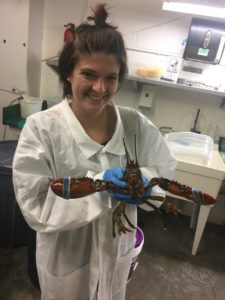
One of the students involved in Research Fellows is Hallie Manchester. Hallie, ’20, joined the program last year and has worked with her research advisor, Dr. Jorgensen, on their project about the American lobster.

“I inject the lobster with Vibrio bacteria containing a gene to glow called GFP. We then study the ratio of bacteria to hemocytes, or lobster blood cells. What we have been finding is a predictable curve of bacterial clearance vs hemocytes present. The hemocytes clump around the bacteria and bring it out of the body as the method of clearance. I will soon start on a project to investigate if the lobsters have an immune memory; if we inject the same bacteria later, will it affect how fast they can clear it from their system? We are also doing qPCR to determine how much live bacteria is in the tissues of the animal when the experiment is over”.

Hallie decided to apply for to the Research Fellows program after taking a science class called biotechnology in high school.

“I knew from then that I at least wanted to try research in college. When I applied to Roanoke, a huge factor to my decision to come here was my acceptance to the fellows. I wanted to work closely with a professor and discover something new. Since entering the fellows I have expanded my ability to do research on paper but also in the lab, not to mention I get paid”.

Hallie has really enjoyed working with her research advisor.

“Dr. Jorgensen has become a big part of my life. He takes us out for lab lunches and helps me network with fellow researchers and people in health professions. During my first freshman semester, I went to dinner with a visiting Virginia Tech Professor and was able to make connections, it was a major highlight! But Doc entrusts me with a lot of responsibilities with experiments and animal husbandry. It’s a really awesome experience to have a professor trust you with their lab and the other students you work with”.

Hallie’s most exciting part of her research so far was doing her first bacterial challenge by herself.

“I had been practicing on old animals and had been doing prep work helping an older peer. Then I got to do a whole experiment by myself. I had to do my own injections, plates, count my own hemocytes, and prep my own animal and reagents. It was crazy to know I was in charge of my own experiment and I could make a discovery”.

Hallie’s biggest goal from undergoing the Research Fellows is to be published in a scientific journal as a coauthor

“As an undergraduate this is a huge project to undertake and to be published would be a giant honor. However, some more realistic goals are to go to national conferences on undergraduate research and make a difference in the lobster fishing industry. Coming from Rhode Island, I have noticed the decline in the fishing industry and my research may make a difference in how we fish for crustaceans, like lobsters.

To anyone considering doing research, Hallie says,

“Being in the fellows has shown me that research is not limited to science. There are awesome projects going on in all the departments! Follow your passion and find out what is going on around campus. Don’t be afraid to approach a professor about their project, you never know if they have a position open. If you have passion, you can figure something out. Also, once you get started, you do a lot of grunt work. Keep working and eventually you will get to do something cool. Just stick it out until you do your part as a newbie. Balancing research, school, sports and social life can seem a bit daunting, but with time management it is possible”.

Damian Ream: Summer Intern Experience at Dominion Energy

Over the summer, Damian Ream, ’18, had the opportunity to work with Dominion Energy in Surry, Virginia. Damian was an intern at the Physics department in Dominion Energy’s Surry Nuclear Power Station.

“The purpose of the health physics department is to analyze nuclear samples taken from the plant to ensure nothing harmful is leaving the power plant, and more importantly, to make sure plant workers are working safely and not receiving larger doses of radiation than what is expected or allowable”.

Damian worked under his supervisor Paul Harris, but also was able to work with full time health physics technicians and students from other colleges.

“I learned a lot about how nuclear energy works and what goes into maintaining and running a power plant. I also was able to take a trip to Dominion Energy’s clearing house where they sell their energy and also look for new business endeavors. I obtained valuable insight on the nuclear industry and was able to further learn and shape my goals for the future”.

Damian’s favorite part about working at the nuclear power station was being able to research some of the new technologies that the power plant has available.

“The most interesting part to me was potentially using drones to check certain plant conditions. One condition in particular was checking the structure and integrity of the containment building using thermal imaging to see where repairs may need to be made. Ultimately it was determined that it was a technology not needed at this time, as it would require a licensed drone pilot due to the fact that it would be used by a corporation for business purposes. That licensing process would cost time and money, and then the drone would only be able to be flown by those few individuals who actually got licensed”.

To anyone considering doing research or an internship, Damian’s advice is to apply to any program or project that interests you.

“Even if you feel you may not be qualified, apply anyways. There were a few interns I worked with from different departments who weren’t chosen for the department they applied for, but their internship application was actually forwarded to another department that ended up hiring them as an intern. Apply even if you’re not sure if you’d be interested in it. I think that’s all part of the internship experience. If you find you like it, that’s great! Dominion Energy is one of the many companies that often offer their interns full-time jobs out of college. If you find you don’t like it then that’s still good. You’ve gained some valuable internship experience, and you just decided a career path you’re not interested in rather than trying to pursue it post-graduation and deciding then”.

2017 Summer Scholars: Sabrina McAllister

Sabrina McAllister, a senior majoring in Psychology, was one of the thirteen students selected into the 2017 Summer Scholars program. Over the summer, she was able to work with her faculty advisor, Dr. David Nichols, to complete her research project titled “Time Perspective as a State-Based Measure”.

“My project is on time perspective (the way a person orients him/herself towards the past, present, or future). I am focusing specifically on the Zimbardo’s Time Perspective Inventory (ZTPI), which is the most popular measure of time perspective in the psychology literature. I am examining its structure to determine ways in which it can be improved and modified to provide more valid and reliable results”.

Sabrina first got into her project through Dr. Nichols.

“My advisor had been previously doing research on time perspective when I started working with him. The first project I took on under his supervision was a literature review that combined sensation-seeking and time perspective, which was how I was introduced to the ZTPI. As I did the reading for my paper, I realized that there seemed to be a lot of uncertainty in the literature regarding Zimbardo’s questionnaire, so I made it my next project to improve on some of that”.

Sabrina decided to apply to be a summer scholar so she could work on her research project without having to worry about getting distracted by classes and campus events. She was able to work closely with her research advisor throughout the summer.

“My research advisor is very helpful. He has given me several bits of advice and taught me new things. I think the best part of working with him is the amount of independence he provides. I can ask direct questions if I’m unsure of something, but most of the time, I’m given an instruction and some resources, and I figure it out myself. It can be more work this way, but it allows me to learn a lot in a very short amount of time, which is thrilling”.

Sabrina has learned quite a bit from working on her project.

“I’ve gained an understanding of statistical concepts that are not included in the standard statistics curriculum, and I’ve gained computer skills that will be useful throughout my life, on the job and off. I am also currently working on writing a final manuscript for my project, and I expect that, as I continue it, I will learn about the nuts and bolts of scientific writing that I haven’t yet come across. It will continue to be lots of intensive work and require ample amounts of time, but it will be worth the effort because, by the end of it, I will have completed two project defenses, presented at a campus poster session, and at a national conference. I also intend to submit the manuscript for publication in the spring, which will be an exciting milestone in both my academic and professional career”.

To anyone considering doing research, Sabrina’s advice is to get started right away.

“Research is time-intensive and long-winded, but it’s very rewarding and beneficial. You’ll get the most out of it if you do it for more than just one or two semesters. I started research in my department during my very first semester, and I wouldn’t have come this far or learned this much if I hadn’t spent this much time with it. If it’s something you’re strongly interested in, contact the people in your department. Even if your first choice of advisor isn’t available, get your foot in the door and do a little bit of something with someone. It’s not a four-year commitment! See what options are available to you, and take advantage of them. Also, don’t be afraid to be original. Most of the research students I’ve talked to came up with their project on their own, pitched the idea to their advisor, and ran with it from there; so you should definitely feel free to explore your own interests”.