Roanoke College Students Travel to Snowbird, Utah for Biology Conference

Pictured above from left to right: Alex Kramer, Ben Walker, Seth Fortmann, and Rebecca Hudon

Roanoke College students Alex Kramer, Ben Walker, Seth Fortmann, and Rebecca Hudon traveled to Snowbird, Utah in mid-July of 2015. They attended the 74th Annual Meeting for the Society for Developmental Biology to present their research. Seth recently graduated from Roanoke College and works at Johns Hopkins University. Three current students, Ben, Alex, and Rebecca, were interviewed about their research experience.

Ben’s research topic was investigating the effects of atrazine on embryonic zebrafish development. He decided to do this research after finishing a similar study on estrogen. Ben won the award for Best Undergraduate Presentation, Honorable Mention and was one of only four undergraduate students to win an award at the conference.

Rebecca’s topic was assessing estrogenic pollution in the Roanoke River using embryonic zebrafish as a bioindicator. She decided on this topic because of her previous experience on the topic during her work in the lab and looks forward to her future endeavors.

Alex’s research topic is about aquatic toxicity of a dental sealant compound. He chose that topic because of its relevance to public health and the large impact it can cause on the industry.

When asked about how it is to work one on one with a professor, Alex said:

“I really enjoy working with Dr. Lassiter because [of] how accessible he is. Whenever I get to a new stage in my research, Dr. Lassiter has always been very helpful in explaining what I need to do next. After we decide what to do next, I am actually running the experiments and am collecting data on my own and at my own pace. Once the data has been finished being collected, we will meet together to analyze and interpret the results together”

Rebecca stated that her favorite part about presenting her research was the feedback she got from other researchers.

“While talking about my research with others I was often given advice about procedures and asked questions that I had not previously considered. These interactions have helped to shape the future of my project.”

Ben’s advice to any students who haven’t gotten involved in research is to find a field that interests you and approach any faculty who performs research that may interest you.

“Being able to use knowledge you learn from the classroom to make an impact, no matter how big, on your specific field is an extremely rewarding process.”

Roanoke College student presents research at Society for Applied Anthropology


In March of 2015, Hayley Field, now a graduate from Roanoke College, presented her research at the Society for Applied Anthropology (SfAA) conference in Pittsburgh, Pennsylvania. Hayley was involved with the sociology department and travelled with fellow Roanoke College student Mariana Araujo, graduate student Stephanie Floyd, and Dr. Chad Morris.

Hayley decided to pursue research in her topic after her research methods class with Dr. Anderson.

“I chose the topic of refugees out of my interest in other cultures and thinking about how difficult and incomprehensible their lives are to individuals like myself, who have never had to worry about being persecuted for reasons such as race or religion. I wanted to create a study that looked more into their lives in order to learn more about the challenges they face. I wanted to ameliorate the many hardships they go through in any way possible by finding ways to help them feel better adapted and welcomed in their new host country. I then decided to apply for Summer Scholars so that I could actually carry out my proposal and the project expanded from there, after discussing it and making it more feasible with Dr. Mehrotra.”

Hayley enjoyed working with a professor one on one:

“It is a great way to form relationships with professors and allows you to learn on a much deeper and more personal level. These experiences really pushed me to work harder and gave me very valuable lessons that I would have never had without having such dedicated professors that were willing to guide me through the process of conducting my own research study.”

Hayley’s favorite part about the conference was learning about all the different research that anthropologists are doing around the world:

“I especially enjoyed going to the sessions that had to do with refugee and immigrant populations because it was a really neat feeling to be able to apply my research to other researchers’ work and find similarities between mine and their findings.”

For anyone interested in research, Hayley says:

“It isn’t that common that so many students are able to do their own research and work one on one with their professors, so it is definitely worth it to find something that you would enjoy doing, such as internships, independent studies, or summer scholars. It helps you get connected with professors and individuals in the community, and it also gives you a great advantage when applying to graduate school or jobs by having had such great experience in your undergraduate years.”

Roanoke College students present at Virginia Tech conference

Virginia Tech Peace Conference

Pictured above from left to right: Jessica Compton, Wesley Knowles, Daniel Osborne, and Kelsey Reedy.

Daniel Osborne, now a junior at Roanoke College, presented his research on individualism in America and its effects on human well-being. Daniel traveled to Virginia Tech with his fellow presenters Jessica Compton, Wesley Knowles, and Kelsey Reedy and Doctors Mike Heller and Srikanth Mallavarapu in early February, 2015.

When asked about his experience on conducting and presenting research, Daniel says:

“Working with Dr. Mike Heller and Dr. Srikanth Mallavarapu was a wonderful experience. Both offered gentle, thoughtful guidance throughout the process of our presentation’s formation. Presenting my research at a conference made me feel important. To be able to share your work and ideas with an eager audience feels wonderful. It reminded me that my academic work has relevance beyond course grades and GPA records. The conference reminded me that my thoughts and writings can prompt reflection in my peers. Presenting research is certainly a challenge that stands outside the comfort zones of many students. However, Roanoke College’s many research opportunities are a special chance for undergraduate students to discover.”

Roanoke College student presents research on mod subculture

Rachel

In late February of 2015, Rachel Barton, now a senior at Roanoke College, was able to present her research on mod subculture. Rachel worked under the Sociology department for her completion of her concentration in Gender and Women Studies. She decided to do research because of her interest in the concentration and interdisciplinary work. Rachel worked with Dr. Sarabia to expand on research Rachel had previously done and to examine gender expressions and subversive identities within the subculture.

Rachel enjoyed her time working one on one with a professor. She commented:

“It was great! I was given the opportunity to structure most of the product independently, do my own research, and basically go wherever I wanted with my argument. I loved being able to create my own project. And, of course, Dr. Sarabia was very helpful every step of the way. He offered me continual one on one feedback and encouraged me to go as far as I could with my research. He was as dedicated to me completing a successful project as I was.”

When asked about how it was to present her research, Rachel said:

“At first, I was really nervous, but it went very well! It was definitely an invaluable experience. I was in charge of creating my own presentation and presenting my research in an effective way. I was on a panel with two other researchers”

For any students interested in doing research, Rachel says:

“Do it! Even if you don’t think you can, even if you’re scared of starting your own projects, do it! There’s nothing like starting from scratch and ending up with a really cool, successful final product that’s completely the result of your own initiative. And the possibilities for research are endless! You can basically do whatever you’re interested in, and you can pick up some new interests along the way! I would recommend going to conferences too. Just imagine, you can get PAID to travel to really cool cities and talk about the crazy cool things that you’re interested in. And other accomplished scholars will encourage you! They can even help you get into graduate school! Why wouldn’t you jump on that opportunity?”

RC Student Conference Presentation: Costume design

SETC 1


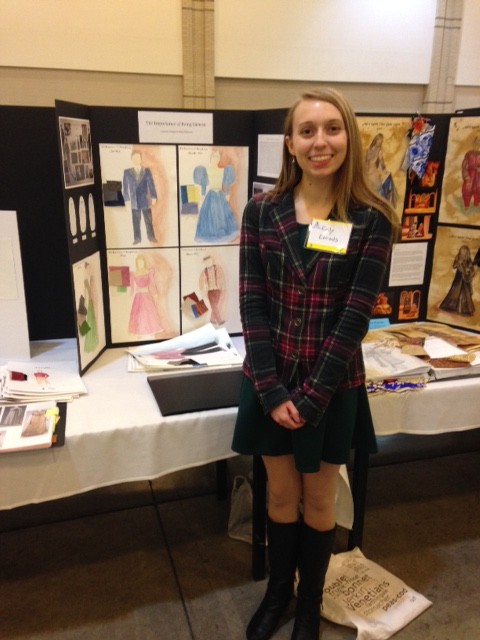
The first week of March, Roanoke College senior Emily Edmonds was able to present her research at the Southeastern Theatre Conference in Chattanooga, TN.  Emily did her work under the Fine Arts department. Emily’s research topic focused on costume design in The Importance of Being Earnest, a play by Oscar Wilde. She decided to pursue research with Dr. Ruhland because of her interest in costuming and her desire to pursue it as a career after graduation.

Emily really enjoyed being able to work with a professor while doing her own research.

“Jennie Ruhland is an amazing teacher and I absolutely loved working with her. Her advice throughout the whole process was so meaningful and helpful. I had to revise and edit my project a bit, but even her criticism was constructive and I learned a lot from it. I learned so much more than I ever could have in a class-room so I am really thankful for the experience.”

When asked about the conference Emily says:

“It was different than I expected. My project wasn’t what is traditional of research presentations so it was nerve-racking because I didn’t know what to expect. Plus, I presented my work in a design competition so that added another unique layer to the experience. Honestly though, once I got set-up and everything was prepared, then things went super smoothly. I sadly didn’t place in the competition, but it was great experience and I’m glad that I entered my work and was able to receive feedback from the judges on how I can improve.”

For anyone considering doing research at Roanoke, Emily says:

“Do it!! I think people get intimidated by the thought of presenting research, but it’s such a valuable experience and a great way to learn how to make your research stronger or clearer. If you put a lot of hard work and planning into something, don’t be afraid to put your work out there. Also, don’t let yourself be limited by thinking research can only be done in certain fields. I am a Theatre major who presented a research project about costuming that I worked on and analyzed for a long time so just because your interests aren’t in the sciences, doesn’t mean that should stop you from pursuing research. Definitely get as much one on one time with the faculty here as possible because you will learn so much. Even if it’s just an independent study, it’s still definitely worth doing.”

Roanoke College Senior Presents at Chemistry Conference

Pittcon

This March, Roanoke College senior Colin Blye presented his research at Pittcon, a conference in Pittsburg, PA that covers research on analytical chemistry and applied spectroscopy. Colin’s project involved working with fast-scan cyclic voltammetry (FSCV), a technique used to measure neurotransmission in the brain. Using FSCV, Colin worked on how to address the problems with field inconsistences that FSCV can cause.

Colin worked under Dr. Keithley in the Chemistry Department in order to learn more analytical chemistry and instrumentation. Colin says:

“Working one on one with a professor is a really good learning experience. Doing research you are able to learn so much about a topic that you would not normally get the opportunity to do in a classroom.”

About his experience at the Pittcon conference, Colin says:

“Being able to present my research at Pittcon was a great experience. It was nice to be able to share my hard work with other people who are interested in FSCV. It was cool having people come by and listen to the progress I have contributed to the technique of FSCV and at the same time learn from them as they provided further guidance and ideas to help with my research.”

Colin’s favorite thing about presenting his research was:

“The whole process from finding my topic to then being able to present it at a conference was the confirmation that hard work and the effort you put into something pays off . In this case I was able to show and explain to people my findings that will ultimately help advance and perfect the FSCV technique.”

Roanoke College Senior Presents at Biology Conference

This past January RC senior Grace England presented her research project at the Meeting of the Society for Integrative and Comparative Biology (SICB), in Austin, TX. Grace’s project was “Does the ventilatory pump affect the gill circulation in blue crabs and lobsters?” and her faculty mentor for this project was Dr. Dar Jorgensen. She and Dr. Jorgensen took data that previous students gathered for this project and combined it with data that Grace collected to support the hypothesis of the ventilatory pump’s involvement in the gill circulation. Grace has been doing research at Roanoke since May 2013.

Grace first became interested in research during her freshman year when she was in Dr. Jorgensen’s Biology 125 lab. Grace explains that he saw her potential for doing research and invited her to get involved and to shadow an upperclassman:

“Through watching research first-hand, understanding its relevance, and expanding my understanding of biology through my 2nd-year courses, I became increasingly intrigued in the physiology research in Dr. Jorgensen’s lab.  I couldn’t wait to start my own research over the summer!”

This was Grace’s first time presenting this particular project and she states that:

“It was truly incredible to come together with Ph.D. scientists, post-doctoral students, graduate students, and undergraduate students like myself to learn from each other.  I went into the conference extremely nervous about presenting.  After the fact, I realized that my nerves had come from all of my previous presentations, in which the audience (a professor or judges) knew more about my topic than I did and were judging me based on how close I came to the ‘right’ answer.  In contrast, with this project, there was not a previously-know ‘right’ answer, and I quickly realized that the people talking to me about my research were not judging me, but were purely interested in the science involved in my project.”

For students considering research opportunities, Grace says:

“Go for it.  Don’t be afraid to approach a professor about research; their research is what they like to talk about most, and they’ll be happy to answer all the questions you have!  The professors at Roanoke will help you find your place, whether in their own lab or a different professor’s lab.  As a result of doing research, you will learn so much—about your subject, about the process of research (including perseverance!), and most importantly, about yourself.  This will help you in any and all future endeavors, wherever life leads you. “

For more information on the Society for Integrative and Comparative Biology, visit: https://www.sicb.org/

Six Students Present at Ecology Conference

ESA banner

Six Roanoke College Students recently presented their research projects at the Mid-Atlantic Chapter of the Ecological Society of America Conference at the University of Maryland on March 29, 2014. The students who attended and presented at the conference were Steph Clements, Thomas Granger, Hannah Johnson, Teresha Santos, Lauren Strong, and Elsa Wieboldt and their faculty mentor was Dr. Rachel Collins. Steph Clements won for best undergraduate poster presentation and Lauren Strong won for best undergraduate oral presentation.

Elsa Wieboldt (’15) is in her third year of doing research and her project is about “the way that land use affects earthworms and the way that the earthworms affect the productivity of the land.” As far as working with Dr. Collins, Elsa explained:

“I really love the experience of working in a close one-on-one setting with a professor. It allows for a personal as well as a professional relationship. Because the professor knows you well they are able to advise you about research in a way that really fits you and the way that you achieve best and succeed.”

Elsa Wieboldt


Steph Clements (’14) is in her first semester of research and in her research she is studying “the effect that diversity has on ecosystem stability using a microcosm experiment including three diversity treatments and multiple trophic levels.” In terms of working with Dr. Collins, Steph stated:

“She was incredibly helpful every step of the way and I worked very closely with her on the whole project. She helped me figure out an experimental design that would be practical for me to complete in one semester and assisted me in the analysis of my results. I met with her a couple of times every week and she even came in on weekends to help me with the project when needed.”

This conference marked Steph’s first time presenting her research at a professional conference and she expressed that

“it was an incredible experience to get to present my research to others in the field of ecology. I enjoyed explaining the work that I have been doing and hearing what people thought about the research that I had been working on. It was also a neat opportunity to get to hear from other important people in the field of ecology who were presenting their own work at the conference as well.”

Clements, Johnson, Wieboldt, Santos, Granger, Strong, Collins


For students considering research opportunities Elsa feels that

“research at Roanoke is an amazing opportunity because you get to experience something that most people cannot until graduate school. You often have the opportunity to create your own project with the help of a professor, along the lines of what is interesting to you. The opportunity of getting to know a professor so well and be involved in research, both theirs and yours, is extremely valuable.  These relationships are resources for life.  You get to have real life experiences while still in college. Significant and lasting knowledge occurs through these out of class room experience – Don’t pass up this opportunity!”

For more info on the Mid-Atlantic Chapter of the Ecological Society of America, visit: https://www.esa.org/midatlantic/

Roanoke College Junior Presents at Sociology Conference

Alex1

Roanoke College junior Alex Berryman recently presented his research earlier this month at the Southern Sociological Society Annual Meeting in Charlotte, NC. Alex’s research project was titled “Managing Transportation and Economic Volatility: What Can Policymakers Learn from Rural Low-income Families?” He also presented this project at the Research showcase in Fintel Library last Friday. Alex’s research began in late 2013 and he is currently doing an independent study this semester. He is also going to be a summer scholars this summer.

Alex mentions that he chose to study transportation inequality

“to apply lessons from my variety of past courses as well as to hopefully contribute to social change that is personally meaningful. Coming from a rural home and offering free automobile repair to select families consistently exposes me to discrete aspects of familial hardship within America.”

His project addresses how owning an unreliable automobile affects a rural low-income family’s ability to keep employment.

“This social phenomenon contributes to the social reproduction of poverty as well as familial hardship- or the inability to afford proper medical care, housing, as well as nutrition.”

Alex2

Alex’s faculty mentor for this project was Dr. Lane Destro who specializes in rural poverty and social policy. Alex met with her once a week and communicated almost every day when working on this project. Alex notes that working one-on-one with a professor

“develops a stronger bond that enables learning to continue within a personalized venture. A more casual friendship can also evolve which is atypical when we consider the formality of school.”

For students considering research opportunity, Alex points out that:

“Research is an additional avenue towards becoming integrated on campus. Independent research is extremely flexible and is designed to conform about the student instead of the student being forced to perform predefined tasks. I doubt that many other institutions provide such an abundant inventory of learning opportunities as Roanoke.”

For more info on the Southern Sociological Society, please visit: https://www.southernsociologicalsociety.org/index.html

Three Students Present at Sociology Conference

ESS

Three students recently presented their research projects at the Eastern Sociological Society Conference. Alex DeLaricheliere presented her project on “The Influence of the Media on HIV/AIDS Knowledge and Attitudes among College Students: 1980’s to Today,” Amelie Rives presented her project on “Victim Blaming and Slut Shaming, the Media’s Influence on Victims of Sexual Assault,” and Marc Berenson also presented another phase of the HIV project.

Alex has been doing research at Roanoke for three years now and she got involved in it when her advisor recommended it to her. “Coming into Roanoke, I didn’t think that sociologists could conduct research at the undergraduate level, but I’m really glad that so many professors were talking about all of the opportunities in the department. Research for me was almost like an internship: learning how to do research has helped me to obtain the skills I will need to continue into graduate school and conduct my own research projects.”

Amelie started doing independent research last year although it has always been an interest of hers. “What people initially don’t realize is how creative the scientific process is. Being able to apply my imagination to a social problem really keeps me coming back to research.”

Conference pic

Both Alex and Amelie worked with Dr. Shannon Anderson on their research projects. Alex explains that they “worked very closely together during all of the phases of the project, and she became a really valuable mentor for me. She let me have a lot of ownership over the project, which I appreciated, but was always there to answer any questions I had.” Amelie also points out that she has “made a lasting relationship with her and we really see eye to eye. I also feel so comfortable asking her questions, which is something everyone should be doing!”

As for advice to students considering research, both Amelie and Alex feel it is a valuable experience. Alex points out that “getting involved in research may seem daunting at first, but there are research opportunities in nearly every academic field that will suit your interests and really help you to expand your skills and your resume. Plus, you get to form even more close bonds with faculty members who can guide you, provide you with advice and become strong mentors for you.”

For more information on the Eastern Sociological Society, visit: https://www.essnet.org/