Pilgrimage Conference at William & Mary

14607975_1228460897210819_1987473134_n

Pictured above (from left to right): Matthew Johnson ’19, Olivia Contakes ’18, Rebecca Thomson ’19, Sidney Rhyne ‘1(9

On September 30th, a group of students from the Camino de Santiago May term travelled to the College of William and Mary to present at the 2016 Annual Symposium for Pilgrimage Studies. The presentation was focused on the connections the students made while walking the Camino de Santiago, an ancient and modernized pilgrimage route from St. Jean Pied de Port in France to Santiago de Compostela in Spain. The group consisted of Olivia Contakes, Kendall (Sidney) Rhyne, Rebecca Thompson, Matthew Johnson, and their professor Dr. Talbot. Olivia and Sidney were able to talk about their experience walking the Camino and their presentation at William and Mary.
Sidney noted the May term was a very different way of learning.

“We were walking a pilgrimage and stopping at churches, and other important places to learn about along our journey. We learned about history, architecture and Spanish culture along the way.”

Sidney’s presentation at William and Mary focused on the graffiti along the Camino. Olivia focused on her experience making friends with other pilgrims on the trail.
Both Olivia and Sidney enjoyed their time presenting what they learned abroad.

Olivia: “The narrow focus of Pilgrimage at the conference ensured that my classmates and I were surrounded with like-minded scholars who could learn from our talks, as well as we could learn from their presentations. After our panel spoke, the audience eagerly participated in the open-floor question period. We were then able to speak to our collective experience as a group. During the reception, my peers and I spoke with a group of students from Christopher Newport University who had walked the Camino with their professor. We spent about 45 minutes gleefully comparing our perspectives of the Way”.
Sidney: “It was nice to sit in on other people’s sessions and hear what they had to talk about, and most of the people there were experts in the field of pilgrimage. I thought it was pretty cool that we were some of the youngest presenters at this symposium”.

Olivia and Sidney encourage any student to take advantage of the research opportunities at Roanoke

Olivia: “Volunteering to work with Dr. Talbot and to speak at the conference has been so fulfilling. I’d encourage anyone with even a slight passion for a topic they’re studying to take any opportunity for research with RC”.
Sidney: “It is a great experience and you learn a lot in the process.”

Roanoke College Students Present at American Chemistry Society

13052602_1098448183545425_1323413120_o

Six Roanoke College students traveled to San Diego, CA to present at the American Chemistry Society in March. Two of those students were Thane Jones and Morgan Claybrook. Thane is a junior majoring in Chemistry who worked with Dr. Hollis for their research project. Morgan is a junior majoring in Biology and Chemistry who worked with Dr. Sarisky.

Thane’s research project was titled “Synthesis and Diels-Alder Reactivity of 1-(furanmethoxy)nonafluorobiphenyl and 4,4′-bis(furanmethoxy)octafluorobiphenyl”, in which he focused on Thermal Self-Heating Polymers. Morgan’s project focuses on cloning the gene DesIV from a specific type of soil bacteria, Streptomyces griseus.

Both Thane and Morgan enjoyed working with their professors while completing their research project.

Thane: “Dr. Hollis and I have been working one and one for the entire project, and I had daily meetings with him over the summer. Working closely with him really helped me to get into the mindset of a researcher. It taught me the types of questions I should be asking and the steps I should take to complete my goals.”
Morgan: “I’ve really enjoyed working for a professor while conducting research as I’ve been able to work independently but I also have someone with a great deal of knowledge on my topic whose advice I can seek out whenever necessary.”

Thane’s favorite part of the conference was during the beginning.

“Chemical supply companies all set up displays and examples of their products. I got to walk around and see the cutting-edge instrumentation, glassware, and apparatuses that are currently used in the field. We also got free T-shirts and such from the representatives.”

Morgan enjoyed seeing and hearing other’s research projects.

“I felt like I was getting to experience what the science community outside of what I get to be a part of at Roanoke College is really like.”

Both Thane and Morgan highly recommended doing research.

Thane: “Research gives you experience that goes beyond the typical course work and labs that you take during the year. Personally, my research has trained me to be a better chemist, and I am extremely grateful for the opportunity to perform research here at Roanoke College.”
Morgan: “It is a very intellectually rewarding process that helps you to learn valuable skills, like troubleshooting and critically evaluating problems, that will be beneficial for a future career.”

Roanoke College students named one of the five finalists in the Wege Prize competition.

FullSizeRender (2)

Lavender and Lydiah

Lydiah Mpyisi, ’16, and Lavender Micalo, ’18, are both students who were both brought up in Nairobi, Kenya where they witnessed first-hand many issues large cities can have such as overpopulation, insecurity and unemployment. Their experiences there helped motivate them into their current project. Lydiah and Lavender’s project was also inspired from Dr. Okeef and Dr. Bucher’s classes. Their project is titled “Greening Urban Slums and Promoting Community Health through Secondary Healthcare Interventions”.

After starting their project, Lydiah and Lavender attended the 7th Annual Millennial Campus Network Conference at the United Nations Headquarters in New York City in August 2015. At the conference, the two learned about the Wege Prize 2016 Competition, a yearly competition where undergraduate students design and propose a product, service, business/non-profit organization, or other solution to solve a problem that can help us transition from a linear economic model to a circular economic model.

Afterwards, Lydiah and Lavender formed Team KYCE (Kenyan Youths for Circular Economy) with students from three other colleges and entered the Wege Prize 2016 competition. Their plan for the project is to use already existing independent projects and integrate them in way that will create a self-sustaining system that will create employment, improve sanitation and hygiene, enhance the aesthetic value of the urban slums, and improve the overall health of the slum communities.

Team KYCE integrates four projects: The Community Cooker, Peepoo, Community Gardens, and Bio digesters. The Community Cooker uses trash, collected by local youth for income, to power a neighborhood cooking facility. Peepoo is a personal toilet that is used to convert human waste into organic fertilizer. Community gardens are pieces of land gardened by a group of people and are used to produce fruits, vegetables, and/or ornamentals. And lastly, Bio-digesters are structures in which organic matter is digested through anaerobic fermentation with the production of a burnable biogas and a nutrient-rich slurry.

“KYCE will work with the locals to set up waste collection and sorting sites. The waste will be sorted out into categories: biodegradable, recyclable, reusable, and combustible. The biodegradable waste will be used a raw material for a bio-digester that will be set up to generate liquid ethanol and biogas that can be used as a source of electricity to the roadside business owners during night hours to curb insecurity. The recyclable wastes will be sold to recycling companies and converted into useful materials that can be resold. The money obtained from the recycling companies will be used to pay the worker at the waste collection site. Wastes that can be re-used will be donated to orphanages or to other members of the slum communities who may be in need of those items. The combustible waste will be sold to the Community Cooker management crew to be used as a source of fuel for the Community Cooker. The payment from this transaction can be used to fuel the trucks used to transport the wastes to the collection sites. With this approach of waste management, we envision that we will be able to re-duce trash and dumpsites that are found in public places in most urban slums in developing countries. Additionally, we plan to work together with the locals to establish urban and/or community gardens to replace the dump sites. The garden will be used to grow food crops, which will not only provide food but will also provide a source of income to those who will be involved in planting and selling the food. To enhance the growth of food, KYCE will partner with Peepoople to obtain the organic fertilizer that Peepoo makes from human waste. Continued use of Peepoo will help to minimize the use of ‘flying toilets’ and defecating in public places. As a result, there will be improved sanitation in the urban slums.”

KYCE was named one of the five finalists in the Wege Prize competition and students will be travelling to Michigan in May to present their project to a panel of judges for the chance to win.

“Our hope is that our project will be chosen as the best. We are currently working on refining the details of the project and the presentation slides. We are happy that we got this opportunity to represent the good work that Roanoke College students, like us, are doing to impact communities in a positive way.”

Roanoke College student presents research in Portland, OR

FullSizeRender-1

Angela Montalvo, a senior majoring in Biology at Roanoke College, presented her research at the Society for Integrative & Comparative Biology in Portland, Oregon this January. She worked with Dr. Jorgensen in the Biology department for her project. Angela first decided to do research during her freshmen year. She became interested working with crabs and lobsters by watching fellow lab partners work with them on underwater treadmills. She then became inspired to do her own research after seeing a recent alumni’s research on the project.
Angela studies the immune response of the American lobsters to an acute bacterial challenge.

“I inject lobsters with a bioengineered bacteria (it is resistant to two antibiotics and expresses green fluorescent protein) and trace where the bacteria lands in their body. I work to better understand how lobsters respond to a bacterial infection and try to determine which organs are best for clearing the bacteria from their hemolymph (blood).”

Angela really enjoyed working with Dr. Jorgensen.

“He pushed me to better myself in class, in the research lab, and as a person. I appreciated having someone I could bounce ideas off of and problem solve.”

One of Angela’s favorite parts about presenting was the questions she’s been asked about her project.

“My favorite one by far is “So, do you still eat lobster?”… the answer is a simple “yes!”. The questions that some ask generate discussion about things that could be done in the lab that would help us better understand what exactly is going on in the lobster. There is not much written about the immune response, which makes this data difficult to interpret at times. New projects have been started because of conversations held at my poster!”

Angela highly recommends students to get involved in research.

“Find an area that you are interested in and talk to a professor about it; there could be an opening in a lab that does similar research or start your own project as an independent study. Doing research taught me how to think through a difficult problem and learn from my mistakes.”

Roanoke College student presents research at the Experimental Biology conference in Boston

IMG_0802 (1)


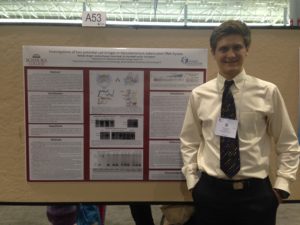
Nicholas Wright, a senior at Roanoke College, presented at the Experimental Biology conference in Boston in March of 2015. Nick’s project focused on understanding the amino acids responsible for binding interactions occurring between two subunits of a protein complex in the bacteria that causes tuberculosis. The project was a collaboration between the Roanoke College Chemistry department and the Department of Integrated Science and Technology at James Madison University. He decided to do research at Roanoke as soon as he found a research project he was interested in.
Nick really appreciated the ability to work with a professor while conducting research.

“Working with my advisor, Dr. Tim Johann, is a great experience. I always feel welcome to talk about an experiment, preparations in lab, techniques, etc. Having worked in labs elsewhere, this is something that is unique and special at Roanoke. In many labs you may rarely see the faculty principle investigator.”

Nick found that presenting can be one of the most challenging components of conducting research.

“You always have to know your audience and remember that the audience does not have the same level of understanding of the project as you do. Communicating science is the most important part of doing research, so it is critical that you prepare for presentations of your work.”

Despite the challenges, Nick still encourages getting involved as soon as possible.

“Research isn’t for everyone, but if you are interested in research and it turns out that you enjoy it, the earlier to start the better. Graduate programs value experience and competency very highly.”

Nick spent the Summer of 2015 doing research at the Scripps Institute, Florida and will be interviewing for graduate programs this spring.

Three Roanoke College students share their experience about their work on a research collaborative

12369988_1015386725184905_1748686324_o

Pictured above: Anna Denisch (top), Rebecca Conter (left) and Emma Clarke (right)

The MARCUS conference (Mid-Atlantic Regional Conference for Undergraduate Scholarship), is an annual conference where students can present their research to other students, professors, and the public. In 2015, the conference was held at Randolph College on October 10th. The conference is multidisciplinary where students can share a topic using knowledge and methods from a variety of fields.

Anna Denisch, ’16, Rebecca Conter, ’17, and Emma Clarke, ’18, another group of students from Dr. Poli and Dr. Stoneman’s Dragon Research Collaborative, attended the MARCUS conference in October 2015. Anna Denisch worked under the education department and spent her time researching dragon lore and writing a children’s book that explains the myths. Rebecca Conter worked with the Virginia Museum of Natural History studying Paleobotany to later develop activity pages to help children learn about Paleobotany. Emma Clarke spent her time on the project studying Lepidodendron fossils and dragon myths.

Rebecca really enjoyed working with Dr. Poli and the “Dragon research team”.

“It’s a very rewarding experience. Dr. Poli and “Team Dragon” (as we call the Collaborative), push me to expand my knowledge and grow independently. The whole team serves as a support system for one-another. Every week, we bounce ideas back-and-forth, looking for ways to overcome obstacles and expand our horizons”

Anna’s favorite moment doing research was when the research group travelled to Beckley, West Virginia

“We went to the quarry where the fossils that are essentially the backbone of the whole project are found. These tree fossils show bark that looks a lot like how dragon scales are portrayed in art about dragons. It was a lot of fun to go with the group and be able to dig around the site looking for the fossils. The best part: we got to keep whatever we found. I now have dragons in my room, it’s pretty amazing.”

All three students encourage getting involved in research:

Emma: Research is a great resume builder as well as a way to get to know more people on campus.

Anna: I would say go for it! But I would also encourage caution and slowness. When you start a research project, it is so easy to come up with a million ideas of all the different things you want to do. I’m telling you now, you can’t. Yes it’s a good idea to have ideas, but with time constraints you really need to pick one or two solid ideas (that hopefully overlap) and just run with those. You may think you have all the free time in the world when a semester and research start, but trust me, by midterms you’re going to be glad that you’ve only got one or two projects to work on for your research.

Rebecca: Don’t be afraid to step out of your comfort zone. Talk to your professors. Explore your options. You have no idea how good it gets until you dive-in!

Two Roanoke College biology students present at the MARCUS conference

12369699_1013558642034380_385712974_o

Pictured above: Benjamin Schwartz (left) and Sarah Petrosky (right)

The MARCUS conference (Mid-Atlantic Regional Conference for Undergraduate Scholarship) is an annual conference where students can present their research to other students, professors, and the public. In 2015, the conference was held at Randolph College on October 10th. The conference is multidisciplinary where students can share a topic using knowledge and methods from a variety of fields.

Benjamin Schwartz, ‘16, and Sarah Petrosky, ‘17, are two students involved in Dr. Poli’s Dragon Research Collaborative, a multidisciplinary research team focused on explaining some of the myths and traditions around dragons. Both students travelled to the MARCUS conference in October to present their research. Ben’s research investigated medicinal properties in “dragon plants” while Sarah’s research focused on the plant species Lycopodium digitalus and why the plant species is extremely flammable.

Both Ben and Sarah really enjoyed working with Dr. Poli on their research projects.

Ben Schwartz: “Working one on one with a professor is an extremely worthwhile experience. Through research, Dr. Poli has become more than just a supervisor to me. She provides me with just enough insight into my research protocol and technique that I am driven in the right direction, but also so that I am forced to critically think on my own and feel comfortable executing the experiment independently. Moreover, she is also a wealth of knowledge for my future ambitions. Harvesting a relationship like this with a professor is invaluable, and I will always hold close to me everything she has taught me.”

Sarah Petrosky: “I really enjoy working with Dr. Poli. For the most part, I work on my own while giving her frequent updates as to how my research is coming along. In my lab, it is a very independent process. I do not have scheduled time in a lab, just goals that I am required to meet on a weekly basis.”

Ben’s favorite part about working on his project was presenting at the conference.

“Some of the Dragon Research Collaborative traveled together to represent the team and spread the word about our interdisciplinary approach toward research. I enjoyed sharing my studies with people outside of Roanoke College and also learning about research that other schools provide.”

The toughest part about Sarah’s research project was managing the development of the plants.

“The plants I work with cannot be grown in a greenhouse. This means that the stages of development that I look at occur only once a year. The incredibly time-sensitive nature of my project, then, places a lot of pressure on me during the weeks of late August through early November, since I have to catch the plants at each stage in their development when it happens, or I would be unable to complete my protocol.”

Both Ben and Sarah recommend getting involved in research and offer their advice to anyone considering it.

Ben: “Whether you need experience for graduate school or employment after college, or if you’re just truly passionate about a subject and want to learn more, then you must get involved. It’s a win-win, you cannot go wrong.”

Sarah: “There are two big suggestions I have. The first one is, when you get involved in research, make sure your other schoolwork is manageable. This is more for your own health more than anything. Different professors run their labs different ways, but it is still a time commitment, and if you have overloaded on courses, it could get very overwhelming very quickly. The second one is, work with a professor that you like and that has a project that is of interest to you.”

Roanoke College senior presents at the MARCUS conference

DSCN1605


The MARCUS conference (Mid-Atlantic Regional Conference for Undergraduate Scholarship), is an annual conference where students can present their research to other students, professors, and the public. In 2015, the conference was held at Randolph College on October 10th. The conference is multidisciplinary where students can share a topic using knowledge and methods from a variety of fields.
Andrew Dittmar, a senior at Roanoke College, was one of the students who participated in the conference. Andrew was involved with the History department for his research project. The project was titled: “”Discovering Liberty: Defining Individualist Anarchism in Liberty, 1881-1908″. It focused on a periodical titled “Liberty”, which covered a radical political philosophy known as individualist anarchism. Andrew’s goal was to investigate the political philosophy and how it managed to become a part of the magazine.
Andrew first came across his research topic while searching for a topic for his Historical Methods course.

“I was struggling to come up with a topic, as my primary historical interests lie in the ancient world and in turn-of-the-20th-century Russia. I was doing a simple Google search trying to somehow unite one of my areas of interest with our course era, and I stumbled across the first page of the first issue of Liberty in 1881. What struck me was a particular page feature a full length eulogy in poem form honoring Sophia Perovskaya, a Russian revolutionary who had, earlier in 1881, been involved in the assassination of Tsar Alexander II, and had been executed for it. The poem continually referred to her action as having been heroic and necessary; I was intrigued, and kept reading. What I discovered was a full-fledged political ideology taking form in the pages of a newspaper”.

One of the things Andrew enjoyed at the conference was how the panel sessions worked.

“I was a part of a five-person student panel, and each of us had researched dramatically different things. My fellow panelists talked about: neurotransmitters in rats; women in French literature; a skeleton used by secret societies at Bennington College; and sound wave patterns. I have no idea why we were all put together, but I learned a lot. It was really cool to see what other students at other schools were researching.”

To anyone considering doing research, Andrew says:

“I know research in a humanities subject area looks very different than research in hard science, but in both instances, research is about uncovering a story, the story behind what, how, and why things are the way they are. Many of these stories have been told, but many are still waiting to be told. So always keep your eye open for a story that you can uncover and tell, because they’re all around you.”

Roanoke College Senior Conducts and Presents Research at UC Davis

DSC_0031


Over the summer of 2015, Maya Shende, a senior at Roanoke College, decided to do a Research Experience for Undergraduate (REU) at UC Davis in Davis, California. She worked in Justin Siegel’s lab in the Genome and Biomedical Sciences Center along with eight other undergraduates.

Maya participated in a ten week program that involved time in North Carolina, California, and Washington. During her first week, Maya went to Raleigh, North Carolina to learn about the Rosetta codebase, a molecular biology/chemistry codebase. Most of her time in the program, however, was spent at UC Davis working on her research project.

“My project involved protein-protein and protein-small molecule interfaces. I was looking at the contacts made between two docked proteins or a protein docked with a small molecule, to see if there was a way to quantify the number of contacts in order to further understanding of protein-protein and protein-small molecule interactions. All of this work was done computationally and all of the docking simulations were run using the Rosetta code.”

For the last week of the REU, Maya went to Seattle, Washington, where she and eight other undergraduates presented their research. One of Maya’s favorite parts of the summer was the conference in Seattle.

“RosettaCon was one of the coolest conferences I have ever been to. First, I was essentially surrounded by celebrities in the world of computational molecular biology and computational chemistry. I spent a week having intellectual conversations with some of the forerunners of the field and learning so much every day. Second, presenting my work to such esteemed scholars in the field was a great experience. Not only did I get an opportunity to better my presentation skills, but I also got great feedback about different routes I could take with my research.”

Maya’s advice to anyone interested in research is to start early.

“The more research you do as an undergraduate, the more you learn and more competitive you will be after graduating. Research is also a great way to learn things that you can’t learn in a classroom environment. It is a way to explore topics that are interesting to you, and apply what you learn in your classes to coming up with solutions to real problems!”

Recent Roanoke College Graduate presents her research in Cheney, Washington

440


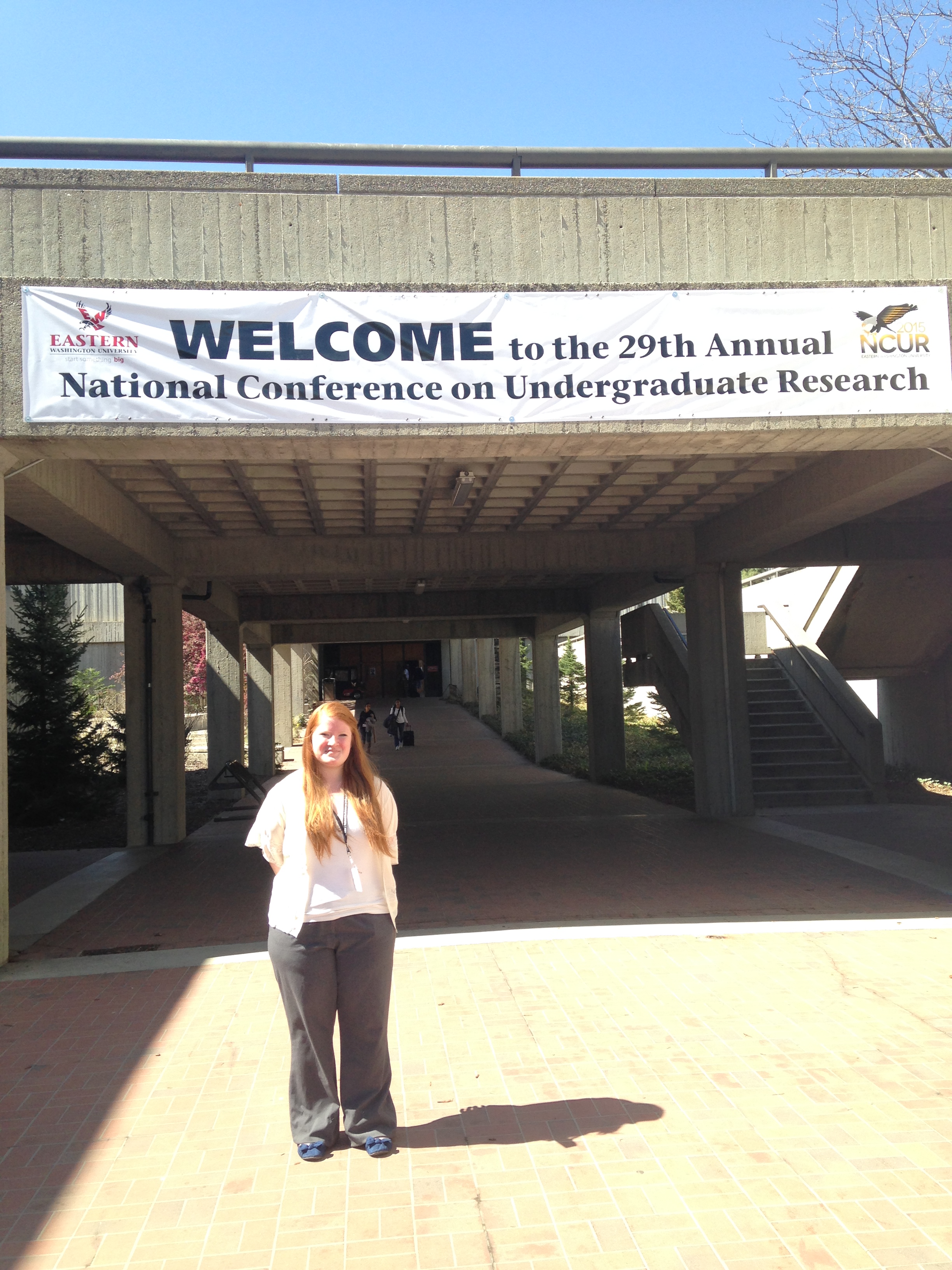
In April 2015, Lydia Delamatta, a recent Roanoke College graduate went to the National Conference on Undergraduate Research in Cheney, Washington. Lydia worked with the Public Affairs department on her project titled “Discrimination Stops Here: How Education Affects Gender Political Equality Across Democratic Nations”. Lydia became involved in research after meeting Dr. O’Keef at a professional development panel organized by the Public Affairs Society. The two then worked together on their project.
Lydia enjoyed her time working with Dr. O’Keef:

“Working one on one with a professor is honestly the best way to learn, and when working with Dr. O’Keef, you feel like your research matters. Working one on one, I was able to ask all the questions I needed to as well as develop a professional relationship. Dr. O’Keef, along with all of the Public Affairs professors, truly bend over backwards to help us cultivate our skills and thoughts, and to perfect our projects, and independent study projects help you recognize their dedication.”

When we asked what Lydia’s favorite part of the conference was she had a hard time choosing one but ultimately decided that presentation day was the best:

“Overall, in the span of only a few hours, I had made two professional connections, both because of the work I had put in with Dr. O’Keef in developing this quantitative research project. I was able to represent myself and Roanoke College at this conference, and I would like to think that on that day I honored both.”

To anyone who hasn’t done research or is thinking about it, Lydia says:

“Definitely get involved in the Undergraduate Research program at Roanoke College and Summer Scholars, and get involved with a professor you would like to work with and ask for their mentorship with a research project. If you have a great work ethic and you ask one of your professors about an undergraduate research project they will help you, either by mentoring you, or finding you the best professor for your topic. Seriously they really will.”