NIH Presentation Highlight

This past Thursday, Seniors Bryn Haden and Kavya Iyer co-presented, “Perceived Neighborhood Environments: Health Impacts and Catalysts for Change” with Dr. Elizabeth Ackley at National Institutes of Health: State of the Science Convening on Food Insecurity, Neighborhood Food Environment, and Nutrition Health Disparities. The research both Bryn, a Public Health and Health & Exercise Science double major and Kavya, a Biochemistry major, conducted was all supported through the Center for Community Health Innovation and Honors Program here at Roanoke College. The purpose of their project is, “To describe the efficacy of the Roanoke Valley Community Healthy Living Index as a scalable model for evaluating neighborhood food and physical activity environments and catalyzing policy and infrastructure change [and] to outline recent findings pertaining to the relationship between perceived neighborhood environments and health outcomes in youth.” Through their research, Bryn and Kavya concluded that, “Perceptions of neighborhood food and physical activity environments demonstrate promise in evaluating neighborhood environments and informing tailored interventions.” Please join us in congratulating Bryn and Kavya for their hard work and phenomenal presentation! 

Research Highlight: Erin McDonnell

Recent graduate Erin McDonnell had the opportunity to present at SDB conference with Dr. Lassiter. I had the opportunity to interview her and get her take on her conference experience.

Can you describe what your research project is about?

At its core, my research project centered around ideas of Behavioral Neuroscience and Toxicology. My experiment looked at the development of zebrafish embryos while being exposed to a chemical compound called Tributlytin (TBT).  I measured brain areas of certain regions and the length of the notochord through phase contrast microscopy. Once the brain had been imaged, I let them develop further in the chemical environment to the age where they could swim and tested for a specific behavioral response. The response that I measured was how long the embryos swam around after being startled.  This was done in order to establish a link between the chemical’s effects on the body as well as later developed behavioral patterns that may be extrapolated to humans. 
We found that TBT does have an impact on how the brain and notochord develop as well as how larvae interact with their environment. Specifically, my research showed that exposure to this chemical, even at 0.1 nM, decreased the size of the forebrain, increased the length of the notochord and increased the amount of time the larvae stayed in a startled state. Other behavioral abnormalities were also found that offers many doors in future directions for expanding the project.

What made you decide to pursue your topic?

         Ultimately, I wanted to work on a project that truly integrated both Psychology and Biology to greater explore the neurological, and I have always had a fascination with the “black box” of Psychology, the concept that the mind can only be explored in matters of influencing input and describing the output. This concept of what is going in affects what is there and changes something that is expressed was an attainable premise to build upon, and is the idea that the project centers on. Marrying that idea to another of my major interests of not knowing how certain drugs and chemicals work within living systems is how I decided to pursue the full topic of the project. 

Talk about the conference experience.

The conference that I went to was the Society for Developmental Biology’s 78thannual meeting. The conference spanned a variety of developmental biology topics such as Evolutionary Biology, Epigenetics, modeling human pathologies, Regeneration and Organogenesis, and new live imaging techniques. My research was accepted for presentation during a poster session that had other neurodevelopment and related projects from all over the nation as well as a few from visiting countries. This was my first conference ever, and at first it was a tad overwhelming. Once I got into the rhythm of the conference, however, everything was incredible.  I learned so much about things I had never even thought about before, all while having a great time interacting with new people and getting to see a different side of my professor. Going to a conference is yet another way to experience a field of study in a more hands on way. I got to hear from top minds in the field and people on more my level of study about the research they have done, where the field is going, and also just simply what excites them about science. It was a whirlwind experience that I think everyone that can, should have. It is also one that, no matter who you are, will gain something from it.  

Why would someone be interested in your findings at a conference?

Personally, I wanted to present my findings at a conference in order to get the experience of presenting as well as network with people I would likely never have the opportunity to meet outside of that conference. It is one thing to present to a room of peers, or even colleagues, but presenting in a space filled with strangers of who most have advanced degrees and want to speak with you about your work is another. It is one that is exhilarating, at times nerve wracking, but in its entirety unique.
While I am a bit biased, my findings alone were intriguing due to the unexplored nature of the chemical I chose and what I ended up finding. I wanted to get the chance to tell other people about what I had done and found.  I was looking at zebrafish and how they reacted in ways that I thought might be seen affecting humans. So not only are there developmental and purely biological implications, but one might be interested in presenting my research at a conference that focuses on health, environmental risk factors for disease or human ecological impacts.  I would love to have someone take a look at the work that I have done and expand on it. My project was meant as a stepping stone that I hope a student will take up in the future.

Research Highlight: Riker Lawrence

Riker Lawrence (’20) presented recently at the Mid-Atlantic Undergraduate Research Conference at Virginia Tech. Her poster was about Psychological Capital (PsyCap), well-being, and work attitudes of employees. It was a joint project with her lab mate, Kaitlin. Riker “wanted to share her work with others because it is a topic that is common in the workplace and can influence the success of a business”. This research examined associations between PsyCap and how employees write about their jobs in addition to exploring the usefulness of Maslow’s (1943) Hierarchy of Needs in coding employees’ writings about their jobs. It was found that Maslow’s Hierarchy of Needs is not very useful when identifying and coding the themes that participants had wrote about their job.

“I think this is important to consider because employees’ attitudes and views on their workplace can impact employee morale. Therefore, measuring these components can possibly be helpful to a business’ success”.   


This was Riker’s first conference that was primarily other undergraduate students. This experience was different from others as at this conference she was around other students like herself instead of the usual professors and graduate students. Riker’s experience at the conference was very positive.

“I think being in [this] conference . . . made me feel more comfortable and confident with my presentation of the poster. It was also interesting to watch those students give oral presentations because it seems less intimidating than the oral presentations that I have experienced at my other conferences. In addition, I had the confidence to help other undergraduate students, who have never been to a conference before, by providing information from my past experience that could help with their poster presentation”.


Frequently Asked Questions

I asked some fellow students frequently asked questions about research and all it entails. Here are their responses.

Why would someone want to do research?

It allows you to further explore areas that you are interested in and connect with professors. It also gives you opportunities to present your research and know more about the research process.it helps you to become more prepared for graduate school or jobs you are interested in

-Rachel Harmon

Why would someone be interested in doing research in the summer as opposed to during the semester?

Doing research during the summer allows the student to have more focus on the research than they would be able to have during the semester. Solely doing research during the summer allows for a deeper understanding of the topic, creates a familiarity with techniques, and strengthens the bond between the research student and the research professor.

                             -Madalyn Wheeler


Doing research in the summer is beneficial because it is the main focus, so you get more out of it. When you do research during the semester, sometimes it is pushed back as a last priority thing that you get to when you have time. 

                      -Claire Aurand


What was your summer research experience like?

My summer research experience was very beneficial to my thought process about what career path I might want to pursue. It made me want to apply for an REU this summer and then consider a career path that involves genetics research.

                             -Madalyn Wheeler


Summer is a laid-back way to get more hands-on experience in a setting of your choice. I was taking summer classes and was still allowed to participate in research. I had limited lab hours due to class, but through what I did I gained a lot of knowledge at a fast pace. 

                             -Claire Aurand


Why did you choose to do off-campus research?

I chose to do off-campus research for the ability to do work in facilities that aren’t available here on campus. I wanted to be able to do work in a field (fluid dynamics) that I wouldn’t normally have access to. My off-campus research experience was more than I hoped for. I was able to experience graduate type research in a field that isn’t offered here on campus. I was able to use different facilities and work closely with my graduate adviser and a graduate student that worked in the same field. I was given insight into what my potential research would be able to look like.

                      -William Lambert


RC Student Presents at the Society for the Study of Emerging Adulthood Biennial Conference

Kiah Coflin, a senior majoring in psychology, presented her research project at the Society for the Study of Emerging Adulthood Biennial Conference in November 2017. Her research project, titled “Associations between emerging adults’ personality and their perceptions of children with clinical and developmental diagnoses”, focused on individuals between the ages 18 to 25 and their perceptions of children with clinical and developmental diagnoses. She then compared the individual’s perceptions to their personalities to look for any correlations.

“The diagnoses we researched included Attention Deficit Hyperactivity Disorder (ADHD), Obsessive Compulsive Disorder (OCD), Autism Spectrum Disorder (ASD), Schizophrenia, Dyslexia, Depression, and Post-Traumatic Stress Disorder (PSTD). We wanted to look at how people perceived others with these disorders so that educational programs can integrate information about personality and help adapt to or fix inaccurate perceptions in school settings as well as promote acceptance of ‘atypical’ behavior. We found that personality traits were frequently related to the participants’ perceptions of the different diagnoses”.

Kiah decided to work on the project after taking it over from a previous student. She works with Dr. Powell who has helped Kiah throughout the research project.

“My research advisor has been incredibly helpful not only in guidance towards my own research endeavors and interests, but as a whole. Dr. Powell is a wonderful role model and she has continuously pushed me to be the best student and researcher I can be”.

Kiah traveled with two other students, Taylor Kracht and Molly Zydel, to Washington D.C. for the conference to present their research projects.

“The conference was slightly overwhelming at first, but an incredible experience to be involved in! Individuals were respectful and interested in my poster presentation, and were very impressed at an undergraduate student presence amongst the master’s students, professors, and scholars presenting. With Dr. Powell’s help, I felt very prepared for my presentation and it was overall a very exciting weekend! It really helped me grow academically and I learned a lot of valuable skills in presenting”.

Now that Kiah has presented her research, she plans to continue her involvement in research projects and conferences in psychology.

“Being a part of a research lab in the Psychology Department has been one of my favorite parts of being an undergrad student so far. I’m surrounded by like-minded, encouraging peers that support one another throughout the research process and anything else throughout the semester. Although it certainly was a lot of work, it pushed me to continue to be motivated, driven, and taught me a lot about psychology skills I didn’t know I had”.

To anyone considering doing research, Kiah’s advice is not to hesitate and to reach out to professors for research projects.

“One can learn a lot about potential fields that they could become involved in and may find something that changes their whole academic trajectory. It may seem daunting, but the professors are there to help!”

Roanoke College Student Presents at 2017 National Conference of Undergraduate Research

Dantaé Henderson is a senior majoring in Spanish with concentrations in Latin American and Caribbean Studies and Teaching English as a Second Language (TESL). She presented her research project, “Du Bois’s Double consciousness and The Afro-Peruvian Identity in Victoria Santa Cruz, ‘Me Gritaron Negra’”, at the 2017 National Conference of Undergraduate Research (NCUR) at the University of Memphis. Dantaé finished her project while completing her independent study for the Spanish major with Dr. Bañuelos-Montes.

She decided to investigate this topic because of her interest in analyzing literature and connecting literature to different theories.

“Vitoria Santa Cruz’s poem, “Me gritaron negra”, reveals how the paradigms of the dominant groups are formed and how the marginalized groups, in this study the Afro-Peruvians, are forced to deny the racial characteristics and cultural manifestations that make up their cultural identity. The stereotypes that separate the groups by race continue to create racial divisions in which the superior groups impose whiteness as the norm, thus imposing a colonialist idealism that categorizes marginalized groups as inferior. Victoria Santa Cruz’s poem is a reaction to the dominant discourse that poses as a threat to nationalism because such discourses manifest a process of acculturation and denial of the Afro-Peruvian’s identity. How does Victoria Santa Cruz resist this discourse of superiority? To understand this process, I will use W.E. B. Du Bois’ concept of double consciousness. The dominant discourse provides a realistic representation of how Afro-Peruvians are depicted in a traditional manner, which maintains, still, colonial stereotypes. This image impacts the perceptions of the Afro-Peruvian, as the dominant discourse continues to expose the stereotypical image; Du Bois believes that the marginalized individual will identify with that message on the long-term. This is the dialogue of the first part of the poem. The second part of the poem alludes to Du Bois’ attainment of the, “self-consciousness…into a better and truer self.” By applying Du Bois theory, I can argue that Victoria Santa Cruz creates an Afro-Peruvian subject that moves from the margin to the center, the creation of the Afro-Peruvian identity”.

Dantaé enjoyed having chance to work with Dr. Bañuelos-Montes.

“It was a great opportunity to utilize the knowledge and specialties of a specific professor because sometimes in the classroom they are not able to work one on one with a student and do a more profound research”.

Dantaé found the experience of presenting her research at NCUR very exciting.

“I never thought that an idea could turn into me presenting this research and defending in a foreign setting. It gave me experience that will help me in my future studies”.

To anyone thinking about doing research at Roanoke, Dantaé suggests you take the opportunity.

“It is a great way to specifically take on a topic that interests you that may not be to do in your regular classes”.

Roanoke College student presents at Society for Integrative and Comparative Biology conference

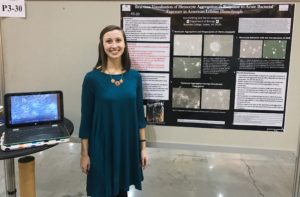
Sara Farthing, a junior at Roanoke majoring in biology with a minor in chemistry and Spanish, had the opportunity to present her research at the Society for Integrative and Comparative Biology conference in January. Her research project was titled “Real-time Visualization of Hemocyte Aggregation in Response to Acute Bacterial Exposure in American Lobster Hemolymph”. She worked with her research advisor, Dr. Jorgensen, to understand the physiology of invertebrates.

“We mainly used the American Lobster as our model organism. Specifically, I am studying the immune response of the American lobsters. I used microscopy to determine how the hemocytes (essentially blood cells) coagulate and also how they react in the presence of bacteria. Using the microscopes, I was able to visualize the cells in real time using time lapse photography. This means I could see the progression of a process over a certain period of time instead of capturing one image, which could be an isolated event out of the context. I was able to visualize the clotting mechanism of hemocytes (the lobster blood cells) in real time and how this process was affected by the introduction of bacterial cells. My results showed that the clotting mechanism is in fact involved in the immune response of the American lobster”.

Sara really enjoyed presenting her research at the Society for Integrative and Comparative Biology conference.

“I had so many people not only listen to my elevator speech but have one on one conversations with me and discussions in which my experience and knowledge was equally valued. In addition I was even able to make connections with other labs across the country who we will be collaborating in the continuation of my project. I had several graduate students and professors say that my research was far more advanced then what they had seen at the undergraduate level. It is possible I am studying phenomena and asking questions that even professionals haven’t thought to ask yet! This was an inspiring and enriching experience that I will never forget”.

Sara loved working with Dr. Jorgensen to complete their research project.

“He is a wonderful mentor who guides and challenges me throughout my research. He makes himself available so that he can be there when things go wrong or if things go right and I want to push ahead to the next level. I am continuously learning from him not only in areas concerning research but he is a role model for me in how to treat and guide others with an encouraging and kind demeanor. He has also become a friend and support network for me here at college. This will be one of those connections that I cherish and will have for the rest of my life”.

For anyone contemplating doing research at Roanoke, Sara says:

“Absolutely do it! No matter what major, there is always an opportunity for you to get involved in research with a professor. All you have to do is ask and professors will be happy and willing to encourage and nurture your passion for this area of curiosity. More than any club or organization, doing research here at Roanoke has helped me find my niche as well as group of students and faculty that I can always count on”.

Roanoke College student presents at Consortium for Computing Sciences in Colleges Southeast conference

Christian Moore, a senior majoring in computer science and math, had the opportunity to present his research project at the Consortium for Computing Sciences in Colleges Southeast conference in November 2016. Christian’s project was titled “Finding the Center of the Universe”. His research advisor was Dr. Anil Shende.

Christian best described his project as imagining a bunch of people in a room walking away from each other.

“If everyone closed their eyes and stood at one point, then started walking away from each other, [then], at some point I ask you to open your eyes.  How many people would you need to look at to find the center where you started? For this problem I designed an algorithm so that we could solve for the center in no more than four observations.  I was able to show mathematically that my algorithm worked”.

Christian found that working with Dr. Shende was very helpful.

“While working, there are many different paths you can take to solve the problem, and sometimes you can find yourself stuck in one way of thinking about your problem.  A huge help that my advisor gave me was reminding me that there are alternate paths to a solution.  This really helped keep me from thinking that there is only one solution”.

Christian enjoyed his time at the conference.

“While I was there, I was part of the student research competition as well as part of the student programming competition. I was able to see the research projects of other students my age from schools around the Southeast.  What I enjoyed most was talking to the various judges and visitors at the conference.  It was amazing to see that the keynote speaker of the conference came by to talk with all the students that were presenting research”.

For anyone thinking about doing research, Christian says:

“Do it. As a younger student I was never really sure whether research or an internship was right for me, so I tried both.  Now after finishing my summer research project, my only wish is that I would have started looking at research sooner.  This summer of research was the driving factor for why I chose to continue on to graduate school after Roanoke”.

Roanoke College student presents “Stat Crew” in Atlanta

David Moreau, a senior majoring in physics and minoring in math, had the opportunity to present his research project at the Joint Mathematics Meeting in Atlanta, Georgia. David’s project was titled “Stat Crew at Roanoke College” where he worked Dr. Roland Minton and a group of students to participate in sports analysis for the various athletic teams at Roanoke.

“It started off in the Fall of 2015 by getting passing statistics to the coaches of the soccer teams. An app was developed by our own Dr. Adam Childers for basketball season to get pinpoint locations of shots so that heat maps could be created, along with player by player statistics for each game. Lastly, this app was tweaked for lacrosse to get shot by shot breakdowns of plays for both teams”.

David became involved in research early in his freshmen year.

“I met Dr. Minton in a scholarship interview during my senior year of high school, where he introduced the idea of Stat Crew to me along with telling me about his golf research. When I decided to come to Roanoke, I emailed Dr. Minton and he kept me informed about the beginning of Stat Crew. At first, I received course credit for the work I was doing. I mostly participated in the data collection process (going to games and actually getting the data and using the app). My input was able to help change the app to become more user-friendly and efficient. This research project, however, is more of a group effort. We would not be here without the effort of the entire Stat Crew, and the countless hours that Dr. Minton and Dr. Childers have invested into making sure the group survives. Through their motivation and dedication to the group, I think all of us in the Stat Crew really wanted to invest our time to make sure we were doing something meaningful for the college”.

David really enjoyed working with Dr. Minton to finish the project.

“Dr. Minton and I have much in common, mostly from our common interest in golf. Getting to know him on such a personal level has been a very rewarding experience. He is definitely one of my role models here at school and makes me excited to continue the work I have done with the Stat Crew.”

At the Joint Mathematics Meeting, David presented on the details of Stat Crew and the group’s goals for the future.

“Presenting my research was quite the experience. I have never been on a stage of such high level of academia before. To be in a room of such experts in the field of Sports Analytics as a sophomore undergraduate student was quite mind numbing. I tried not to think about it too much by the time I got up there. The hotel I was presenting at was quite intimidating, but the support of the MCSP department was unwavering and helped immensely as I was up there on stage”.

David believes getting involved in research was one of the best decisions he made.

“Roanoke has some immense opportunities for people willing to put in the work for them. As a sophomore undergraduate student, I presented at the biggest math meeting in the world. I truly believe that I only would have gotten this opportunity here at Roanoke and no-where else. For that, I am grateful to the staff of the MCSP department for putting their faith in me to do a good job representing the school”.

For anyone thinking about doing research, David says:

“Research at Roanoke will take you places that you never would have expected. Take advantage of any opportunity you can, as the staff here is willing to put as much effort in as you are to help see you succeed”.

Roanoke College seniors present at ASM conference

021

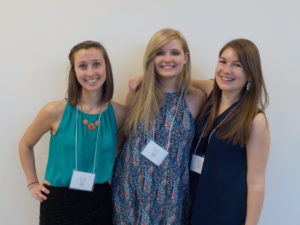
Pictured above from left to right: Sara Farthing, Kirsten Norman, Savannah Scott

The American Society for Microbiology (ASM) regional conferences are more intimate gatherings than the national conference where students and professors present their research projects and learn about others. Roanoke College students Savannah Scott, ’17, and Kirsten Norman, ’17, were two of the students who went to an ASM Virginia conference in November. Their research project was titled, “Development of Novel mcrA and pmoA qPCR Primers and Probe Targeting Methanogens and Methanotrophs in Cattle Farm Samples as a Method of Microbial Source Tracking”. They worked with Dr. Crozier to complete their research.


Both Savannah and Kirsten began the project over the summer.

Kirsten: “In the beginning of the summer we focused on researching more about methanogens and methanotrophs. Once we determined the genes we wanted to target, mcrA and pmoA, we moved on to the next step of primer and probe creation through the program Sequencher. Producing primers and probe allowed us to quantitatively analyze the amount of methanogens and methanotrophs in samples we acquired at the horse farm. What we hope to apply our research to in the future is microbial source tracking which allows one to track where contamination is coming from in bodies of water.”

Savannah really enjoyed working with Dr. Crozier to complete their project.

“My research adviser did a wonderful job in training me the first semester I started research. Then he took a hands-off approach once I figured out the direction of my project. This encouraged me to plan ahead, to learn how to think critically and to learn how to troubleshoot. If I was really stuck, however, he was always there to offer help and guidance.”

Both Savannah and Kirsten had a rewarding experience at the ASM conference

Savannah: “It was really exciting to be able to meet and talk to graduate students about their projects and how they got to where they are. I made many connections with graduate professors and got some insight into possibilities for future work in my field! Many of them offered great advice. Additionally, it was so fun to be in a room with people with the same interests!”

Kirsten: “It pushed me out of my comfort zone, but in a good way because it helped me gain confidence in presenting my research to people that have a lot of knowledge about the subject I am researching. It was inspiring to see what a wide range of people attending the conference including everything from undergraduate research students to graduate students in the progress of completing their Ph.D. Ultimately attending a conference such as this gives one a look into what life after undergraduate studies could look like.”

When asked about why they started and completed their research project, both Savannah and Kirsten saw it as a great experience for after graduation, but quickly grew to love the topic.

Savannah: “Shortly after beginning work in the lab, I realized a passion for microbiology. I continued my research fueled by ambition to find answers and natural curiosity about the subject itself and the techniques involved in microbiology research. I was encouraged by answers that lead to more questions, and the stubborn desire to know why. When the opportunity to present in a conference revealed itself, I was eager to present my findings to experts and professionals within the field I am working because of the insight they would be able to provide. I also knew it would be great experience for graduate school and my future career as a microbiologist.”

Kirsten: “I have a strong desire to pursue research post-graduation and that is what got me interested in performing research in the first place. Another reason as to why I have continued to participate in research is because of the interesting microorganisms we get to study in Crozier’s lab and just how well our lab works together in research.”