Summer Scholars Introduction: Alexandra Grant and Dannielle Allen

For the Summer Scholars program, a number of students are chosen to pursue a research topic of their choice that could be used to benefit people. In 2015, thirteen students were accepted into the program. Two of those thirteen are Alexandra Grant and Dannielle Allen.

image
Alexandra Grant

Alex is a rising senior at Roanoke College majoring in psychology with a concentration in neuroscience. Alex has been interested in the aging of the brain since high school and has worked in the dementia center of a nursing home. She has been conducting research at Roanoke College since her sophomore year with Dr. Whitson. Alex has been volunteering at the Salem Veterans Affairs Center for Neurocognitive services during her junior year and plans to do so in her senior year and into graduate school.

Alex’s project is titled: “Aging and Brain Area Measurements with MRI”. Alex’s research focuses on the fact that as people age they become susceptible to certain diseases such as neurological diseases. In pervious neurological research, it has been shown that certain areas of the brain can be affected as people age. Alex’s project will analyze three parts of the brain, the ventricle, corpus callosum, and cerebellum, and analyze the differences between people who have some form of dementia and those who don’t.

FullSizeRender
Dannielle Allen

Dannielle is a rising senior at Roanoke College majoring in Biochemistry. Dannielle has been doing research at Roanoke College since her freshmen year with Dr. Sarisky. Outside of school work, Dannielle is a part of the Honors Program, a member of HEAT (Health Education Awareness Team), and plays Field Hockey for Roanoke College.

Dannielle’s project is titled: “Cloning and Expression of PurF from Sulfolobus solfataricus”. Dannielle’s research focuses on purines, nitrogenous bases that are used as building blocks for DNA, and the Archaeal species Sulfolobus solfataricus. This species is thought to contain genes that code for PurF, a protein that is vital in purine biosynthesis. Dannielle’s project will be creating a plasmid that will be able to produce the PurF protein and analyzing it.

Roanoke College students present at Virginia Tech conference

Virginia Tech Peace Conference

Pictured above from left to right: Jessica Compton, Wesley Knowles, Daniel Osborne, and Kelsey Reedy.

Daniel Osborne, now a junior at Roanoke College, presented his research on individualism in America and its effects on human well-being. Daniel traveled to Virginia Tech with his fellow presenters Jessica Compton, Wesley Knowles, and Kelsey Reedy and Doctors Mike Heller and Srikanth Mallavarapu in early February, 2015.

When asked about his experience on conducting and presenting research, Daniel says:

“Working with Dr. Mike Heller and Dr. Srikanth Mallavarapu was a wonderful experience. Both offered gentle, thoughtful guidance throughout the process of our presentation’s formation. Presenting my research at a conference made me feel important. To be able to share your work and ideas with an eager audience feels wonderful. It reminded me that my academic work has relevance beyond course grades and GPA records. The conference reminded me that my thoughts and writings can prompt reflection in my peers. Presenting research is certainly a challenge that stands outside the comfort zones of many students. However, Roanoke College’s many research opportunities are a special chance for undergraduate students to discover.”

Summer Scholars Introduction: Ben Cowgill and Andrew Feeney

Thirteen students were enrolled in the 2015 Summer Scholars program. Introducing two more of the summer scholars, we welcome Ben Cowgill and Andrew Feeney.

11221529_10205765929562946_8411990952527702037_n

Ben Cowgill

Ben Cowgill is a rising junior at Roanoke College who is majoring in religious studies. Born and raised in Winston-Salem, North Carolina, Ben has been highly involved in religion since high school and it has influenced his choices in research and academics. When he isn’t busy with school, Ben is involved with many different clubs and organizations including Pi Lambda Phi Fraternity, Alternate Break Program, Lutheran campus ministries, and the Honors Program. He is also currently the Vice President of the Student Government Association at Roanoke College.

Ben’s project is titled: “Effects Of Participation In Denominational Governance On Religiosity Among Youth and Young Adults”. Ben’s research aims to understand the long-term effects of church-wide denominational programs on participants. In order to do so, Ben will investigate a group of youth and young adults going to the Episcopal Church who were involved in a program called the Official Youth Presence, a program which represents youth at General Convention.

10522556_10153297473078792_4478217965510854423_n

Andrew Feeney

Andrew Feeney is a rising senior at Roanoke College majoring in Economics with a minor in Mathematics. Andrew is from Old Greenwich, Connecticut and is a member of the Roanoke Men’s Lacrosse Team. In his free time, Andrew participates in many different clubs including Best Buddies, Relay for Life, and Habitat for Humanity. Andrew is also the founder of the campus chapter for the Fellowship of Christian Athletes.

Andrew’s project is titled: “Roanoke Economic Index”. Andrew details the project as a creation between two economic indices, a coincident index that reveals information on the underlying economic conditions for the Roanoke Metropolitan Statistical Area, and a leading index which forecasts changes in the coincident index. With the combination of the two, Andrew hopes to allow local businesses to have better information before making major decisions.

Roanoke College student presents research on mod subculture

Rachel

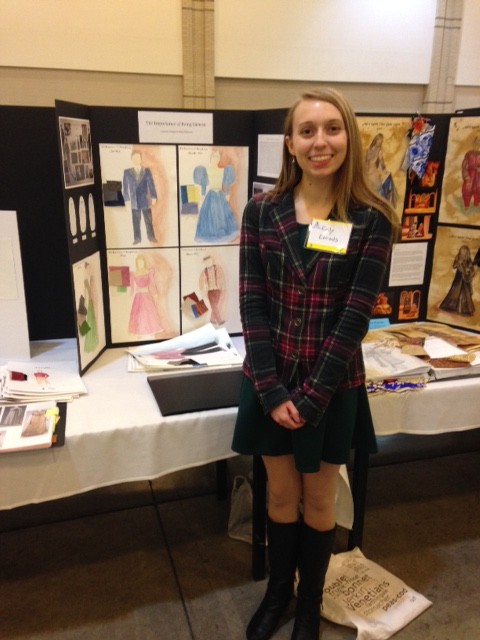
In late February of 2015, Rachel Barton, now a senior at Roanoke College, was able to present her research on mod subculture. Rachel worked under the Sociology department for her completion of her concentration in Gender and Women Studies. She decided to do research because of her interest in the concentration and interdisciplinary work. Rachel worked with Dr. Sarabia to expand on research Rachel had previously done and to examine gender expressions and subversive identities within the subculture.

Rachel enjoyed her time working one on one with a professor. She commented:

“It was great! I was given the opportunity to structure most of the product independently, do my own research, and basically go wherever I wanted with my argument. I loved being able to create my own project. And, of course, Dr. Sarabia was very helpful every step of the way. He offered me continual one on one feedback and encouraged me to go as far as I could with my research. He was as dedicated to me completing a successful project as I was.”

When asked about how it was to present her research, Rachel said:

“At first, I was really nervous, but it went very well! It was definitely an invaluable experience. I was in charge of creating my own presentation and presenting my research in an effective way. I was on a panel with two other researchers”

For any students interested in doing research, Rachel says:

“Do it! Even if you don’t think you can, even if you’re scared of starting your own projects, do it! There’s nothing like starting from scratch and ending up with a really cool, successful final product that’s completely the result of your own initiative. And the possibilities for research are endless! You can basically do whatever you’re interested in, and you can pick up some new interests along the way! I would recommend going to conferences too. Just imagine, you can get PAID to travel to really cool cities and talk about the crazy cool things that you’re interested in. And other accomplished scholars will encourage you! They can even help you get into graduate school! Why wouldn’t you jump on that opportunity?”

Summer Scholars Introduction: Emma von der Lieth and Tessa Sydnor

The Summer Scholars program is one of the many research opportunities available at Roanoke College. Students can apply to the program to spend their summer doing paid, intensive research with a professor. Summer Scholars receive free housing and work full time to further their research.
Summer Scholars of 2015 has 13 students enrolled doing research in a variety of different topics and fields. Two of them are Emma von der Lieth and Tessa Sydnor

image
Emma von der Lieth

Emma von der Lieth is a junior at Roanoke College who is majoring in International Relations and minoring in French. Emma has always been fascinated with travel and wishes to travel aboard to several different countries. An advocate of Women’s rights, Emma wants to work for a non-profit organization to promote women’s rights in developing countries.
Emma’s project title is “War on Women: A Mixed Methods Analysis of Sexual Violence During Armed Conflict”. In her research, Emma wishes to explore the relationship between violence against women and armed conflict. Using mixed methods of quantitative and qualitative research, Emma will analyze the data around armed conflict and the reported amount of rape in 27 different countries in Middle East, Africa, and Asia between 1990-2012.

DSC_0626
Tessa Sydnor

Tessa Syndor is a senior at Roanoke College who is majoring in Literary studies. Tessa’s upbringing in Europe has giving her a unique view on different cultures around the globe. Being involved in with her father’s work with refugees since she was little, Tessa wishes to use her studies to help voice the problems refugees have and to better their lives.
Tessa’s project is titled “Representing Refugee Experience: Reading and Researching the Literature of Displacement” In her research, Tessa will examine four books detailing the experiences refugees face in their lives and critically analyze their similarities and differences. By doing so, Tessa hopes this will help in the understanding of trauma refugees endure.

Roanoke College Research Assistant Spotlight: Elizabeth Bullock

Picture of Me

The Work Study Research Assistant program (WSRA) is one of the various research opportunities at Roanoke College where students can participate in doing research with a professor. In the Work Study program, students are paid for their help in the research project they are affiliated with. Any student can work with a faculty member throughout all the departments on campus. One example of a student in WSRA is Elizabeth Bullock, a freshman at Roanoke College. Elizabeth works in the English department with Dr. Almeder. She began doing research in September 2014.

When Elizabeth was asked about how doing research with professor was, she said:

“It’s great! You really get to experience a lot more working with a professor. I have learned a lot more than I would have not working with Dr. Almeder.”

Elizabeth says the greatest benefit to being in WSRA program is:

“Being closer to the professors and jumping into experiences. By the end, I’ll have all this weird knowledge about stuff I didn’t even know existed. It’s a crazy experience and a lot of fun.”

RC URAP Student Spotlight: Ann Shreckhise

MDCHS PIC 1 (2)

The Undergraduate Research Assistants Program (URAP) is a program where students work one on one with a faculty member on a research project together. Students apply their senior year of high school and can work on their research program for four years. Ann Shreckhise is a senior who entered the program her freshmen year. She applied to work with Dr. Rearick on a project named Understanding the Choices We Make: A Psychological, Physiological and Kinematic Examination of Human Motion.

Ann says she has been able to incorporate her studies across disciplines to ask questions from different perspectives and analyze data in new ways. Using her backgrounds from biology and psychology she has been able to further her research.

Ann’s favorite part of URAP is:

“The student-faculty interactions that result from working one on one with a professor over the course of four years has made my research experience an incredible endeavor. As an undergraduate, I did not expect to have the opportunity to develop my own questions while working alongside a faculty member. Particularly, attending conferences where I am able to present my research and learn about others’ has been a highlight during my time as a URAP student.”

When asked if incoming/current students should do research, Ann says:

“Absolutely get involved in research! Even if you are not sure what you want to study, get involved with a professor’s lab. It’s the best way to figure out what you are interested in.”

RC Student Conference Presentation: Costume design

SETC 1


The first week of March, Roanoke College senior Emily Edmonds was able to present her research at the Southeastern Theatre Conference in Chattanooga, TN.  Emily did her work under the Fine Arts department. Emily’s research topic focused on costume design in The Importance of Being Earnest, a play by Oscar Wilde. She decided to pursue research with Dr. Ruhland because of her interest in costuming and her desire to pursue it as a career after graduation.

Emily really enjoyed being able to work with a professor while doing her own research.

“Jennie Ruhland is an amazing teacher and I absolutely loved working with her. Her advice throughout the whole process was so meaningful and helpful. I had to revise and edit my project a bit, but even her criticism was constructive and I learned a lot from it. I learned so much more than I ever could have in a class-room so I am really thankful for the experience.”

When asked about the conference Emily says:

“It was different than I expected. My project wasn’t what is traditional of research presentations so it was nerve-racking because I didn’t know what to expect. Plus, I presented my work in a design competition so that added another unique layer to the experience. Honestly though, once I got set-up and everything was prepared, then things went super smoothly. I sadly didn’t place in the competition, but it was great experience and I’m glad that I entered my work and was able to receive feedback from the judges on how I can improve.”

For anyone considering doing research at Roanoke, Emily says:

“Do it!! I think people get intimidated by the thought of presenting research, but it’s such a valuable experience and a great way to learn how to make your research stronger or clearer. If you put a lot of hard work and planning into something, don’t be afraid to put your work out there. Also, don’t let yourself be limited by thinking research can only be done in certain fields. I am a Theatre major who presented a research project about costuming that I worked on and analyzed for a long time so just because your interests aren’t in the sciences, doesn’t mean that should stop you from pursuing research. Definitely get as much one on one time with the faculty here as possible because you will learn so much. Even if it’s just an independent study, it’s still definitely worth doing.”

Roanoke College Research Assistant Spotlight: Sabrina McAllister

DSC03843

The Work Study Research Assistant program (WSRA) is a large program that contains many students from different parts of the college. Freshmen and seniors, biology and history majors, and everything in between can become a research assistant. Sabrina McAllister, a freshman at Roanoke College, is an example of just one of the many students in the WSRA program. Sabrina works in the Psychology department under Dr. Lindsey Osterman. She began her research last semester.

Sabrina was very excited to do research here at Roanoke.

“I came to Roanoke for all the research opportunities; I wasn’t going to miss out! Doing research with a faculty member is a huge step away from just classroom lectures. It allows you to apply what you learn to the ‘real-world’ and enhances your general experience. Not to mention, it’s a fantastic resume-builder.”

While doing research under Dr. Osterman, Sabrina learned she really enjoyed working one on one with a professor.

“Working directly with a professor is really helpful. They are able to connect you to a whole lot of people in or around their field, which is great when looking for internships, scholarships, and other opportunities. I meet fairly regularly with my professor and we talk a lot casually too; I feel that she is getting to know me as a person rather than just another student in a class.”

For anyone looking into becoming a work study research assistant, Sabrina says:

“Find a professor you click with and ask them about their research, if they have any (most do). Even if they can’t offer you a position, they will likely be able to direct you to someone who can. What you research doesn’t even have to be directly related to your major. It’s really important, though, that you seize the opportunities available to you. Roanoke has lots, so just start looking for them.”

Roanoke College Senior Presents at Chemistry Conference

Pittcon

This March, Roanoke College senior Colin Blye presented his research at Pittcon, a conference in Pittsburg, PA that covers research on analytical chemistry and applied spectroscopy. Colin’s project involved working with fast-scan cyclic voltammetry (FSCV), a technique used to measure neurotransmission in the brain. Using FSCV, Colin worked on how to address the problems with field inconsistences that FSCV can cause.

Colin worked under Dr. Keithley in the Chemistry Department in order to learn more analytical chemistry and instrumentation. Colin says:

“Working one on one with a professor is a really good learning experience. Doing research you are able to learn so much about a topic that you would not normally get the opportunity to do in a classroom.”

About his experience at the Pittcon conference, Colin says:

“Being able to present my research at Pittcon was a great experience. It was nice to be able to share my hard work with other people who are interested in FSCV. It was cool having people come by and listen to the progress I have contributed to the technique of FSCV and at the same time learn from them as they provided further guidance and ideas to help with my research.”

Colin’s favorite thing about presenting his research was:

“The whole process from finding my topic to then being able to present it at a conference was the confirmation that hard work and the effort you put into something pays off . In this case I was able to show and explain to people my findings that will ultimately help advance and perfect the FSCV technique.”